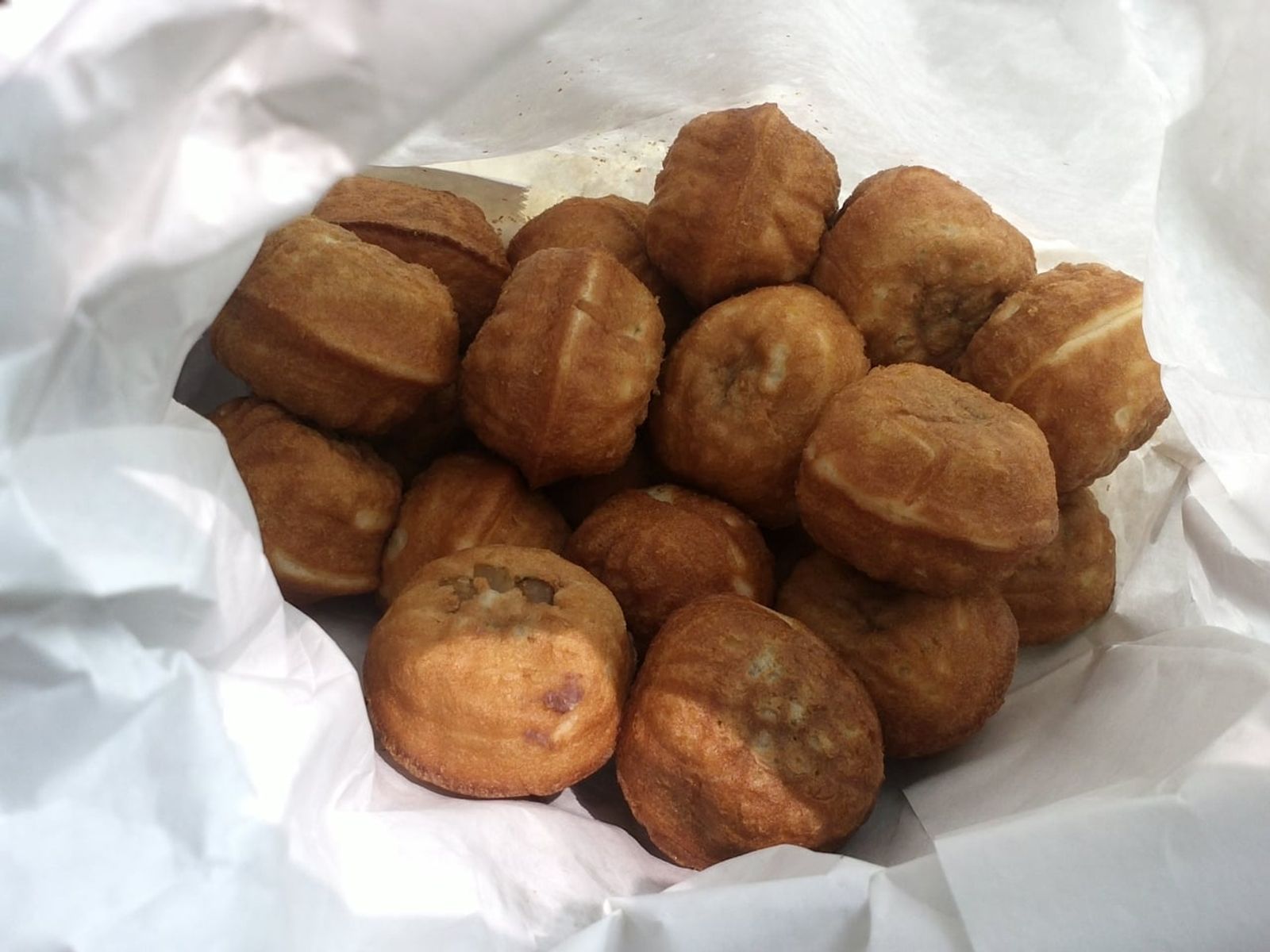
Hodugwaja, a Cheonan specialty · Photo: Asfreeas / CC BY-SA 3.0 (Wikimedia Commons)
 KoreaSouth Chungcheong
Cheonan Hodugwaja: A Goryeo-Era Walnut Legend and a 1930s Treat From Outside Cheonan Station
Hodugwaja, the walnut-shaped cakes Koreans buy by the bag at highway rest stops and train stations, come from Cheonan in South Chungcheong. Here is the Gwangdeoksa Temple legend about Korea's first walnut trees, the disputed birth year of the snack (1934 or earlier?) and how to enjoy it.
A Walnut-Shaped Cake With Real Walnut Inside
Hodugwaja are small cakes baked by pouring batter into walnut-shaped molds and filling them with sweet red bean paste and a piece of walnut. The outside is thin and soft, and inside you get sweet bean paste and nutty walnut in the same bite. They are bite-sized, so a paper bag or box of them is perfect for sharing. In Korea they are everywhere at highway rest stops and train stations, practically the definition of a road-trip snack, and the place known as their birthplace is Cheonan in South Chungcheong. Locals proudly call hodugwaja a Cheonan specialty, and the city has even pushed for a quality certification system for the cakes. Behind Cheonan's claim lies an old legend about walnut trees.
The Gwangdeoksa Walnut Tree and the Legend of Yu Cheong-sin
Gwangdeoksa, a temple in Gwangdeok-myeon, Cheonan, has a walnut tree designated a Natural Monument in 1998. It is estimated to be about 400 years old and stands 20 meters tall. A story comes with it: in 1290, the 16th year of King Chungnyeol of Goryeo, the envoy Yu Cheong-sin returned from the Yuan court in China with walnut saplings and nuts. He planted the saplings in the temple grounds and the nuts in the garden of his family home. A stone in front of the tree commemorates the spot as the place where Yu Cheong-sin first planted walnut trees. This should be read as a legend, though. One researcher argues that Yu Cheong-sin never actually returned to Korea and that the story was created to promote Cheonan walnuts, and there are also accounts that walnut trees already grew on the peninsula before his time. His name also appears in sources as both Yu and Ryu Cheong-sin.
1934 or 1931? The Disputed Birth Year
The most widely told story says hodugwaja were born in 1934. A married couple, Jo Gwi-geum and Sim Bok-sun, who ran a bakery in Daeheung-dong in front of Cheonan Station, created a cake containing walnut and shaped like a real, life-size walnut. This account is reportedly recorded in the Encyclopedia of Cheonan Culture, a local history reference. However, newer research questions the date. A local historian has pointed to a photo in the Japanese-language newspaper Chosen Shimbun dated September 27, 1931, showing a shop with a sign reading "Cheonan specialty walnut cakes, main store," and argues that the claim that 1934 was the first year cannot be right. The original source still needs checking, but both accounts show that by the early 1930s walnut cakes were already being sold in Cheonan as a local specialty.
Spreading Nationwide Through Stations and Rest Stops
Cheonan has long been a transport hub where the roads heading south from Seoul branch off. Cheonan Station, on the Gyeongbu railway line, was already busy with travelers in the 1930s, so the story of the cakes being born at a bakery in front of the station fits the geography well. As people passing through picked up a bag on their way, hodugwaja became Cheonan's signature snack. Today walnut cakes are sold all over the country, but boxes and bags often carry the Cheonan name to claim authenticity. Downtown Cheonan has shops that have baked hodugwaja for several generations, and some use 1934 in their brand story. The city's push for a quality certification system was likewise meant to protect the quality of Cheonan hodugwaja, given how widely the name is used.
How to Enjoy It and Where to Buy
Hodugwaja taste best warm, straight from the mold. The outside is slightly crisp and the bean paste inside is moist, quite different from cakes that have cooled. Many shops let you watch the machines as batter is poured into the molds and walnut pieces are added, so if you are in Cheonan, buy a fresh batch and eat it right away. If red bean is not your thing, check the counter: some shops also sell versions with other fillings. If you are taking some home as a gift, eat them the same day or the next. To keep them longer, freeze them and warm them up before eating to get close to the fresh-baked taste. There are walnut cake shops around Cheonan Station and throughout downtown, and if you have time, a drive to Gwangdeoksa Temple to see the legendary walnut tree makes for an unusual side trip. Walnuts ripen in autumn, so visit then and you may see the tree heavy with nuts.