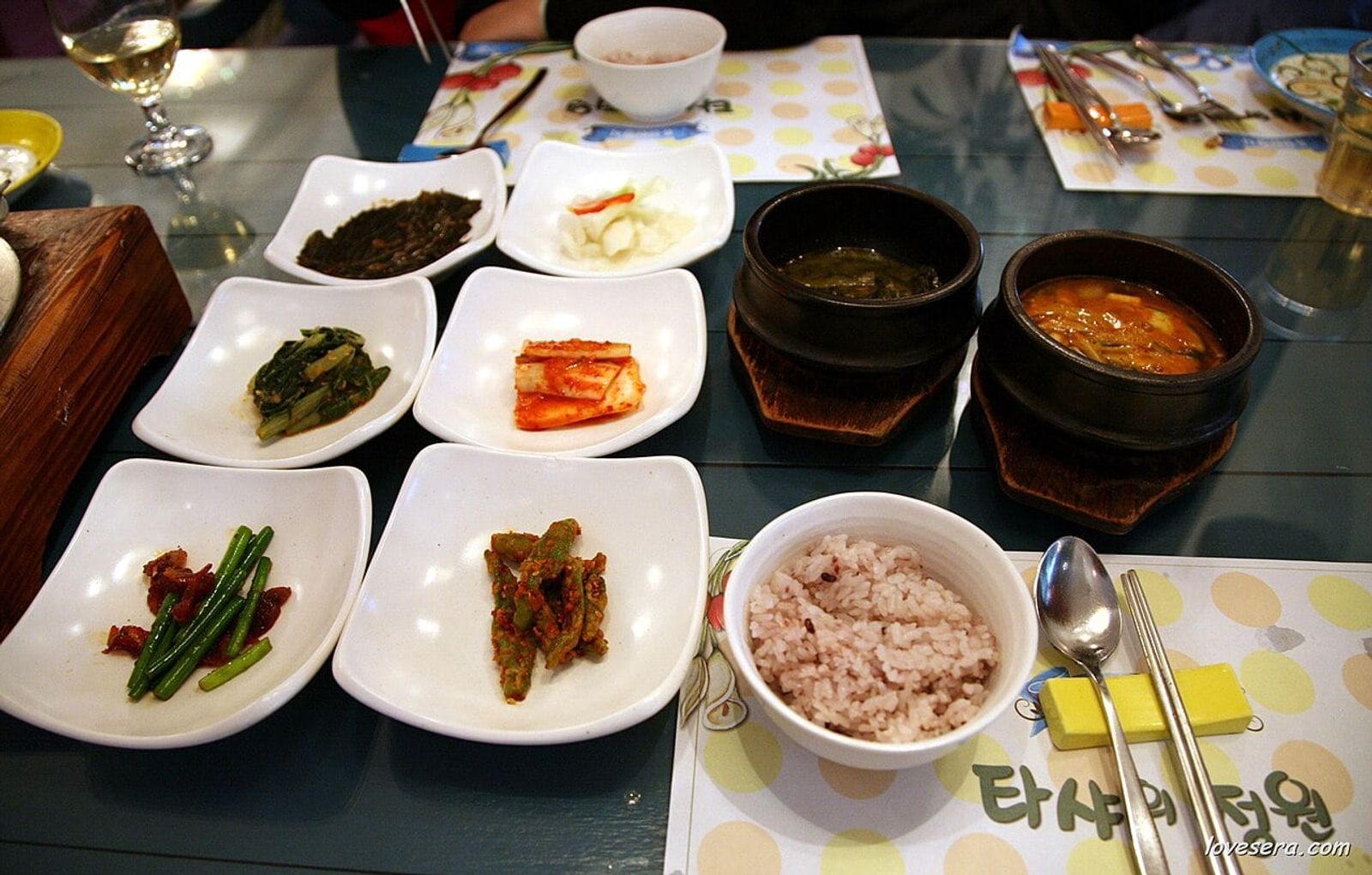
A baekban set table
How Korean Restaurants Work: Why Side Dishes Are Free, Why Water Is Self-Serve, and Where to Pay
Side dishes appear the moment you sit, a bell summons the staff, you pay at the counter, and there is no tipping. Here, in order, are the moments that puzzle first-time visitors to a Korean restaurant.
From the Door to Your Seat
At an ordinary Korean restaurant you walk in without a reservation and take any empty table. There is no need to wait to be seated; if staff ask 'how many?', hold up fingers. Popular places use a tablet at the entrance or apps like Tabling and CatchTable to register a wait and issue a number. If a phone number is required and yours is foreign, tell the staff and they will write you down by hand. Where there is floor seating, take off your shoes before stepping up — Koreans joke that you should check your socks for holes first. Wet wipes or a damp towel on the table are for your hands, and cutlery is in a drawer on the side of the table or in a container. The chopsticks are metal and can feel slippery at first; using the spoon alongside makes things much easier.
Side Dishes Are Free, and So Are Refills
Before your order arrives, small plates of kimchi, seasoned vegetables, black beans, pickled radish and the like are set out. These are 'banchan' — side dishes served automatically and free of charge. Their number and variety vary by restaurant; 'baekban' set-meal houses in the southwest may bring out more than ten. They are already included in the menu price, so enjoy them freely. When a dish runs out, refills are also free. Help yourself at a self-service counter if there is one; otherwise call a server and ask for more. Because hygiene rules require leftover banchan to be discarded rather than reused, it is polite to take only what you will eat. Note that rice (gonggibap) is not a side dish — it is usually a separate item at 1,000 to 2,000 KRW — and at barbecue restaurants, side dish refills are free but extra lettuce for wraps may carry a charge.
Ordering: The Bell, the Tablet, and 'Imo-nim'
Most Korean restaurant tables have a call bell. Do not wait for staff to come by; press it when you are ready to order. If there is no bell, raising a hand and calling 'jeogiyo' or 'yeogiyo' (excuse me) is normal and not rude at all. Many restaurants now have a tablet on each table for ordering and even paying, usually with English, Japanese and Chinese menus. Dishes marked '2 people or more' — hot pots, braises, barbecue — must be ordered in at least two portions. Water is usually self-serve: pour it yourself from the dispenser, free of charge. Sometimes barley tea in a kettle replaces water. Some customers affectionately call older female staff 'imo(-nim)', meaning aunt, but as a visitor 'jeogiyo' is the safest choice.
Table Manners: Spoons, Bowls and Elders
The defining feature of a Korean meal is using both spoon and chopsticks. Rice and soup are eaten with the spoon, side dishes with chopsticks, and rice and soup bowls stay on the table rather than being lifted. Unlike in Japan or China, holding a bowl while eating was traditionally considered impolite, though people are relaxed about it today. Avoid sticking your spoon or chopsticks upright in the rice, as it evokes ancestral rites. When dining with elders, wait for them to pick up their utensils first, receive drinks with both hands, and step away to blow your nose. Slurping soup is not an issue, and serving yourself from a shared stew onto a personal plate is now standard. Leaving food is not considered rude, so do not feel pressured to finish.
Paying, Tipping and Opening Hours
When you finish, do not wait at the table: take the bill (many places do not even issue one) to the counter at the entrance and pay there. Cards are accepted everywhere, foreign cards almost always work, and refusing a card for a small amount is illegal, so you need not worry. Korea has no tipping culture; if you leave a tip, staff may chase you down to return it. Tax and service are already included in menu prices. In a group, the Korean way is for one person to pay and the others to transfer their share later, but asking to 'pay separately' works at most places. Typical hours are 11 a.m. to 9 p.m., many restaurants close for a 'break time' between 3 and 5 p.m., and last orders are 30 to 60 minutes before closing. Twenty-four-hour gukbap (soup and rice) shops and convenience stores are reliable late-night options.
A Quick Guide to Restaurant Types
Knowing restaurant types from their signs makes choosing easier. 'Baekban / hansik / gisa-sikdang' are set-meal houses serving rice, soup and side dishes — the most Korean meal you can have, at 8,000 to 12,000 KRW per person. 'Gukbap / seolleongtang / haejangguk' are single-serving hot soups with rice, easy for solo diners and often open 24 hours. 'Bunsik' means light fare like tteokbokki, gimbap and ramen. 'Gogijip / samgyeopsal / galbi' are grill-at-your-table barbecue houses with a two-person minimum; 'chicken / hof' means fried chicken and beer in the evening; 'pojangmacha / pocha' are casual drinking spots serving snacks with alcohol. 'Junggukjip' is a Korean-style Chinese restaurant for jajangmyeon, jjamppong and sweet-and-sour pork, and 'hoetjip' specializes in live raw fish. Dining alone, gukbap, bunsik and baekban places are most comfortable; for barbecue, look for signs reading '1-person samgyeopsal'.