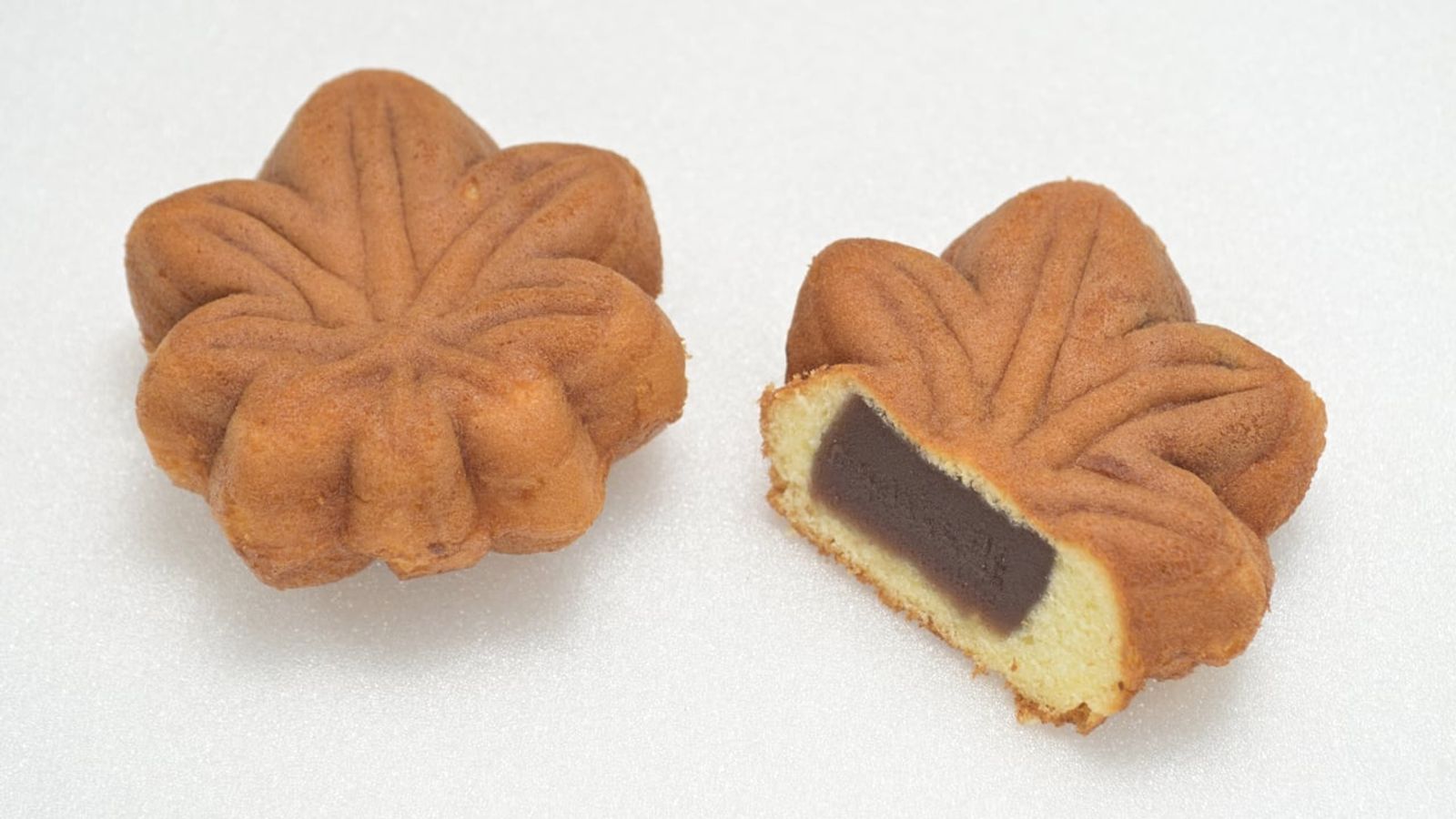
Momiji manju with sweet bean paste inside · Photo: Ocdp / CC0 (Wikimedia Commons)
 JapanHiroshima
120 Years of Momiji Manju: How Miyajima’s Maple-Leaf Cake Became Hiroshima’s Classic Souvenir
Ask about Hiroshima souvenirs and the first answer is momiji manju, a maple-leaf-shaped cake. Here is how it was born on Miyajima in 1906, how its creator’s choice not to monopolize it made it the whole island’s specialty, the 1980 comedy boom, and tips for tasting one fresh off the griddle.
A Maple-Leaf Castella Cake
Momiji manju is a cake made from a castella-like batter of flour, eggs, sugar and honey, filled with sweet bean paste and baked in a maple-leaf mold. The standard filling is smooth koshi-an, and the method is nearly the same at every maker. The name comes from Momijidani, "Maple Valley," Miyajima’s famous spot for autumn leaves. It began as a specialty and souvenir of Miyajima (Itsukushima), one of the Three Views of Japan, but today it is known nationwide as a souvenir representing all of Hiroshima Prefecture, not just the island. It is said to be the first name people mention when asked about Hiroshima souvenirs. It is also nicknamed "momiman," and it marked its 120th anniversary in 2025.
Born in 1906 at an Inn’s Request
The creator of momiji manju is said to be Takatsu Tsunesuke, a wagashi confectioner on Miyajima in the late Meiji era. In Momijidani stood an old inn founded in 1854, where many notable guests, including royals, politicians and writers, stayed. The inn’s proprietress wanted "a sweet you can only taste here," and asked Takatsu, who supplied the inn with sweets, to make one worthy of the name Maple Valley. After much trial and error, Takatsu completed his "maple-shaped baked manju" in 1906. Bean paste wrapped in castella batter made with honey and eggs, it was a very stylish sweet for its time. He registered a trademark for it in 1910. A story that it began with a joke made by a famous figure is also widely told, but it is not confirmed by records, and many regard it as folklore.
Never Monopolized, So It Became the Whole Island’s
Takatsu’s own choice was a big reason momiji manju became the whole island’s specialty. Trademarks back then were valid for 20 years, and he did not renew his. He served as head of the Miyajima confectioners’ association, devoted himself to training younger craftsmen, and is said to have wanted momiji manju to be Miyajima’s specialty rather than his shop’s alone. After the trademark expired in 1927, anyone with a mold could make and sell it, and before World War II there were already 12 makers on the island. In 1934 a visiting member of the imperial family asked whether there was a version with chunky bean paste, which led to tsubu-an momiji manju. Until the 1960s each one was baked by pressing the mold by hand, but after a Hiroshima company developed an automatic baking machine, shops everywhere could make them with consistent quality.
The 1980 Comedy Boom and Endless Flavors
The decisive moment for momiji manju’s national fame was the manzai (Japanese stand-up comedy duo) boom of 1980. On stage, one member of the popular duo B&B would shout "Kibi dango!" as Okayama’s specialty, and his partner from Hiroshima would fire back "Momiji manju!" while making a maple-leaf shape with both hands. The gag became a huge hit and spread the name across Japan almost overnight. In 1984, during the boom, cheese momiji and chocolate momiji appeared as the first fillings other than bean paste. Custard cream, matcha, chestnut, apple and other flavors followed, along with variations such as a mochi-style dough and the deep-fried "age-momiji." Today about 20 makers, large companies included, carry on the traditional taste while continually releasing new flavors.
Tasting One Fresh, and Buying Them
The best way to enjoy momiji manju is to buy one fresh from the griddle on Miyajima’s shopping streets. The island is lined with shops selling them hot, and at many you can watch through the window as machines pour batter and rotate the molds. Some shops still have craftsmen hand-baking with molds out front, and there are facilities where you can try hand-baking yourself. Cheese and chocolate versions are said to taste even better warmed in a microwave for about 10 to 20 seconds so the filling melts. Gift boxes are sold in wide variety not only on Miyajima but also at the JR and Hiroden Miyajimaguchi stations, in the Hiroshima Station building, at downtown department stores and at makers’ own shops. Texture and sweetness vary a little from shop to shop, so buying single pieces from a few places to compare is fun.