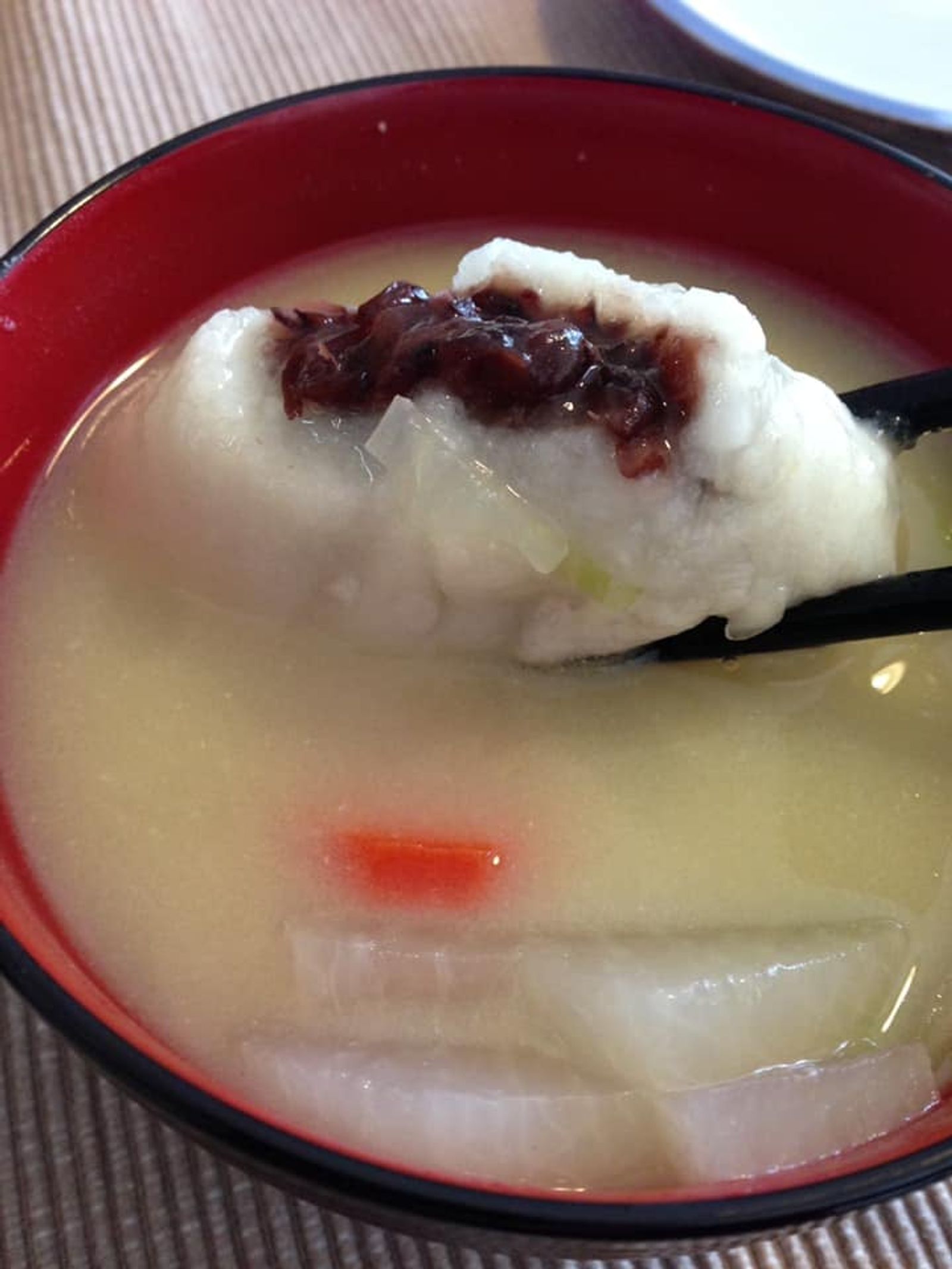
Bean-paste mochi inside An-mochi zoni · Photo: Xanthippespert / CC BY-SA 4.0 (Wikimedia Commons)
 JapanTakamatsu
An-mochi Zoni: Kagawa’s New Year Soup of White Miso and Bean-Paste Mochi
Mochi filled with sweet bean paste, in a savory white miso soup? It sounds puzzling at first. Here is the story behind An-mochi zoni, the New Year dish of eastern Kagawa: the "Three Whites of Sanuki" and sugar, the wishes in its ingredients, and why even locals are split on it.
White Miso Zoni With Bean-Paste Mochi
Zoni is the mochi soup eaten at New Year in Japan, and the broth and shape of the mochi vary widely by region. Kagawa’s zoni, especially in the eastern plains, is one of the more unusual. It puts "an-mochi," round mochi filled with sweet red bean paste, into a slightly sweet white miso (shiro miso) broth, hence the name An-mochi zoni. Once served, it is sprinkled for fragrance with lightly toasted, powdered aosa seaweed and bonito flakes. Bite in and the mochi stretches in the mellow, salty white miso broth as the sweet bean paste flows out, blending sweet and savory. It is a celebratory dish eaten over the first three days of the New Year, handed down mainly in the eastern plains of Kagawa.
A Wish From the Days When Sugar Was Precious
People are said to have started eating An-mochi zoni between the end of the Edo period and the early Meiji era. From the mid-Edo period, the Takamatsu domain, which ruled eastern Sanuki, used the dry, mild climate to promote salt-making and the growing of sugarcane and cotton, and the resulting salt, sugar and cotton became famous products known as the "Three Whites of Sanuki." Even in a sugar-producing region, though, sugar was expensive and precious for ordinary people. So, the story goes, wanting to enjoy the taste of sugar at least during the first three days of the New Year, people tucked unrefined sugar (shiroshita-to) inside their mochi, and that was the start of An-mochi zoni. The sweet mochi soup carries the simple wish of people long ago to taste precious sugar to their heart’s content.
The Wish in Round-Cut Ingredients
The ingredients carry meaning too. Along with the round mochi, vegetables such as daikon, carrot and taro are cut into rounds, expressing the wish that "everything goes smoothly and roundly this year." In some places small taro are peeled and added whole. The broth is normally made with the dried sardines Kagawa calls iriko, but in coastal areas it may be made with dried pufferfish or goby. Depending on the household, tofu, fried tofu, scallion or kamaboko fish cake may go in, or blanched chrysanthemum greens may be added. One tip is to use a wide-bottomed pot so the bean paste inside the mochi does not burst out. So even the same An-mochi zoni tastes a little different from home to home.
Even Locals Are Divided
An-mochi zoni is introduced as a representative Kagawa dish, but not everyone in Kagawa eats it. Opinions are split, with roughly half of residents eating it and half not. Even within the prefecture, mountain villages near Awa (today’s Tokushima) traditionally ate zoni with round mochi in red miso or clear broth instead. Japanese zoni broadly splits into white miso with round mochi in the Kansai region and clear broth with square mochi in the Kanto region, and Kagawa adds its own twist of bean paste. In neighboring Ehime, white miso zoni with bean-paste mochi reportedly becomes more common in the eastern areas close to Kagawa. Across the sea, parts of the Kumamoto coast also have zoni with bean-paste mochi, but in a different style, with clear broth and lots of ingredients.
How Travelers Can Try It
An-mochi zoni is basically home cooking eaten at New Year, so unlike udon or honetsukidori it is not something you can order at a restaurant any time. If you want to try it, the realistic options are to visit Kagawa around the year-end and New Year holidays, or to check in advance for restaurants serving local dishes or hands-on cooking programs. Depending on the season and the shop, some places may have it on the menu, so asking at a local tourist information center is another approach. If it is your first time, thinking of it as a sweet-and-salty, almost dessert-like soup rather than "sweet mochi soup" makes it easier to approach. The mix of white miso’s mellow saltiness, the sweetness of bean paste and the aroma of aosa is a taste found only in Kagawa, different from Korean tteokguk and from zoni elsewhere in Japan. Since even Kagawa locals disagree about it, tasting it yourself and finding out which side you are on is part of the fun of the trip.