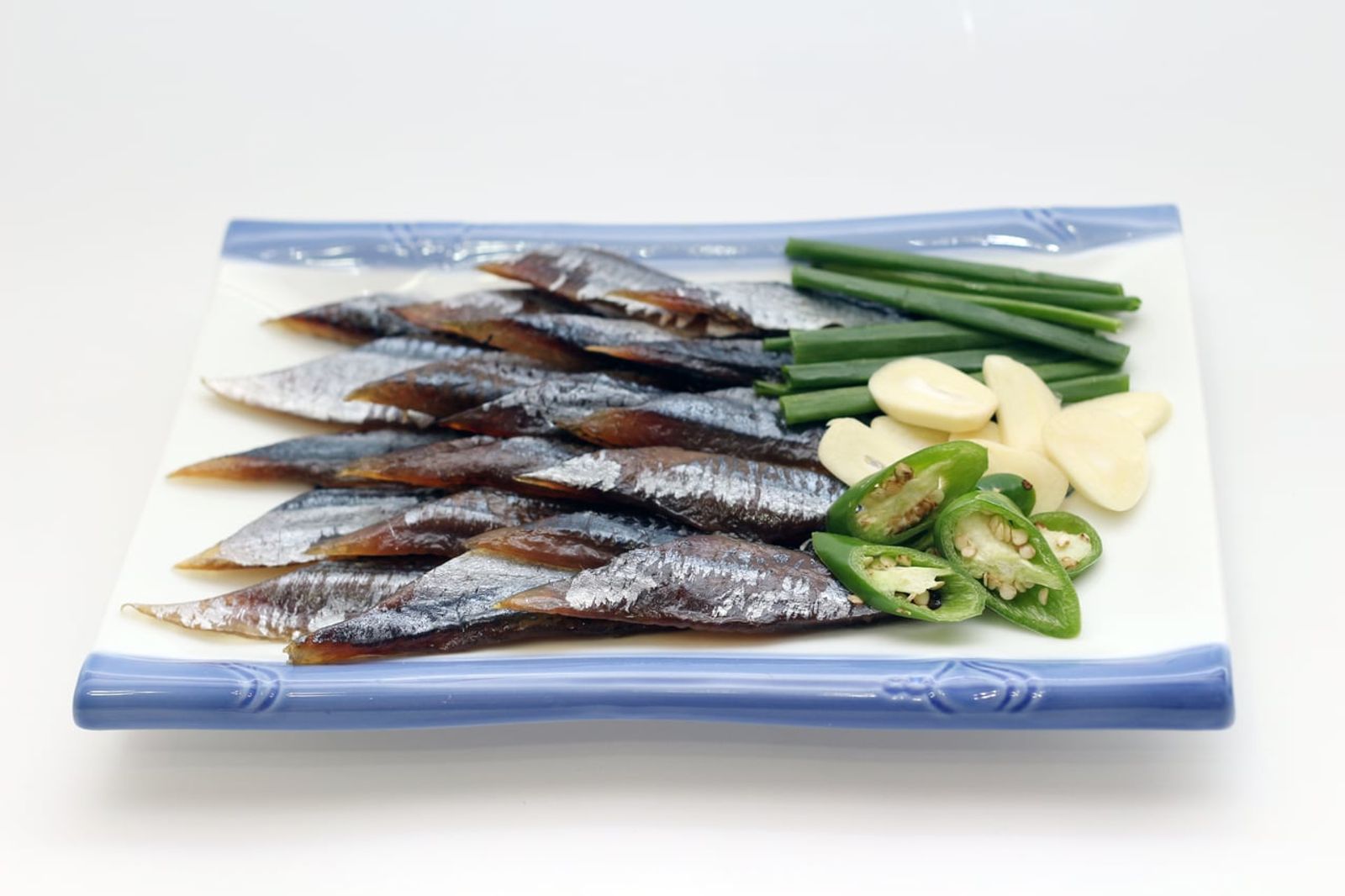
Gwamegi with chives, garlic and chili · Photo: Hyeon-Jeong Suk / CC BY 2.0 (Wikimedia Commons)
 KoreaNorth Gyeongsang
Gwamegi: Pohang's Wind-Dried Winter Fish, From Herring to Saury
Every winter, rows of half-dried fish hang along the harbor in Guryongpo, Pohang. This is gwamegi, fish that freezes and thaws in the sea wind until chewy, eaten wrapped in seaweed. Here is where the name comes from, what Joseon-era books say, why herring gave way to saury, and how to eat it.
Frozen, Thawed and Shaped by the Wind
Gwamegi is herring or Pacific saury hung in the winter sea wind and dried as it repeatedly freezes and thaws. It is a local food of the Yeongil Bay area around Pohang in North Gyeongsang, and Guryongpo in Pohang is its best-known home. The fish freeze in sub-zero wind at night and thaw in the sun by day, and English-language sources say the process continues until the water content falls to about 40 percent. The result is firm and chewy on the outside but moist and oily inside. It has the rich, nutty fat of a blue-backed fish, so some first-timers find it strongly fishy, while fans seek it out every winter. Because opinions split so sharply, the usual way to eat it is not on its own but wrapped with vegetables and seaweed.
The Name: "Gwanmok," Fish Threaded Through the Eyes
The accepted explanation is that the name comes from gwanmok (貫目), "pierced eyes," because the fish were threaded through the eyes on sticks or straw rope to dry. Gyuhap chongseo, a household manual written around 1809, notes that herring whose two eyes are clear enough to see through are dried and have a remarkable taste. Yeojido-seo, a gazetteer compiled under King Yeongjo, records that Yeongil County sent gwanmok as tribute. Together they suggest it was a specialty of the Yeongil Bay area by the late Joseon period. A modern source often quoted is a 1967 magazine essay by novelist Kim Dong-ni, a native of Gyeongju. He described "gwanmegi" from his hometown as herring freeze-dried whole, without gutting or salting, and wrote that after half a century of eating every kind of cuisine he still knew nothing as delicious.
From Herring to Saury and Back Again
Gwamegi was originally made from herring, once plentiful in the East Sea. When herring catches dropped sharply in the 1960s, the abundant Pacific saury took its place, and for decades gwamegi simply meant saury gwamegi. In the 2020s the trend has reversed, with saury declining and herring returning, so herring gwamegi is becoming common again. The method has changed too. In the old days, households around Pohang, Yeongdeok and Guryongpo threaded fish through the eyes and hung them by the kitchen vent or under the eaves. Left in the open at night they froze, then thawed in the warmth of the breakfast fire and were lightly smoked, turning into gwamegi on their own. In the 1990s better transport such as vacuum packing and media coverage led to mass production on dedicated drying racks, and in the 2000s it became a national winter delicacy, helped by the popular food comic Sikgaek.
How to Wrap and Eat It
The most common way to eat gwamegi is as a wrap, or ssam. Place a piece on dried laver (gim), fresh sea mustard (miyeok), napa cabbage or lettuce, add chives, garlic and green chili, dip it in vinegared chili paste (chogochujang) and eat it in one bite. The seaweed and vegetables tame the oiliness and fishiness, making it much easier for newcomers. It is a classic partner for soju. Gwamegi comes in two forms. Tongmari, the whole fish dried intact, is closer to the traditional method but has a stronger smell and takes work to prepare. Today most gwamegi is split open, gutted and boned before drying, a style that developed to make it easier for city dwellers. If it is your first time, try the cleaned version as a wrap, and move on to tongmari once you are hooked.
When and Where to Try It
Gwamegi needs cold wind, so it is a winter food. Fish usually start going up on the drying racks in late autumn and the season peaks in midwinter, when you can see fish hanging everywhere in Guryongpo. Vacuum-packed gwamegi is shipped all over Korea, but eating it on site in the sea breeze is a different experience. The Guryongpo Gwamegi Culture Museum, which explains the history and production of gwamegi, opened in 2016, and Pohang has held a gwamegi festival around November every year since 1997. Festival dates can change from year to year, so check Pohang City's information before you go. Combine it with the Guryongpo Modern History Street and Homigot Cape to see Pohang's eastern coast in a day.