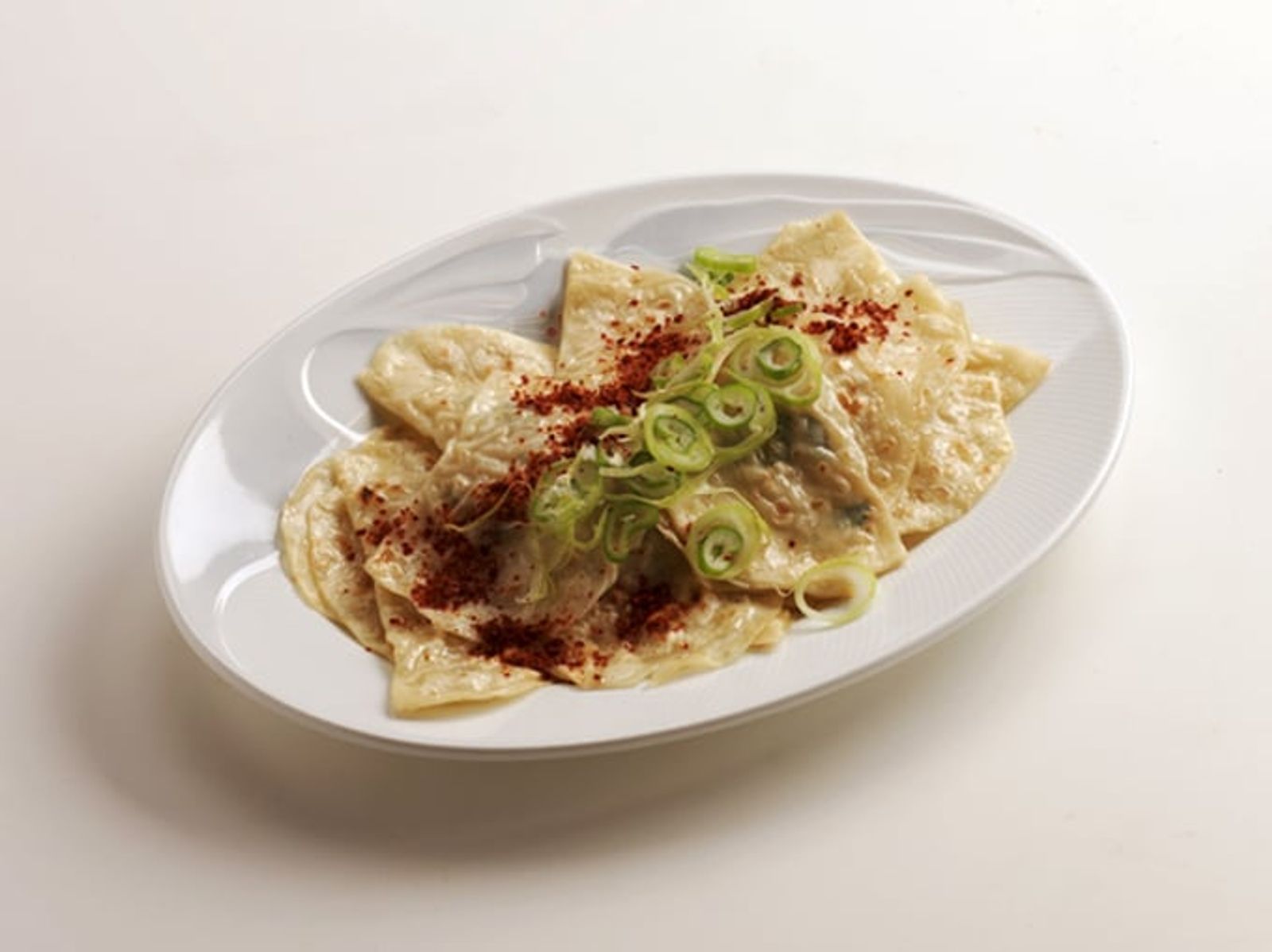
Napjak-mandu with soy sauce, scallion and chili flakes · Photo: 대구광역시 / CC BY 4.0 (Wikimedia Commons)
 KoreaDaegu
Napjak-mandu: Daegu's Paper-Thin Flat Dumpling and Its Snack-Bar Story
If you picture plump dumplings, Daegu's napjak-mandu may surprise you. Here is how this flat, griddled dumpling with a thin wrapper and a little glass noodle and chive filling appeared in 1960s Daegu, how it became one of the Daegu 10 Flavors, and how locals eat it dipped in tteokbokki sauce.
A Dumpling That Lives Up to Its Name
Napjak-mandu is literally "flat dumpling." A very thinly rolled wheat wrapper holds just a little glass noodle, garlic chive and scallion, folded into a half-moon and fried golden on an oiled griddle. With so little filling, it can look more like a thin pancake than a dumpling. That means the flavor comes from the toasted wrapper rather than the filling. The surface that touches the oil turns crisp, the middle stays chewy, and a nutty wheat flavor leads. The Daegu way is to add seasoning on top or pair it with other dishes. First-timers are often surprised that there is hardly any filling, but many say that after a few bites the simplicity becomes the charm.
Born in 1960s Daegu
According to Daegu City and local culture sources, napjak-mandu appeared in Daegu in the early 1960s and began to be sold commercially around 1963. In the years after the Korean War, when food was scarce, people made wrappers from relatively easy-to-get wheat flour, added just a few ingredients such as glass noodles, chives and scallions, and shaped them flat. That is described as the starting point. Saving on filling and frying a thin wrapper in oil began as a matter of necessity, but over time it became the very thing that makes Daegu's napjak-mandu distinctive. You will often hear that war refugees created it, but there is no clear evidence for that. What is certain is that it has been an everyday snack for Daegu people for decades.
From Snack-Bar Treat to Daegu 10 Flavors
The snack-bar culture of the 1960s and 70s played a big part in spreading napjak-mandu across Daegu. Government campaigns that encouraged wheat-based foods in place of rice coincided with a boom in snack bars, and napjak-mandu became a staple around school gates and traditional markets. For anyone who went to school in Daegu, it is a nostalgic taste that comes to mind together with tteokbokki. In 2006 Daegu City held a public contest and evaluation of local foods and chose 10 out of 76 candidates as the "Daegu 10 Flavors." Napjak-mandu made the list alongside ttaro-gukbap, grilled makchang, mungtigi, Dongin-dong braised short ribs and muchimhoe. The criteria included local character, uniqueness and familiarity. Today it is a local food that visitors to Daegu make a point of trying.
How to Eat It Like a Local
The basic way is to drizzle soy sauce over the griddled dumplings and top them with chopped green onion and chili flakes. The salty soy and the scallion aroma suit the nutty wrapper perfectly. The other classic is to dip them in spicy tteokbokki sauce or pile them on top of tteokbokki, and many people order the two together at snack bars. In Daegu it is also eaten with jjolmyeon (chewy spicy noodles) or with muchimhoe, another of the Daegu 10 Flavors: squid, sea snails and other seafood tossed with vegetables in a spicy, tangy dressing. Wrapping that sweet-sour-hot mix in a napjak-mandu lets the plain wrapper balance the seasoning. Some places pour the soy dressing on for you and others leave it to you, so look for the bottles on the table.
Where to Try It
You can find napjak-mandu almost anywhere in Daegu: snack bars, shops near schools and traditional markets. There are several long-established specialists, and in places such as the Gyodong Market and Nammun Market areas you can watch it being fried on the griddle. A local report notes that wrapper thickness, amount of filling and cooking style vary from shop to shop, with some making very thin, sparsely filled dumplings and others stuffing them more generously, so comparing a few is fun. To promote the Daegu 10 Flavors, the city has designated the 10th, 20th and 30th of every month as "Daegu 10 Flavors Day," with discounts and other offers at participating restaurants (as of 2025). Whether the event runs and which places take part can change each year, so check Daegu City's food information site. It is inexpensive, so a plate to share makes a good snack while sightseeing.