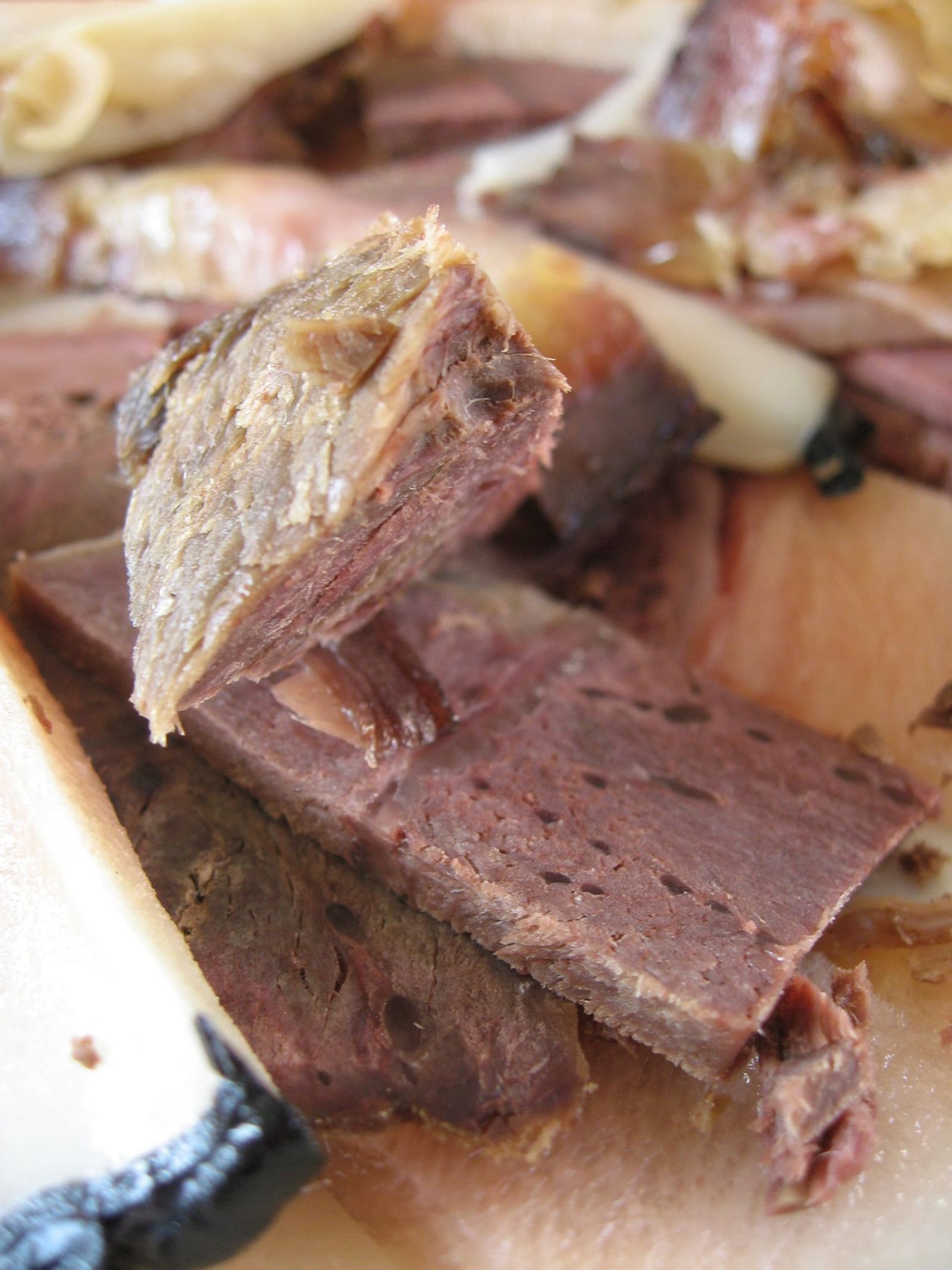
Boiled and sliced whale meat (suyuk) · Photo: Andrew 鐘 / CC BY 2.0 (Wikimedia Commons)
 KoreaUlsan
Jangsaengpo Whale Meat: From Prehistoric Rock Art to a Whaling Port and Today's Table
Ulsan is Korea's whale city. Here are the Bangucheon petroglyphs that carved whale hunts thousands of years ago, Jangsaengpo's role as the hub of Korean whaling until the 1986 moratorium, why only whales accidentally caught in nets can be sold today, and what cuts such as une and obegi mean.
Whales Carved in Stone Thousands of Years Ago
Ulsan's bond with whales goes back to prehistory. The Bangudae petroglyphs on a cliff along the Daegokcheon stream in Ulju County preserve about 300 images thought to have been carved between the Neolithic and Bronze Ages. Of the 237 that can be identified, whales are the most numerous at 62. Harpoons, boats and nets are carved too, making it a precious record of early whaling. The petroglyphs were discovered in 1971 and designated a National Treasure, and in July 2025 they were inscribed on the UNESCO World Heritage List together with the nearby Cheonjeon-ri inscriptions and petroglyphs as the "Petroglyphs along the Bangucheon Stream." Because the Sayeon Dam submerges them for part of each year, conservation has long been controversial. Since April 2026 Ulsan has run a free shuttle linking the petroglyph parking lot with Daegok-ri and Cheonjeon-ri.
Jangsaengpo, Korea's Whaling Base
Jangsaengpo, a harbor on Ulsan Bay, became a whaling port only in modern times. In 1899 a Russian whaling company, licensed by the Korean Empire, began using Jangsaengpo to process whales. After the Russo-Japanese War the rights passed to Japan, and from around 1915 Jangsaengpo was the main whaling port on the peninsula. Most of the whale meat caught then was reportedly exported to Japan. After liberation in 1945, some 200 Koreans who had worked on Japanese whaling ships founded a company and began operating out of Jangsaengpo, and the habit of eating whale meat took root locally. At its peak in the late 1970s, Jangsaengpo had about 20 whaling boats and some 10,000 residents. Overhunting shrank whale stocks, however, and when the International Whaling Commission banned commercial whaling in 1986, the hunts stopped and Jangsaengpo went into a long decline.
Where Today's Whale Meat Comes From
With commercial whaling banned, deliberately catching whales in Korea is illegal. Whale meat on the market is, in principle, from bycatch: whales of non-protected species caught accidentally in nets set for other fish. When a whale is caught, the fishing crew must report it to the coast guard, which checks for signs of illegal hunting such as harpoon marks and issues a certificate before the whale can be auctioned and sold. Protected species and whales showing signs of illegal capture must be destroyed. According to reports citing coast guard data, around 50 to 70 minke whales were caught as bycatch each year from 2019 to 2024. That makes whale meat rare and expensive, and illegal whaling is punishable by up to three years in prison or a fine of up to 30 million won. Environmental groups argue that some whales go unreported and criticize eating whale meat at all, so the debate over this food culture continues.
Une, Obegi, Bagaji: Different Cuts, Different Tastes
People in Jangsaengpo have long eaten whale meat divided by cut. The soft belly that melts in the mouth is une, the chewy, crunchy tail and fins are obegi, and the back meat with a good mix of lean and fat is bagaji. There is also makjjikgae, chunks of raw meat, yukhoe, raw meat cut into strips and dressed, and dishes made from the innards. People say whale has twelve different tastes depending on the cut. Names such as une, which appear to come from Japanese, are a trace of the colonial-era whaling history. The most common way to eat it is suyuk, various cuts boiled and thinly sliced, dipped in salt, a seasoned sauce or salted shrimp. Baleen whales, and minke whales above all, are considered the tastiest. The flavor is often described as somewhere between beef and fish, but richness and texture vary greatly by cut, so first-timers often choose an assorted plate with a little of each.
Visiting the Jangsaengpo Whale Culture Zone
Jangsaengpo, once in decline, has been reborn as a whale-themed destination. The Jangsaengpo Whale Museum was built to commemorate the 57th annual meeting of the International Whaling Commission held in Ulsan in 2005, and it displays whaling boat models, whale skeletons and other material on whaling history. The area, now known as the Jangsaengpo Whale Culture Special Zone, brings together a number of other whale-themed attractions. Ulsan's Nam-gu district holds the Ulsan Whale Festival around Jangsaengpo every year; it used to be held mostly in May or June, and in 2026 it ran from October 15 to 18. Whale meat restaurants cluster around Jangsaengpo too, with about 25 in business according to a 2019 article. Supply depends on bycatch and prices are high, so check the price and portion on the menu first. Even if you skip the whale meat, the museum and a seaside walk make it well worth a stop.