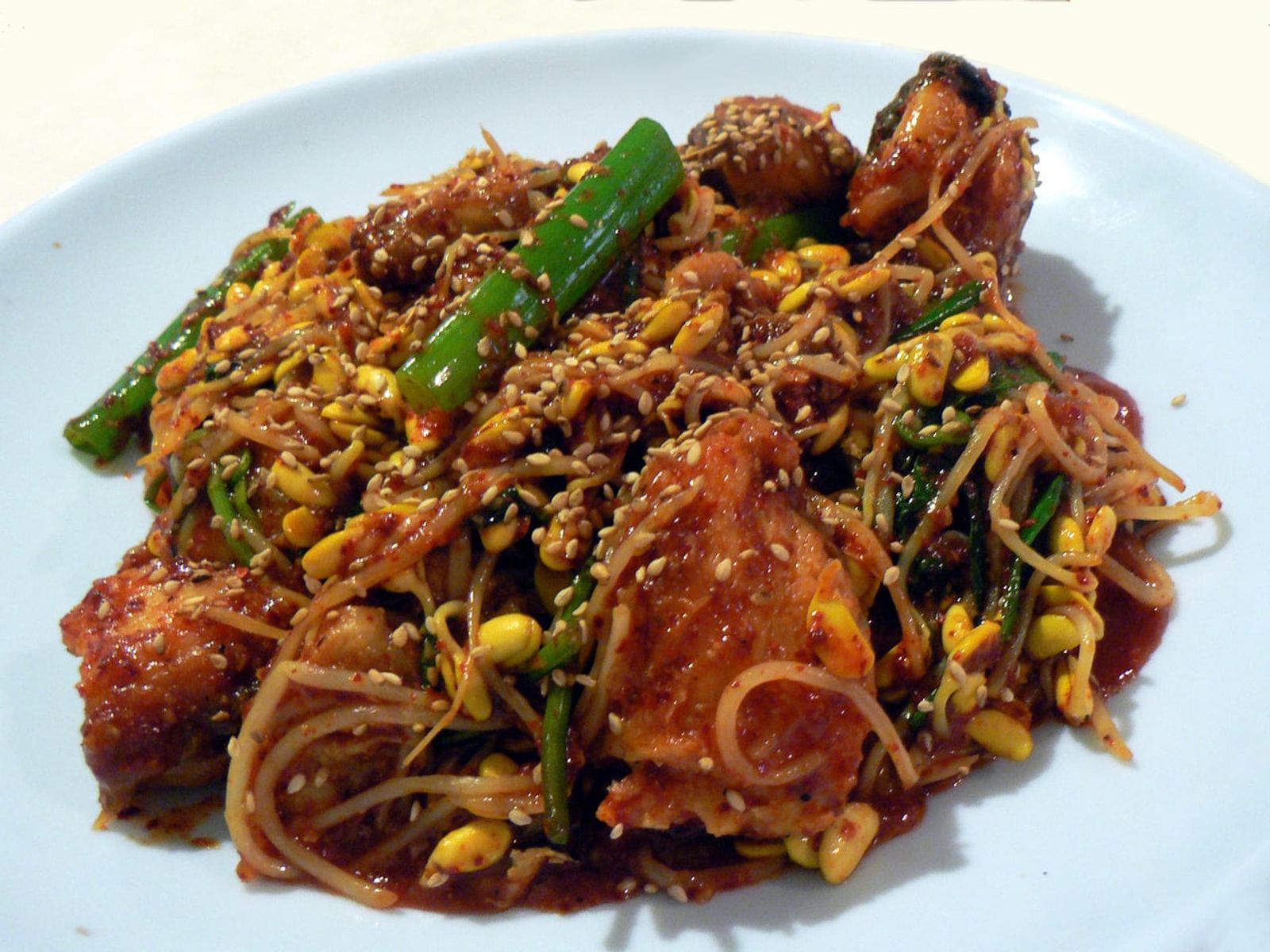
Agujjim with bean sprouts and water parsley · Photo: stu_spivack (Flickr) / CC BY-SA 2.0 (Wikimedia Commons)
 KoreaSouth Gyeongsang
Masan Agujjim: How an Ugly, Discarded Fish Became Korea's Famous Spicy Braise
Anglerfish used to be thrown back because of its looks. Tossed with bean sprouts, water parsley and a fiery sauce, it became a national favorite. Here is how agujjim began in Odong-dong, Masan, how Masan's dried-fish version differs from the fresh-fish style elsewhere, and how to enjoy it.
A Fish Thrown Away for Its Looks
With its huge mouth and lumpy body, the anglerfish was unwelcome for a long time. According to English-language sources, it was rarely eaten until the 1940s because of its ugly appearance and low market value, and it was often discarded when caught. Korean sources likewise say it had little use and was frequently thrown away. Its transformation into food is credited to the fish market in Masan, South Gyeongsang. The story goes that fishermen brought their anglerfish to market taverns and eateries and asked the cooks to turn it into something tasty to go with drinks, and that was the beginning of agujjim. As other fish became scarcer in the late 20th century, this newly discovered delicacy grew popular. The standard name is agwi-jjim, but in Gyeongsang dialect it is usually agu-jjim, and that is the spelling you will see most often on restaurant signs.
Odong-dong, Masan: The Home of Agujjim
The area around Odong-dong in Masan is considered the birthplace of agujjim. The dish is now loved all over Korea, but specialist restaurants still cluster around Odong-dong, known as "Agujjim Street." The former city of Masan once chose nine scenic sights and five flavors, the "9 Views and 5 Tastes," to attract tourists, and agujjim was one of the five tastes. Note that in 2010 Masan merged with Changwon and Jinhae, and today it forms Changwon's Masanhappo-gu and Masanhoewon-gu districts. Officially the place is Changwon, but the dish is still called "Masan agujjim." It has spread so widely that Seoul has well-known agujjim streets of its own, in Sinsa-dong and Jongno, but travelers who want to taste the original should head to Odong-dong in Masan.
Dried Versus Fresh Anglerfish
The defining feature of Masan-style agujjim is dried anglerfish. In the traditional version, the fish is dried in the cold sea wind and then tossed in the sauce so the flavor soaks in; sources give the drying time variously as 15 to 30 days or 20 to 30 days. Dried anglerfish becomes firm and chewy with a satisfying bite, and the seasoning penetrates deep into the flesh. Elsewhere, cooks usually use fresh anglerfish with the innards removed. Fresh-fish agujjim is softer and moister but not as chewy as the Masan style, so the texture varies quite a bit by region and restaurant. The flesh is mild, and the skin and the parts near the fins are rich in collagen with a pleasantly chewy texture. On your first visit to Masan, ask whether the restaurant uses dried fish before you order.
Bean Sprouts, Sea Squirt and Water Parsley
The sauce for agujjim gets its heat from plenty of chili powder and its depth from doenjang, soy sauce, minced garlic and chopped scallions. Then there are the bean sprouts, which are essential: piled high and tossed with the fish in the sauce, they add crunch and a refreshing taste. Water parsley (minari) brings a fresh fragrance, and mideodeok, a small sea squirt, adds a popping texture and a taste of the sea. Mideodeok is also known as a specialty of the Masan area. Many places thicken the sauce with starch so it clings to the ingredients, which means there is little liquid and the red sauce coats the fish and sprouts. Heat levels vary by restaurant but are generally high, so if you are sensitive to spice, ask for it milder when ordering. Agujjim is also a much-loved partner for soju.
How to Eat It and Finish With Fried Rice
Agujjim usually comes on a big platter for sharing, so many restaurants sell it by size: small, medium or large. Start by piling bean sprouts and sauce onto pieces of fish, and if it gets too hot, cool your mouth with rice or the soup that comes with it. The anglerfish has thick bones that make it easy to pick the flesh off, but do not miss the chewy skin and cartilage. The real finale is fried rice. Rice, vegetables and crumbled laver are stir-fried in the leftover sauce on a hot plate until a slightly crispy crust forms on the bottom, making a crunchy, savory fried rice. At many places you order it separately, so the trick is to leave a little sauce. If you are in Masan, share a platter on Odong-dong's agujjim street and take a look around the Masan fish market too.