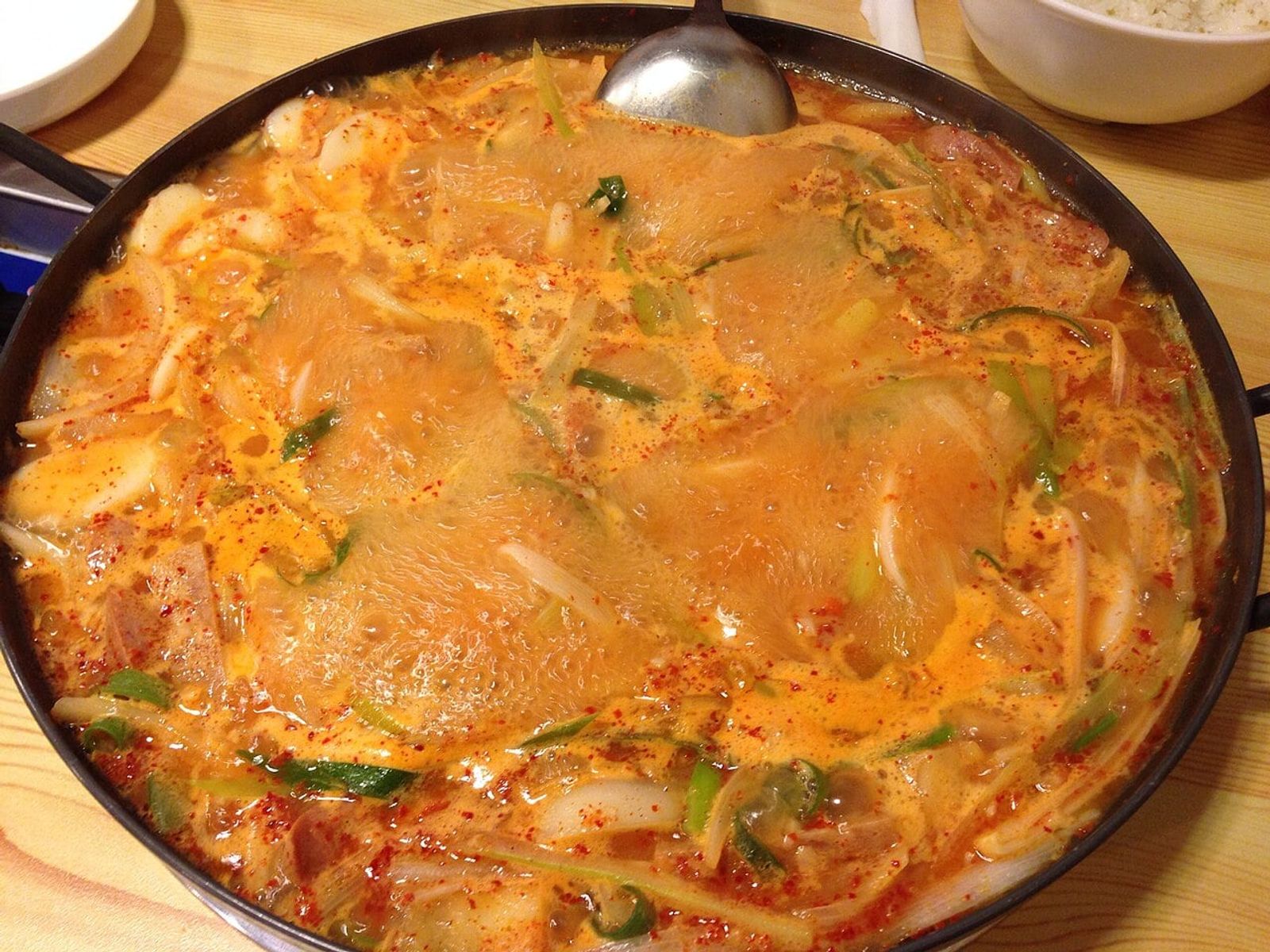
Uijeongbu budae-jjigae
The Origin of Budae-jjigae: The Korean 'Army Stew' Born from the Scars of War
Ham, sausage, kimchi and instant noodles bubbling in one pot: budae-jjigae was born around U.S. army bases in the 1950s. Learn the difference between Uijeongbu and Songtan styles, the story behind 'Johnson-tang', and what to know when ordering.
What Budae-jjigae Is: A Dish with an Unusual Name
Budae-jjigae combines 'budae' (military unit) and 'jjigae' (stew), so it literally means 'army stew'. Ham, sausage, ground meat, baked beans, kimchi, tofu, rice cakes and instant noodles are simmered in a chili-seasoned broth as a hot pot. Unlike other Korean stews, its main ingredients are Western processed foods. Orders of two or more portions come in a pot set on a tabletop burner and are eaten as they cook. Start with the broth, ham and sausage; once it boils, add the ramen noodles; finish by frying rice in the pot or mixing rice into the broth. At around 10,000 KRW per person it is cheap and generous, a favorite for office lunches and student gatherings.
The 1950s: Born Around U.S. Army Bases
Budae-jjigae grew out of the severe food shortages right after the Korean War (1950-53). With everything scarce, in towns with U.S. bases — Uijeongbu, Dongducheon, Songtan in Pyeongtaek, Yongsan in Seoul — ham, sausage and canned goods that trickled out of the bases were traded at markets. To make these unfamiliar Western meats taste Korean, people simmered them with kimchi and gochujang, and the stew was born. Early on it was sometimes confused with 'kkulkkuli-juk', a porridge boiled from U.S. mess-hall leftovers, but budae-jjigae was always a separate dish made from whole ingredients. Odeng Sikdang in Uijeongbu is regarded as the original: in 1960 its founder, Heo Gi-suk, sold stir-fried ham and sausage from the base and began cooking them as a stew at customers' request. The restaurant is still run by the family's third generation.
'Johnson-tang' and the Two Regional Styles
Around Yongsan and Itaewon in Seoul, budae-jjigae was also called 'Johnson-tang', a name said to date from U.S. President Lyndon Johnson's visit to Korea in 1966. This version uses cabbage instead of kimchi and is heavy on cheese and sausage; a few old Yongsan restaurants still use the name. There are two main regional styles. Uijeongbu style is a clear, sharply spicy broth built on kimchi, ham and sausage. Songtan style from Pyeongtaek is richer and thicker, loaded with cheese, bacon, ground meat and sausage. The 'Budae-jjigae Street' near Uijeongbu Station and the 'Budae-jjigae Alley' in Songtan are the shrines of each style, with the original restaurants clustered together for easy comparison.
Ramen and Spam: What Completed the Dish
Korea's first instant ramen appeared in 1963 and became ubiquitous in the 1980s, and adding ramen noodles to budae-jjigae became standard. The noodles soak up the broth, deepening the flavor and stretching the portion, so 'add sari (extra noodles)' is an essential step. Besides ramen, you can choose udon noodles, glass noodles or rice cakes. Spam became the signature ingredient after licensed production began in Korea in 1987. Korea is the world's second-largest Spam consumer after the United States, and exchanging Spam gift sets at holidays is one of the sights that most surprises visitors. It is a cheap canned meat in America, but in Korea the memory of its postwar scarcity lingers and it is still treated as a premium side dish.
What to Know When Ordering
Most places take orders from two portions, though some serve single-portion budae-jjigae in an earthenware pot. Rice is usually ordered separately (1,000 to 2,000 KRW a bowl) and extra noodles cost 2,000 to 3,000 KRW. The default heat is 'medium' by Korean standards; many restaurants will tone it down if you ask for 'less spicy'. Because processed pork is the main ingredient, it is not suitable for halal or kosher diets, nor is it vegetarian. Once the solids are gone, add rice to the broth for a porridge-like finish or order fried rice. Uijeongbu's Budae-jjigae Street is a five-minute walk from Uijeongbu Station on Seoul Subway Line 1, making it an easy half-day food trip.