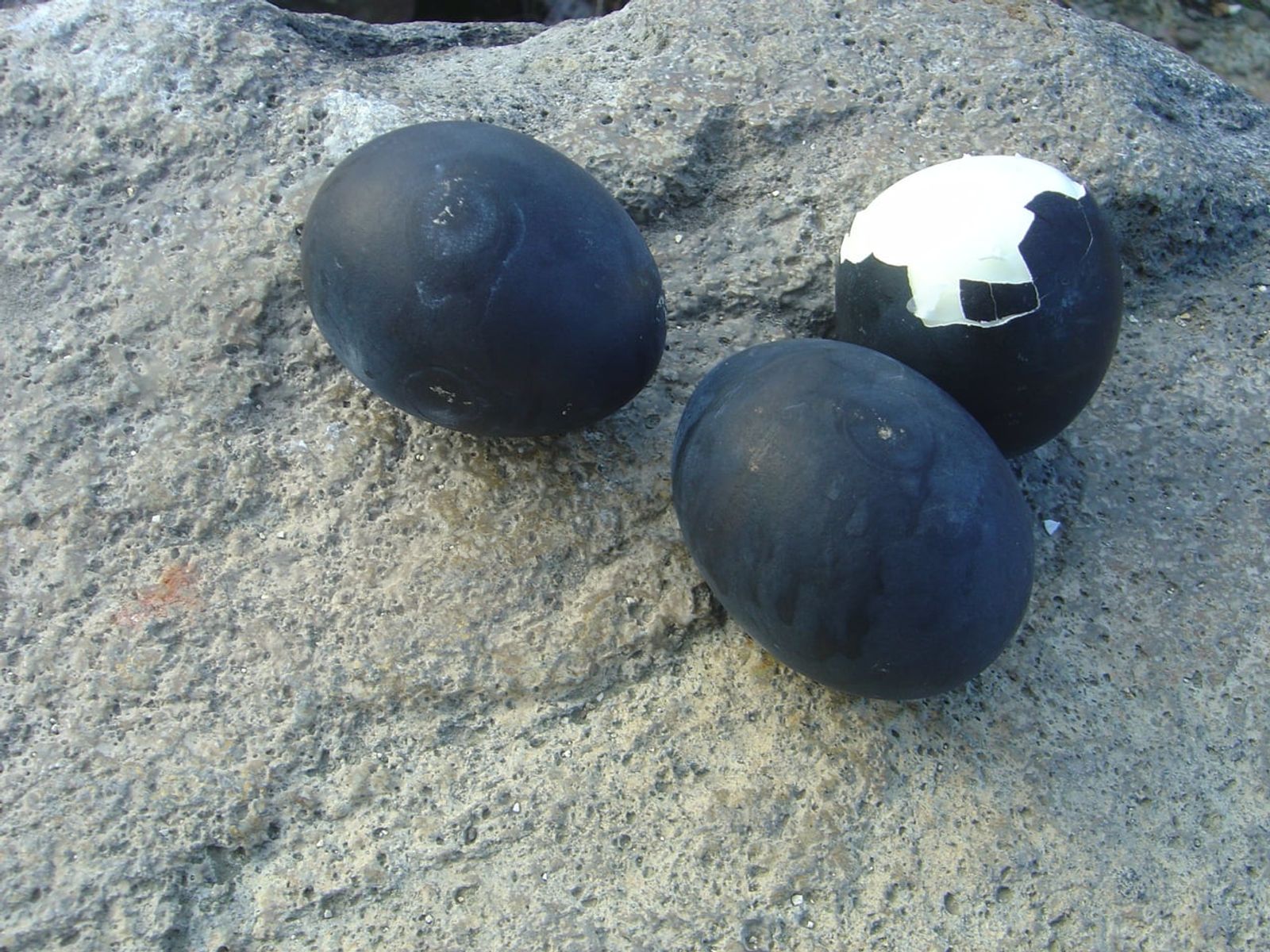
Black eggs at Owakudani · Photo: David Monniaux / CC BY-SA 3.0 (Wikimedia Commons)
 JapanHakone
Owakudani's Kuro-tamago: The Secret of the Black Eggs Said to Add Seven Years to Your Life
Everyone who visits Hakone's Owakudani ends up holding a black egg, a kuro-tamago. Here is how they are made in this steaming volcanic valley, why the shells turn black, where the "seven extra years" story comes from and what to keep in mind about volcanic activity.
From "Hell Valley" to Owakudani
Owakudani, home of the black eggs, is a valley formed by eruptions of the Hakone volcano, and it is said to have been created by an explosion about 3,000 years ago. Plumes containing hydrogen sulfide still rise all around, and visitors can see boiling hot springs and steaming vents up close, making it one of Hakone's signature sights. In the Edo period, the landscape earned it the names Jigokudani (Hell Valley) and O-jigoku (Great Hell). Then on September 5, 1873, on the occasion of a visit by Emperor Meiji and the Empress, it was renamed Owakudani, "the valley of great boiling." It traded its fearsome name for one describing the earth bubbling up.
60 Minutes in an 80°C Pond, Then 15 in 100°C Steam
Kuro-tamago are boiled in Owakudani's hot spring ponds. According to tourism guides, raw eggs are first placed in a pond of about 80°C and simmered slowly for about 60 minutes. During this time, hot spring minerals cling to the porous shells and turn them black. The eggs are then steamed in a steamer at about 100°C for roughly another 15 minutes. Freshly made kuro-tamago are jet black outside, but peel them and the inside looks like an ordinary hard-boiled egg, white with a fully cooked yolk. A pinch of salt is the standard seasoning. Some travel media say they contain more umami than regular boiled eggs, but that repeats the seller's description, so take it with a grain of salt.
Why Do the Shells Turn Black?
The long-standing explanation goes like this: iron in the hot spring water clings to the tiny pores of the shell, hydrogen sulfide reacts with it to form black iron sulfide, and the shell turns black. Many tourism guides still use this explanation. Japanese Wikipedia, however, reports that research around 2020 suggested a different mechanism, linking the color to the Maillard reaction between amino acids from organic matter and sugars. Since sources disagree about the chemistry, the only certain thing is that eggs boiled in these ponds come out with black shells. Only the shell is black and the inside is perfectly normal, so eat without worry.
The Roots of "Eat One, Live Seven Years Longer"
Kuro-tamago come with the saying that eating one adds seven years to your life. Behind it is Owakudani's Enmei Jizo, the "life-prolonging" bodhisattva. Legend has it that some 1,200 years ago the monk Kobo Daishi (Kukai), traveling the provinces, was saddened by Owakudani's hellish landscape and carved a statue of Jizo to pray for people's salvation. Because the hot spring pond where the eggs were boiled lay near that Jizo, the story goes, people came to say the eggs extend your life through its blessing. One explanation for "seven" is that it is a lucky number in Japan, as in the Seven Lucky Gods, so it simply became the accepted figure. Japanese Wikipedia calls the claim a sales pitch, so enjoy it as a fun legend.
What to Know Before Visiting a Volcanic Area
Owakudani is an active volcanic area. On May 6, 2015, the Japan Meteorological Agency raised Mt. Hakone's volcanic alert level to 2 (restrictions around the crater), and the Hakone Ropeway suspended all service. Restrictions were partly lifted only in July 2016, when the black egg shop reopened. The level rose to 2 again in May 2019, was lowered to 1 on October 7 that year, and the ropeway fully resumed on October 26. Before you go, always check the JMA volcanic alert level and the Hakone Ropeway's operating status. Volcanic gas contains hydrogen sulfide, and visitors with asthma or heart or respiratory conditions, small children and pregnant women are advised to take particular care. Kuro-tamago are usually sold in packs of several, and they taste best bought and eaten right there in Owakudani.