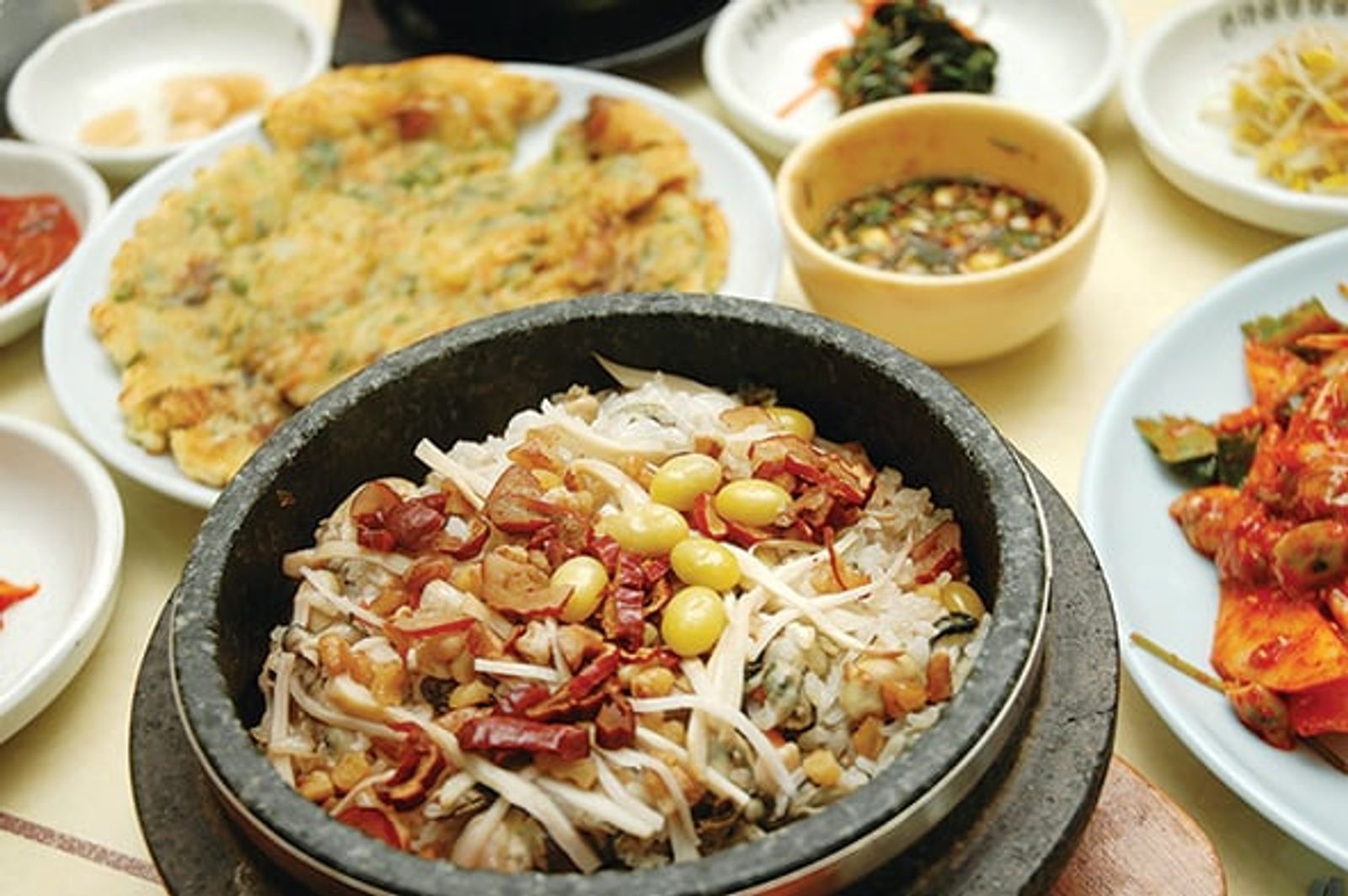
Seosan oyster rice in a stone pot · Photo: Seosan City Government / CC BY-SA 4.0 (Wikimedia Commons)
 KoreaSouth Chungcheong · Seosan
Eoriguljeot of Ganwoldo, Seosan: The Red Oyster Jeotgal of a Village That Called the Oysters Home
Ask what Seosan tastes like and most locals will name Ganwoldo eoriguljeot, small oysters fermented with nothing but salt and chili powder. Here is why it became famous here, where the name may come from, the full-moon oyster ritual, and how to eat it.
Ganwoldo, an Island That Became Mainland
Ganwoldo is a small village on the inner shore of Cheonsuman Bay, south of Seosan. As the name suggests (do means island), it used to be an island, but the Seosan seawall and land reclamation joined it to the mainland, so today you can simply drive in. Cheonsuman is also known for the migratory birds that winter here. Just offshore stands Ganworam, a tiny hermitage. Legend says the early Joseon monk Muhak attained enlightenment here while watching the moon. A gravel path appears only at low tide, so check the tide table before you go. Visitors who come for the hermitage almost always end up tasting, and buying, eoriguljeot at the harbor restaurants.
Two Theories Behind the Name
Eoriguljeot is a type of guljeot, or oyster jeotgal: raw oysters salted and fermented, then tossed with chili powder. What the prefix eori means, however, is not clear, and sources offer several explanations. One says it comes from eol (eori), a prefix meaning small or not fully grown, because the oysters here are small. Another says it refers to oysters cured with only a little salt, giving a milder jeotgal. A third links it to eoleolhada, the tingling heat the chili seasoning leaves in your mouth. Whichever is right, they all point to what makes Ganwoldo's version special: small oysters and a punchy chili seasoning. Eoriguljeot is also on Seosan City's list of the city's nine signature flavors, the Seosan 9-mi.
Why Ganwoldo Oysters Soak Up the Seasoning
The sea around Ganwoldo has more mudflat than rock. Oysters start life on small stones, drop off after about two years and keep growing in the mud. Oysters raised this way are dark and have many fine, hair-like fringes. A 2004 Seoul Shinmun travel feature explains that Ganwoldo oysters have larger fringes relative to the body, so when they are tossed in chili powder the seasoning clings to a wider surface, which makes them tastier. They look and taste quite different from oysters farmed in deep water. The local oysters also have a long paper trail. Hosallok, a gazetteer of the Seosan area written by Han Yeo-hyeon in 1619, describes the oysters of Ganwoldo and nearby Ungdo, noting that Ganwoldo's ripen in autumn and winter and disappear by the second or third month. Ganwoldo fishers are said to have built their trade by selling oysters and jeotgal at the Gwangcheon market in neighboring Hongseong.
Salt, Chili and Time
Ganwoldo-style eoriguljeot needs very little: oysters, salt and chili powder are almost all there is. The raw oysters are first mixed with salt and left to ferment in an earthenware jar, then tossed by hand with a seasoning of chili powder made from sun-dried peppers. Local sellers insist that it only tastes right when seasoned with sea salt and chili alone and aged in a jar, ideally using sea salt that has been stored long enough for its bitter brine to drain away. Well-aged eoriguljeot leads with the sweetness of the oyster and the kick of chili rather than salt, followed by the gentle savoriness of fermentation. If you are worried about a fishy taste, start with a tiny bit on a spoonful of rice.
The Oyster-Calling Ritual and How to Eat It
Ganwoldo keeps a unique folk custom tied to its oysters. Every year on the first full moon of the lunar new year, around high tide, villagers hold the Gulbureugi Gunwangje, an oyster-calling rite praying for a good harvest, in front of the eoriguljeot monument at the village entrance. Women dressed in white march to the beat of traditional drums and make offerings. Unlike fishing-village rites elsewhere, which are usually led by men, this one is led by the women who gathered the oysters and made the jeotgal. The classic way to eat eoriguljeot is a small piece on freshly cooked white rice. Restaurants around Ganwoldo harbor often serve it with gulbap, rice cooked in a stone pot with oysters, jujubes and nuts, and this nutritious oyster rice is also on the Seosan 9-mi list. If you buy a packed tub to take home, keep it refrigerated and eat it fairly soon.