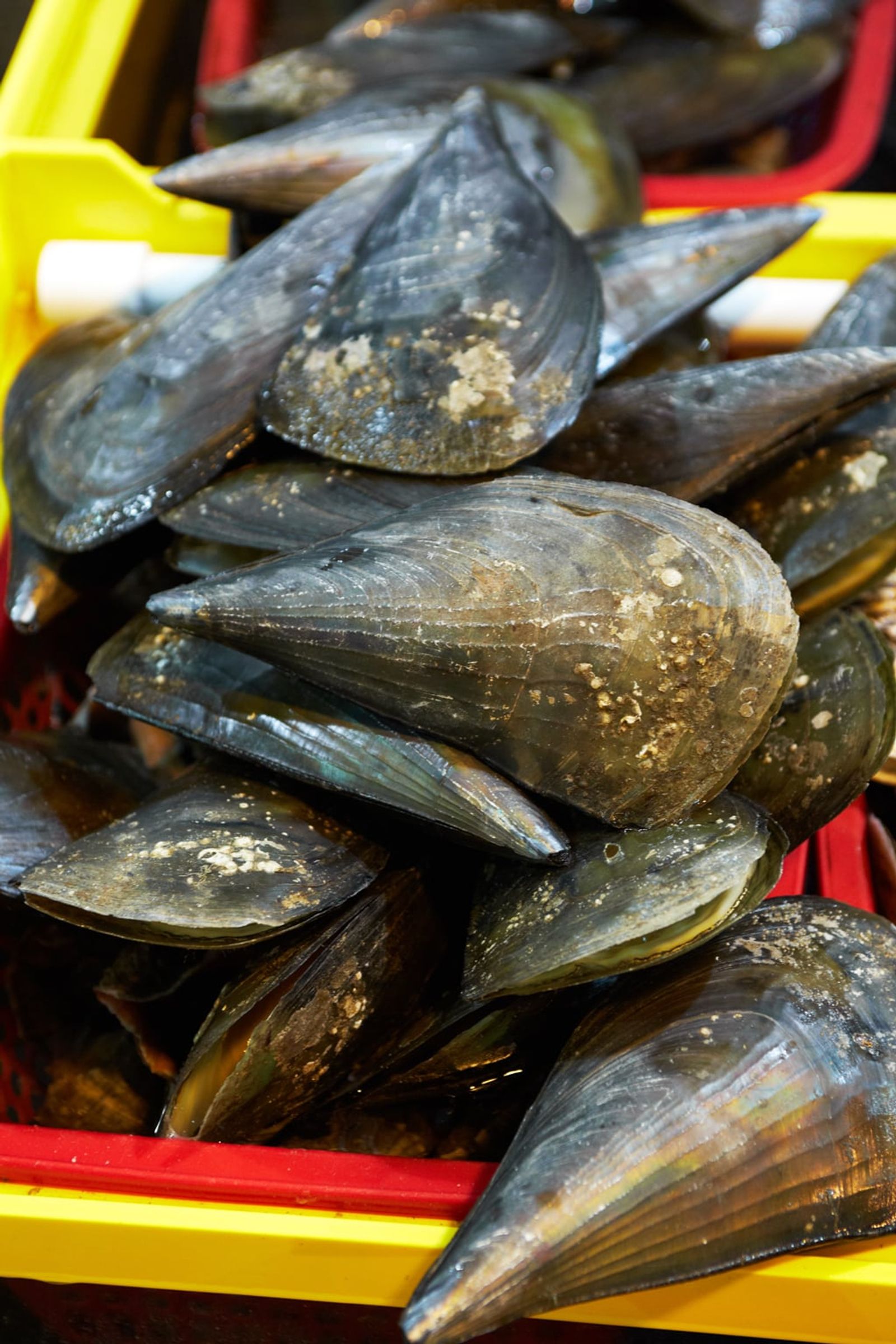
Pen shells (kijogae) · Photo: 국립국어원 (National Institute of Korean Language) / CC BY-SA 2.0 KR (Wikimedia Commons)
 KoreaSouth Chungcheong · Boryeong
Boryeong's Ocheon Port Pen Shells: Where Divers Bring Up Korea's Scallop-Like Adductors
Ocheon Port in Boryeong is said to land 60 to 70 percent of Korea's pen shells, or kijogae. Here is how this winnowing-basket-shaped clam is harvested, the best ways to eat its sweet adductor, when it is in season and tips for visiting the port.
Ocheon, the Pen Shell Kingdom
Ocheon Port sits at the mouth of Cheonsuman Bay in Ocheon-myeon, northern Boryeong. Tucked deep inside the bay, it is sheltered enough that boats can ride out rough seas without a big breakwater, which is why it has long been called a natural harbor. On the hill above the port, the walls of Chungcheong Suyeong Fortress, the Joseon-era headquarters of the region's navy, still stand. The port's signature catch is the pen shell, kijogae in Korean. News reports say Ocheon accounts for 60 to 70 percent of Korea's production, though some put it at 60 percent. The exact share changes from year to year, but nobody disputes Ocheon's nickname, the pen shell kingdom. Oysters, clams and abalone are plentiful too, so the tanks outside harbor restaurants are always full of shellfish.
A Giant Clam Shaped Like a Winnowing Basket
Kijogae takes its name from the ki, a traditional winnowing basket used to toss grain and separate out the chaff. The triangular shell, pointed at one end and fanning out at the other, really does look like one, and large specimens are said to approach 30 cm. It belongs to the same family as the pen shells known in Japan as tairagi. Pen shells live standing upright with their pointed end buried in the muddy seabed. The shell is big, but the prize inside is the large muscle the clam uses to open and close, the adductor, which locals in Ocheon call the eye. Pen shell adductors were once mostly exported to Japan, but they are now widely used in Korea as a premium ingredient.
Down to the Seabed by Diving Boat
Pen shells are not dredged with nets or rakes. According to a 2003 Seoul Shinmun report on Ocheon, every pen shell is gathered by divers who head out on diving-gear boats, locally called meoguri boats, descend 30 to 40 meters to the seabed and pull them up one by one. The work is dangerous and becomes difficult as soon as waves rise, and the article notes that once you know this, the high price makes sense. The same report says harvesting is banned during the July–August spawning season, that pen shells are caught the rest of the year, and that May brings both the biggest catch and the best flavor. Other reports also name spring as the season, and the Ministry of Oceans and Fisheries has featured pen shell as its seafood of the month for June. In short, late spring to early summer is the best time to eat pen shells in Ocheon.
How to Eat the Adductor
Pen shell adductors can be eaten almost any way: raw, grilled, stir-fried or as shabu-shabu. Raw, they are sliced thin and dipped in chogochujang, a vinegared chili paste; when cooking, the trick is to cook them only lightly, since they toughen quickly. If you clean them at home, be sure to cut away the dark innards, where toxins can build up. Kijogae samhap, a trio, is also popular. It is best known as a specialty of Jangheung in South Jeolla, but it is often recommended as a winter treat in Boryeong as well: thinly sliced adductor, beef brisket (chadolbagi) and shiitake are grilled together and wrapped in lettuce. Adductors spoil quickly at room temperature, so cook them right away or freeze them.
If You Go to Ocheon
To reach Ocheon, leave the Seohaean Expressway at Gwangcheon IC, pass through Cheonbuk and cross the Boryeong seawall. Restaurants serving pen shells and seasonal seafood cluster around the port, so you can choose from the tanks and eat right away. Climb toward the walls of Chungcheong Suyeong Fortress for a view over the bay and harbor; the sunset from the coastal lookout is also said to be lovely. Many shops sell cleaned, frozen adductors by the box, perfect for making samhap or grilling at home. Bring a cooler so they do not thaw on the way back. Daecheon Beach is about 30 minutes to the south, so stopping at Ocheon for a pen shell meal fits easily into a Boryeong trip. Remember that July and August are the closed season, so live pen shells may be hard to find then.