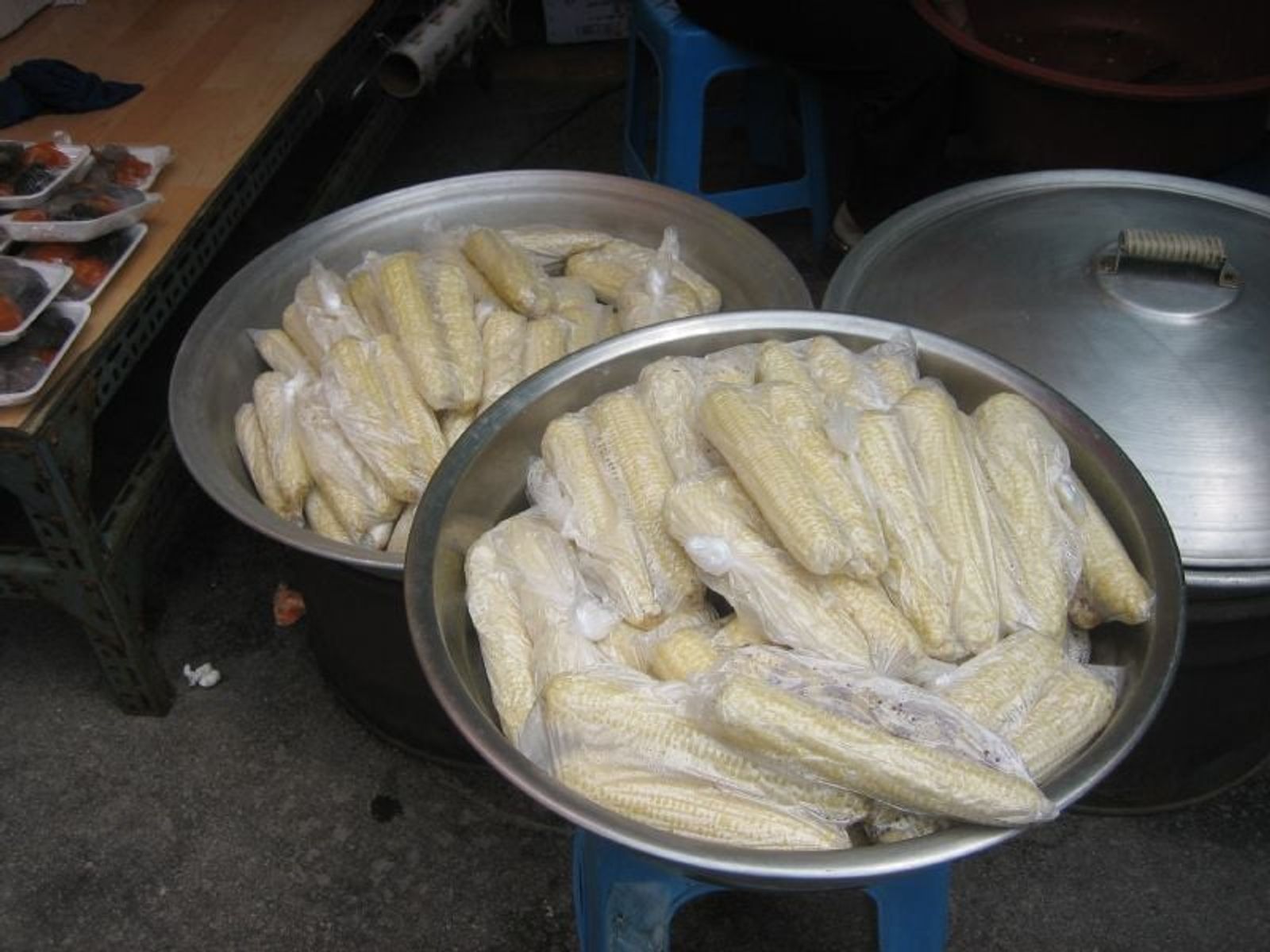
Steamed corn sold at a Korean market · Photo: N-C (Flickr: www.flickr.com/photos/n-c/) / CC BY-SA 2.0 (Wikimedia Commons)
 KoreaNorth Chungcheong · Goesan
Goesan's Daehak Chal-oksusu: The Summer Corn a Professor Bred for His Hometown
Every summer, roadside stalls across Korea put up signs for Goesan daehak chal-oksusu, university waxy corn. Here is why a corn has university in its name, the story of the scientist who bred it for his home village of Jangyeon, what makes it different and when and how to eat it.
Why Is There a University in the Name?
The name daehak chal-oksusu, university waxy corn, might make you picture corn grown on a campus, but it actually means waxy corn developed by a university professor. It began when the late Dr. Choi Bong-ho, a native of Jangyeon-myeon in Goesan County and a professor at Chungnam National University's College of Agriculture, gave the variety he bred to farmers in his hometown. Villagers are said to have chosen the name to thank him. Goesan is a mountainous county in central Chungcheongbuk-do, and university corn now ranks with salted napa cabbage and chili peppers as one of its three signature crops. Each summer, roadside stalls not only around Seoul but all over the country hang signs for Goesan university corn; the name has become shorthand for Korea's favorite summer snack.
Professor Choi and Yeonnong No. 1
Jangyeon is a mountain village. According to Wikitree, Professor Choi wanted to raise the incomes of farmers in his hometown, so he put his training in plant breeding to work on corn. From the 1980s he collected heirloom corn from around the country and crossed them again and again, and after 12 years of research released a variety called Yeonnong No. 1 in 1991. Most sources say Jangyeon farmers began growing it in 1991, though one article puts the start at 1996, so accounts differ. In the early days Choi is said to have loaded a truck with corn and driven around apartment complexes promoting it himself, and to have supplied the seed only to Goesan farmers. His devotion to his hometown has long been a local story; he passed away in May 2025 at the age of 88.
From 10 Farms to 1,500
At first, just 10 farms grew it on 3 hectares, but after it was commercialized in earnest in 1999, cultivation took off. In 2011 Goesan daehak chal-oksusu was registered as Geographical Indication No. 77, and it was named a Power Brand by the Ministry of Agriculture for several years. To protect quality, it is grown only within designated areas so that pollen from other varieties does not mix in, and nearby fields are kept free of other corn varieties. According to the Kyunghyang Shinmun, 1,539 farms recently grew about 9,552 tons on 1,149 hectares, and Wikitree put annual sales at around 30 billion won. Corn that started in Jangyeon, a township of fewer than 2,000 people, has become the signature industry of the whole county. Farm numbers and income figures vary by year and by article, so treat them as a rough guide.
What Makes It Different and How to Eat It
A cob of university corn has 8 to 10 rows of kernels, fewer than the roughly 15 to 17 often cited for ordinary corn. Fewer rows mean a slimmer, longer cob that is easy to hold, and the thin kernel skins get stuck in your teeth less. Like other waxy corn it is chewy and springy, quite sweet, and holds its sweetness relatively long after harvest. That is why Goesan farmers say it is delicious steamed with nothing but a pinch of salt, no sugar or sweetener needed. Steamed corn is best eaten warm, but it is said to come back well even after being cooked, frozen and reheated. If you receive fresh corn by delivery, it loses sweetness as it sits, so steam it right away and wrap any extras individually in plastic and freeze them.
When and Where to Find It
In Goesan the corn is sown in spring, and full-scale harvesting and sales begin around mid-July. Some farms stagger planting to stretch the harvest, so fresh corn is around all summer, and roadside sales sometimes continue until around Chuseok in early autumn. If you visit Goesan, you will easily find stalls selling freshly steamed corn along the roads around Jangyeon and the county seat. Delivery orders are popular too; one report says more corn goes out by courier than is sold on the spot. Newer products such as bread made with corn flour are also being developed. If your summer trip includes Goesan's valley spots such as the Sanmagi Old Road or Hwayang Gugok, take a bag of steamed corn along.