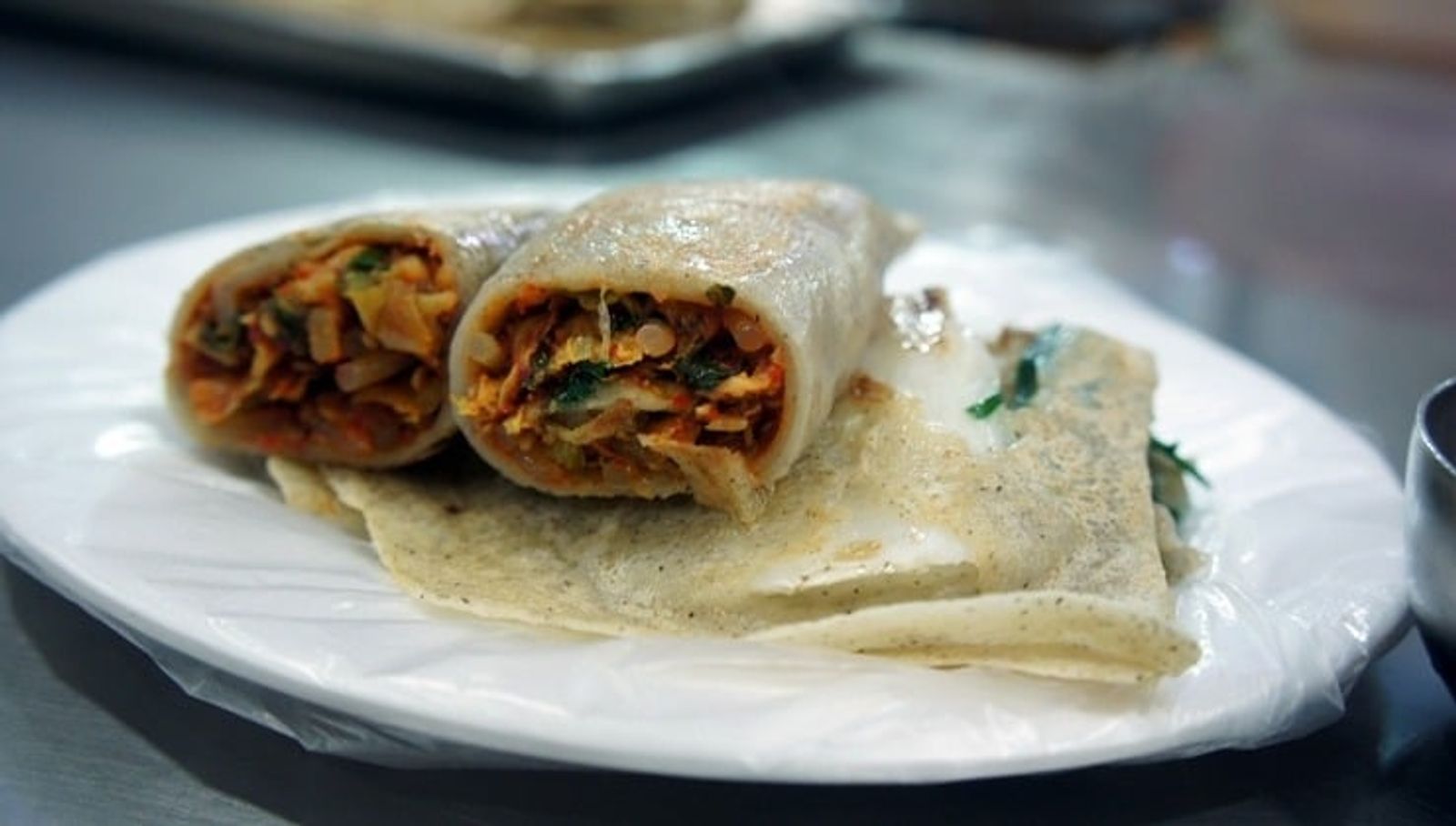
Buckwheat crepes rolled around kimchi filling · Photo: 김다혜 / CC BY 2.0 KR (Wikimedia Commons)
 KoreaGangwon · Pyeongchang
Buckwheat of Bongpyeong, Pyeongchang: Buckwheat Crepes and More in the Market Town of a Classic Korean Story
Bongpyeong in Pyeongchang is the setting of Lee Hyo-seok's short story When Buckwheat Flowers Bloom, and every autumn its fields turn white with buckwheat blossoms. Here is the story behind the town and how to eat its buckwheat food, from kimchi-filled buckwheat crepes (chongtteok) to buckwheat jelly.
A Buckwheat Town Made Famous by a Story
One short story did much to make Bongpyeong-myeon in Pyeongchang County known as buckwheat country: When Buckwheat Flowers Bloom, published in 1936 in the magazine Jogwang by Lee Hyo-seok (1907–1942), who was born here. It follows Heo, an aging peddler who travels from market to market and never misses the Bongpyeong market day because he cannot forget a woman he spent one night with there in his youth. The scene of the peddlers walking eighty li of mountain road from Bongpyeong to Daehwa by moonlight is famous, and since the story has long been in Korean school textbooks, almost every Korean knows it. Thanks to its description of buckwheat blossoms that look "as if salt had been scattered," Bongpyeong became synonymous with buckwheat fields and buckwheat food. The author's birthplace, a literary museum and spots evoking the story's tavern are all nearby.
Why Buckwheat Suits the Gangwon Highlands
Buckwheat is known as a crop that grows well in cool climates and poor soil and matures quickly. In the Gangwon highlands, with few rice paddies and short summers, buckwheat, potatoes and corn long filled the table in place of rice, so noodles, jelly and crepes made from buckwheat became everyday food here. Today there are large buckwheat fields around Bongpyeong; one report says more than 1.7 million square meters surround Lee Hyo-seok's birthplace. The flowers begin to open from late August into early September and peak in September, when you can walk paths between the white fields. Chuncheon's makguksu, also in Gangwon, uses buckwheat too, but what sets Bongpyeong apart is the chance to eat many buckwheat dishes at one table: crepes, jelly and pancakes along with noodles.
What Memil Jeonbyeong (Chongtteok) Is
If you try only one buckwheat dish in Bongpyeong, make it memil jeonbyeong. A thin buckwheat batter is cooked into a crepe on a griddle, then a line of chopped, seasoned kimchi is laid along it and the crepe is rolled up. The kimchi filling is mixed with scallion, garlic, sesame oil and toasted sesame, and some places add seasoned pork, tofu or glass noodles. Buckwheat has little elasticity and tears easily, so making the crepes thin and even takes skill. In Gangwon it is also called chongtteok, and the widely told explanation is that the long rolled shape resembles a rifle barrel (chong means gun). Strictly speaking, some say chongtteok is the version rolled around a filling and jeonbyeong the plain crepe without one. Jeju has a similar dish, bingtteok, rolled around shredded radish instead.
How to Eat It and What to Pair It With
Memil jeonbyeong is best eaten freshly cooked and warm. The wrapper is thin and plain, so the kimchi filling comes through clearly; it is on the spicy side, so if you are sensitive to heat, start by sharing one. Some dip it in soy sauce, and at the market it is often sold in a mixed plate with memil-jeon, a flat buckwheat pancake topped with kimchi or napa cabbage. Bongpyeong restaurants commonly serve a spread of buckwheat noodles with buckwheat crepes, buckwheat pancakes and potato pancakes. Some also offer seasoned buckwheat jelly (memilmuk muchim) or a warm broth with jelly in it. The noodle broth varies a lot from place to place, so on a first visit try ordering one cold noodle soup and one spicy mixed noodle to share and compare. Buckwheat flour and buckwheat tea are popular souvenirs.
When to Go: The Hyoseok Culture Festival and Market Days
For both blossoms and buckwheat food, September is the best time. Since 1999 the Pyeongchang Hyoseok Culture Festival has been held around Bongpyeong-myeon each September, with walks through the buckwheat fields, a food market recreating the story's market scene and literary events. It gets crowded, so weekday mornings are calmer than weekends; check each year's announcement for exact dates. Outside festival time, the Bongpyeong five-day market is said to be held on dates ending in 2 and 7. Time your visit for a market day and you can watch vendors griddling buckwheat crepes and browse buckwheat and wild greens. The Lee Hyo-seok Literary Museum, his birthplace and a spot evoking the story's tavern are nearby, making an easy half-day route. Read the story before you go and the market will look quite different.