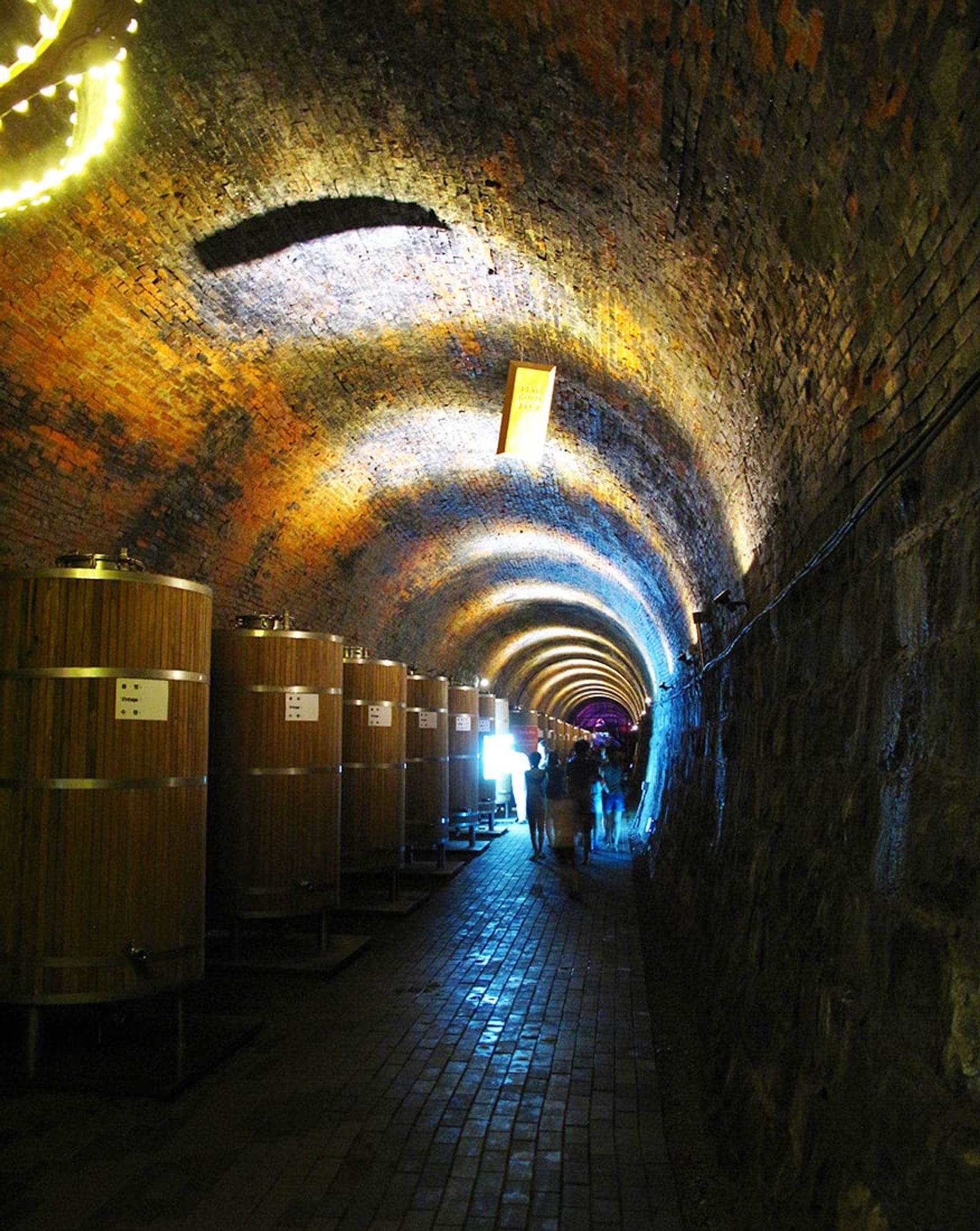
Persimmon wine casks in Cheongdo's Wine Tunnel · Photo: Ken Eckert / CC BY-SA 4.0 (Wikimedia Commons)
 KoreaNorth Gyeongsang · Cheongdo
Cheongdo Bansi: The Secret of Korea's Seedless Flat Persimmon
Cheongdo's bansi persimmon is known for being flat as a tray and having no seeds. Here is its nearly 500-year-old origin story, why it doesn't form seeds, and how to enjoy it as soft hongsi, frozen persimmon, dried slices and persimmon wine, plus the autumn festival.
A Persimmon Flat as a Tray
Cheongdo is a county in North Gyeongsang Province, set in a mountain-ringed basin south of Daegu. Its persimmons are called bansi, written with the character for tray, because they are flat like one. Above all, they have no seeds. Korean press reports describe Cheongdo as the only place in the country that grows seedless persimmons. According to a 2023 article, some 6,000 farming households in the county produce about 33,000 tonnes of persimmons a year, and around 40% are processed into dried slices and other products. In autumn the whole county turns orange. Bansi is an astringent variety, so rather than eating it straight off the tree, the classic way is to let it ripen into soft hongsi.
1545: A Scholar Brings Home a Persimmon Branch
The traditional origin story goes back to the mid-Joseon era. According to local press, in 1545, the first year of King Myeongjong, a scholar named Park Ho from Sewol village in Cheongdo's Iseo-myeon brought home persimmon scions when he returned from serving as magistrate of Pyeonghae (around today's Uljin), grafting them onto Cheongdo's native persimmon trees. One version adds that he got the branches through a friend traveling to Ming China as an envoy. The trees suited Cheongdo's soil and climate and spread. They were first called Sewol bansi after the village, later becoming Cheongdo bansi. Two persimmon trees about 150 years old are said to still stand in Sewol village. It is worth remembering, though, that this origin is a handed-down story.
Why No Seeds? Female Flowers and May Fog
Research found that bansi's seedlessness comes from a combination of variety, terrain and climate rather than a single cause. According to local press, bansi trees mostly bear only female flowers, and there are almost no pollinator trees with male flowers in the area, so fertilization rarely happens. On top of that, Cheongdo's basin is thick with fog in May when the persimmons bloom, which keeps bees from working and stops what little pollen there is from spreading. Interestingly, Cheongdo trees planted elsewhere are said to produce seeds. After about a year of investigation by the Korea Forest Service, Cheongdo bansi was registered as Geographical Indication No. 28 in March 2010. For eaters, the best part is simple: when you scoop a soft hongsi with a spoon, there are no seeds to pick out.
Hongsi, Frozen Persimmon, Dried Slices and Wine in a Tunnel
With soft flesh and plenty of sugar and juice, bansi is ideal as hongsi and very popular frozen as ice hongsi. Because it has no seeds, rather than being dried whole like gotgam it is cut into three or four pieces and dried as gammallaengi, and Cheongdo's dried persimmon slices were registered as Forest Service Geographical Indication No. 62 in 2024. Other products include semi-dried persimmons, gotgam, persimmon vinegar and persimmon-leaf tea. For something different, visit the Wine Tunnel in Songgeum-ri, Hwayang-eup: a former railway tunnel about 1,015 m long, completed in 1904 (some sources say 1898), now used as a persimmon-wine aging cellar and café, with casks lined up along the cool brick walls. Cheongdo persimmon wine was reportedly served at the 2005 APEC dinner in Busan. Check opening hours before you go.
When to Go: The Autumn Bansi Festival
Bansi ripens between September and November. The best time to visit Cheongdo is autumn, especially during the Cheongdo Bansi Festival, held every October since 2006. The festival grounds feature a tunnel hung with ripe persimmons, persimmon-picking, a bansi market and food zones. According to press reports, the 2022 festival, the first after the pandemic, drew an estimated 450,000 visitors over three days. A Cheongdo Bansi marathon is also held in October. Even outside the festival, an autumn drive through Cheongdo's countryside shows tree after tree heavy with orange fruit. Ripe hongsi bruise easily, so if you are taking some home, choose firm persimmons and let them ripen, or buy only what you will eat soon. Dates and venues change every year, so check Cheongdo County's information.