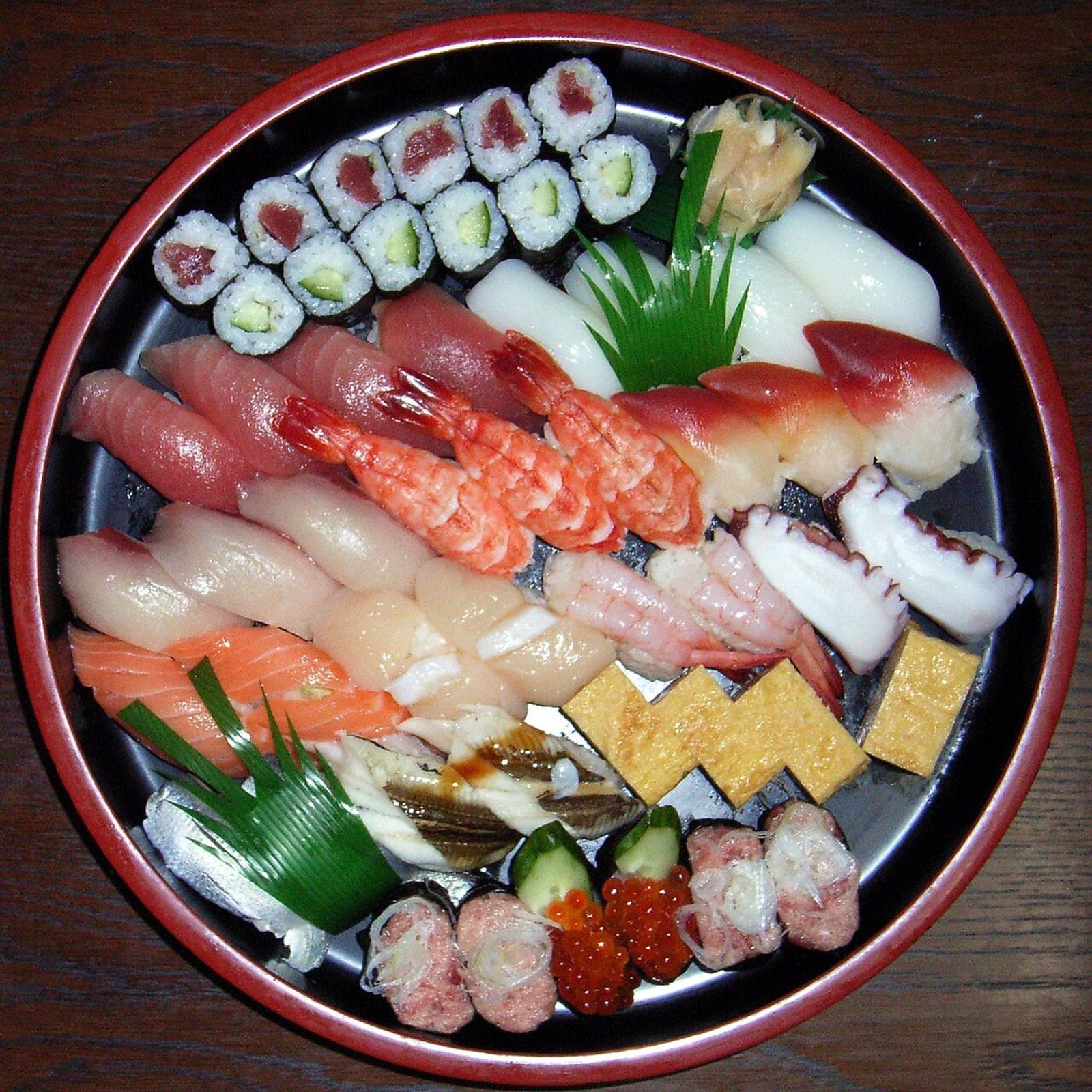
Nigiri sushi
The History of Sushi: From Fermented Preserve to Edo Fast Food to Omakase
Sushi began as fish preserved in fermented rice. Follow how today's nigiri was born at Edo street stalls in the 19th century, how conveyor-belt sushi was invented, and the etiquette to know at an omakase counter.
What Sushi Is: A Dish About Rice, Not Fish
Sushi is vinegared rice — seasoned with vinegar, sugar and salt — topped with or wrapped around fish, seafood, egg or vegetables. Abroad it is thought of as 'raw fish', but in Japan the essence of sushi is the seasoned rice, called 'shari'. Inari-zushi, a fried tofu pouch filled with rice, and chirashi-zushi, rice with toppings scattered over it, are sushi even without raw fish. Styles include nigiri (hand-pressed rice topped with an ingredient), maki (rolled in seaweed), oshi-zushi (pressed in a mold, a Kansai style) and temaki (hand-rolled cones). The topping is called 'neta'; tuna, salmon, shrimp, squid, sea urchin and salmon roe are the classics. The pickled ginger served with sushi, 'gari', is for cleansing the palate between pieces.
Narezushi: Fermented Sushi 1,000 Years Ago
Sushi traces back to a preservation method from Southeast Asia and southern China: fish packed in salt and cooked rice and left to ferment. Lactic fermentation of the rice kept the fish from spoiling, and the rice was discarded when the fish was eaten. The technique reached Japan with rice farming and became 'narezushi', already recorded in 8th-century Nara-period documents. Funazushi (crucian carp sushi), still made around Lake Biwa in Shiga Prefecture, preserves this original form: salted carp is packed in rice and fermented for a year or more, developing a strong, cheese-like smell and sourness. In the Muromachi period (14th-16th centuries) a shorter-fermented 'namanare' emerged in which the rice was eaten too, and in the 17th-century Edo period, mass-produced vinegar gave rise to 'hayazushi' (quick sushi), which used vinegar for sourness instead of fermentation. That is where sushi as a rice dish truly begins.
Edomae: Nigiri Born at the Street Stall
The nigiri we know was born in Edo (today's Tokyo) in the 1820s. A cook named Hanaya Yohei is credited with popularizing bite-size hand-pressed vinegared rice topped with fish. Sushi then was commoners' fast food, eaten standing at street stalls (yatai) with the fingers, and each piece was two or three times today's size. 'Edomae' means 'in front of Edo', the catch from Tokyo Bay. Without refrigeration, fish could not be served plain, so techniques developed: marinating in soy (zuke), curing in vinegar (shime), simmering (ni) and aging between sheets of kelp (kobujime). This preparation, called 'shigoto' (work), is the heart of Edomae sushi, and when a high-end chef asks you not to dip in soy sauce, it is because each piece is already seasoned to suit it. After the 1923 Great Kanto Earthquake, Tokyo's sushi masters dispersed across the country and the Edomae style became the national standard.
The Invention of Conveyor-Belt Sushi and Its Democratization
In 1958 Yoshiaki Shiraishi, owner of Genroku Sushi in Higashiosaka, Osaka, was inspired by a brewery's conveyor belt to send sushi around the restaurant on a moving belt. Letting customers pick plates themselves and billing by plate color slashed labor costs and prices, and the concept spread nationwide after its showcase at Expo '70 in Osaka. Today large chains such as Sushiro, Kura Sushi, Hama Sushi and Kappa Sushi lead the format, with plates starting at 100 to 150 yen. Orders placed on a tablet arrive on a dedicated express lane, and dropping five finished plates into a slot may trigger a prize game. For visitors it is the easiest, most affordable way to sample many kinds of sushi, and menus extend to ramen, udon and desserts. Budget about 1,500 to 2,500 yen per person.
Etiquette at the Omakase Counter
'Omakase' means 'I leave it to you': a menu-less course in which the chef serves the day's best ingredients in a chosen order. Famous Tokyo counters cost over 20,000 to 50,000 yen per person and book out months ahead, but lunch omakase or neighborhood sushi bars offer the experience for 5,000 to 10,000 yen. A no-show is a serious loss for a small shop, so always call ahead to cancel. At the counter, eat each piece as soon as it is placed. Fingers or chopsticks are both fine. Dip the fish side, not the rice, lightly in soy sauce, and eat pre-seasoned pieces as they are. Adding extra wasabi or separating the fish from the rice is considered rude; gari is for cleansing the palate between pieces. Go easy on perfume, ask once before taking photos, and light conversation with the chef is welcome. If there is something you cannot eat (sea urchin, raw fish), mention it when booking and most chefs will adjust.
A Traveler's Guide to Sushi
Depending on budget and taste, there are three tiers. Cheapest are the conveyor-belt chains, family-friendly with English tablets. In the middle are 'tachigui' (stand-and-eat) counters in department-store basements and markets, and neighborhood sushi bars, where 3,000 to 8,000 yen buys chef-pressed sushi. Tokyo's Toyosu Market, the Tsukiji Outer Market and Osaka's Kuromon Market have many sushi shops that open early in the morning. A few menu words help. Maguro (tuna), otoro (fatty tuna belly), chutoro (medium-fatty tuna), sāmon (salmon), ebi (shrimp), ika (squid), tako (octopus), uni (sea urchin), ikura (salmon roe), anago (sea eel), tamago (egg), kappa-maki (cucumber roll), tekka-maki (tuna roll). An 'ichinin-mae' (one-person) set brings 8 to 10 pieces; among the grades 'nami' (regular), 'jo' (superior) and 'tokujo' (special), starting with 'jo' is a safe choice for beginners.