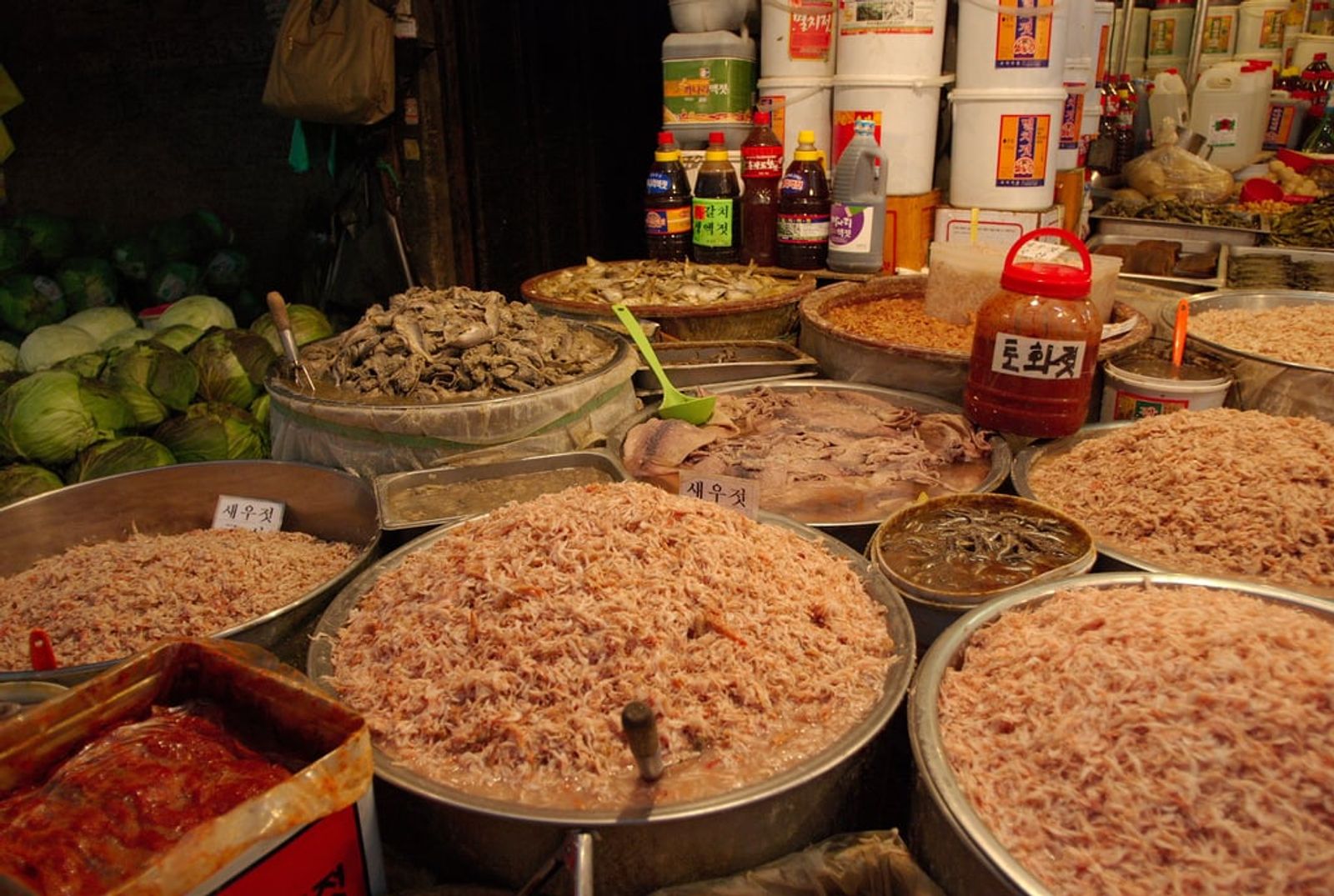
Salted shrimp and other jeotgal on sale at a market · Photo: hwayoungjung / CC BY-SA 2.0 (Wikimedia Commons)
 KoreaNorth Jeolla · Buan
Gomso Jeotgal in Buan: A Salted-Seafood Town Built on a Seawall and Sea Salt
Gomso Port on the south side of the Byeonsan Peninsula is counted among Korea's three great jeotgal (salted seafood) markets. Here is how a seawall linking three islands created the port and its salt pans, why Gomso jeotgal is said to be less salty, and what to buy and how to eat it.
Gomso, One of Korea's Three Great Jeotgal Markets
Jeotgal is Korea's fermented salted seafood: the flesh or innards of fish, shellfish or shrimp, salted and left to mature. It gives kimchi its savoury depth and is also a side dish that makes you eat far more rice than planned. Gomso Port in Jinseo-myeon, Buan, is counted with Ganggyeong and Gwangcheon in South Chungcheong as one of Korea's three great jeotgal markets. A large complex of jeotgal shops and processing plants surrounds the port, reportedly producing more than 7,000 tonnes a year. One report notes that only three or four jeotgal shops existed in the early 1970s, compared with around 60 today. Gomso is also North Jeolla's third-largest fishing port after Gunsan and Gyeokpo.
A Town Born From a Seawall Linking Three Islands
Gomso was once an island. In the last years of Japanese colonial rule, seawalls were built to link three islands, Yeondong, Gomso and Jakdo, and Gomso became a port that boats could use. The reclaimed land behind the seawall, between Yeondong and Gomso, was turned into salt pans. Some accounts say the port was built for colonial extraction, so the town's beginnings carry a painful history too. The Chilsan fishing grounds off Wido Island in Buan were famous for their yellow croaker markets at sea until the 1970s. Croaker boats and other fishing vessels crowded into Gomso, making it a collection point for seafood, and a jeotgal town grew where abundant fish met the salt from the pans next door.
The Secret Is Gomso's Sun-Dried Sea Salt
You cannot talk about Gomso jeotgal without the Gomso salt pans next door. Under Japanese rule they produced boiled salt, made by heating seawater over wood fires, and shortly after liberation they switched to sun-dried sea salt made by sun and wind. A salt warehouse built in 1946 still stands, and the grid of shallow pans yields around 2,000 tonnes of salt a year. In mid-May, the peak of the season, pine pollen blows in from the Byeonsan mountains and settles on the salt crystals, which is why Gomso salt is also known as pine-pollen salt. Jeotgal-making here is said to have begun in the early 1940s, when the new salt pans made sea salt available. Many say this salt is why Gomso jeotgal is described as 'not too salty, almost sweet'.
What to Buy: From Yellow Croaker to Hairtail Innards
At Gomso you can see countless kinds of jeotgal in one place: salted shrimp, anchovy sauce, pollock roe, squid, short-neck clam and other shellfish. The most Gomso-like experience, though, is trying the varieties that Jeolla people love. Top of the list is hwangseogeojeot, made from a small croaker that Jeolla locals call hwangsaegi. Hairtail is used whole: its innards become galchi-sokjeot, intensely savoury, and its body becomes galchijeot. Dombaejeot (jeoneo-bamjeot), made from gizzard shad innards, is another Jeolla favourite. Many shops offer tastings, so sample a few before you choose. In summer, bring a cool box or use a delivery service to be safe.
Eating It the Gomso Way, and the Autumn Festival
The simplest way to enjoy jeotgal is with rice. When you have no appetite, a spoonful stirred into a bowl of hot white rice is said to be all you need, which is why jeotgal is known as a classic 'rice thief'. Around the port, restaurants serve jeotgal set meals with several kinds as side dishes, and set meals built around baby hairtail (pulchi), named for its resemblance to a long blade of grass. The Gomso Jeotgal Centre has exhibition and hands-on spaces, and has run activities such as making salt mixed with mulberries, mulberry leaves and glasswort. In autumn the Gomso Jeotgal Fermentation Festival offers kimchi-making with jeotgal and discount sales; dates change every year, so check ahead.