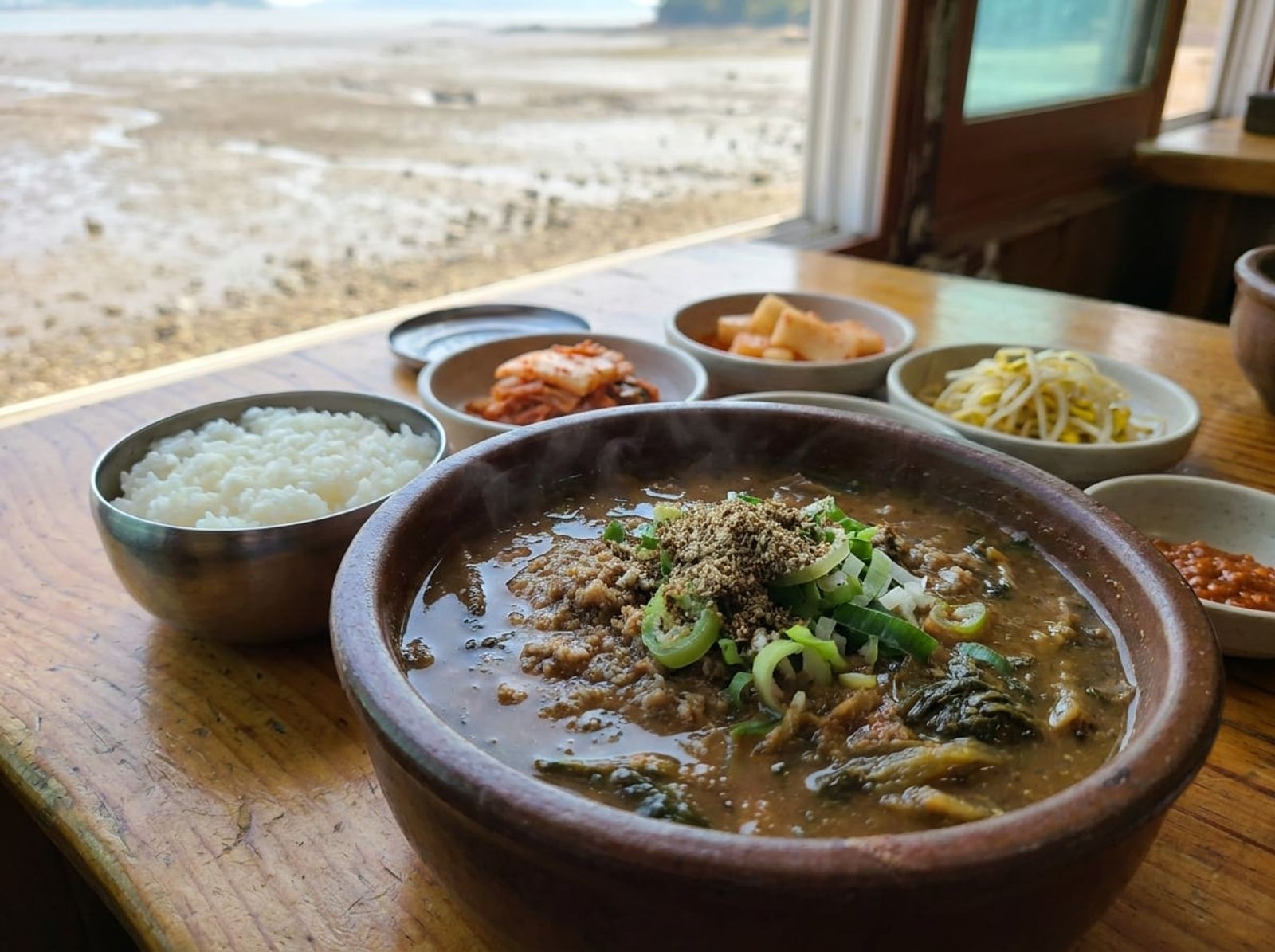
Suncheon Bay Jjangttungeo-tang
 KoreaSouth Jeolla · Suncheon
Suncheon Bay Jjangttungeo-tang: A Hearty Stew Made From the Mudflat's Hopping Fish
On the mudflats of Suncheon Bay lives jjangttungeo, a mudskipper that crawls across the mud on its fins. Here is what jjangttungeo-tang tastes like, how it is made from a fish that hibernates and is hard to farm, and what to know before ordering it by the bay.
Jjangttungeo, the Dancer of the Mudflats
Jjangttungeo is a goby-family fish, Boleophthalmus pectinirostris, growing to about 18 cm. Its eyes pop up on top of its head, and at low tide it hops and crawls over the mud on its pectoral fins, which has earned it the nickname "dancer of the mudflats." The 19th-century fish guide Jasan Eobo by Jeong Yak-jeon is said to record it as cheolmogeo, "the fish with protruding eyes." At low tide it breathes partly through its skin and grazes on diatoms on the mud surface; when the tide comes in it retreats into a burrow it has dug. Because it is sensitive to environmental change, it is regarded as an indicator of a clean mudflat. Suncheon Bay is famous for its reed beds and vast flats, and the Boseong-Suncheon tidal flats are part of the Getbol, Korean Tidal Flats, listed as a UNESCO World Natural Heritage site in 2021. Suncheon City presents the stew made from this fish as a local specialty.
A Fish That Hibernates and Is Caught One by One
Jjangttungeo hibernates. According to a Korean study, it comes out onto the mud from May to November, while the water stays above 16°C, and spends the rest of the year hibernating in its burrow. Its season therefore runs from summer, when it is most active, into autumn, and many people rate autumn, when the fish fatten up before winter, as the tastiest time. It is difficult to farm, so what you eat is still wild-caught from the flats. The fish are clever at dodging nets, and skilled locals catch them one at a time with a snagging line, so the catch never comes easily. Because it is scarcer than loach, people here sometimes rank jjangttungeo-tang a cut above chueotang, the better-known loach soup.
How the Stew Is Made
At a glance jjangttungeo-tang looks a lot like chueotang, Korean loach soup. A common method is to simmer the cleaned fish until soft, grind them bones and all or press them through a sieve to collect the flesh and broth, then dissolve doenjang soybean paste into it and simmer it thick with dried radish greens or cabbage leaves, radish and squash. Some cooks add perilla seed for nuttiness, and garlic and chili powder round it out. Other places simmer the fish whole instead of grinding them. Here cooks are split between removing only the gallbladder and leaving the innards, or cleaning out all the innards. Many describe the stew as lighter and more mellow than loach soup because it is seasoned more gently, and its clean, warming broth makes it a popular hangover cure. Besides the stew, jjangttungeo is eaten as a hot pot, grilled, as roughly cut raw slices and deep-fried.
How It Became Suncheon Bay's Specialty
Jjangttungeo has long been eaten in mudflat villages along Korea's south and west coasts, and the stew is made in many parts of South Jeolla, including Yeongam, Suncheon, Sinan and Haenam. An old saying holds that it tastes especially good when the barley ripens, and another claims that eating a hundred of them will keep colds away, which shows how it was valued as a strengthening food. Such benefits are folk belief, of course. In Suncheon the stew became a travelers' dish fairly recently. According to one report it became known as a Suncheon Bay specialty after being featured in the media in the 1980s, and as the Suncheon Bay wetland grew into a major attraction, a bowl of jjangttungeo-tang after walking the reed beds became almost a fixed part of a Suncheon trip. The real appeal is seeing the mudflat with your own eyes and then tasting a fish that came from it.
Where and How to Eat It
Jjangttungeo-tang is easy to find at restaurants around the Suncheon Bay wetland. Near the wetland entrance several places serve it alongside other southern mudflat dishes such as a cockle set meal, so if you are in a group you can order different dishes and share. It is usually ordered per person and comes with rice and Jeolla-style side dishes. If it is your first time, taste the broth on its own first, then adjust it a little with the condiments on the table if it seems mild. It has almost no fishy smell and a nutty, earthy taste, so anyone who enjoys loach soup will take to it easily. You can watch the fish hopping on the mud from the boardwalks of Suncheon Bay during the daytime in warm months when the tide is out, so plan a reed-bed walk and a meal together. In winter the fish are hibernating in their burrows, so you are unlikely to see them on the mud.