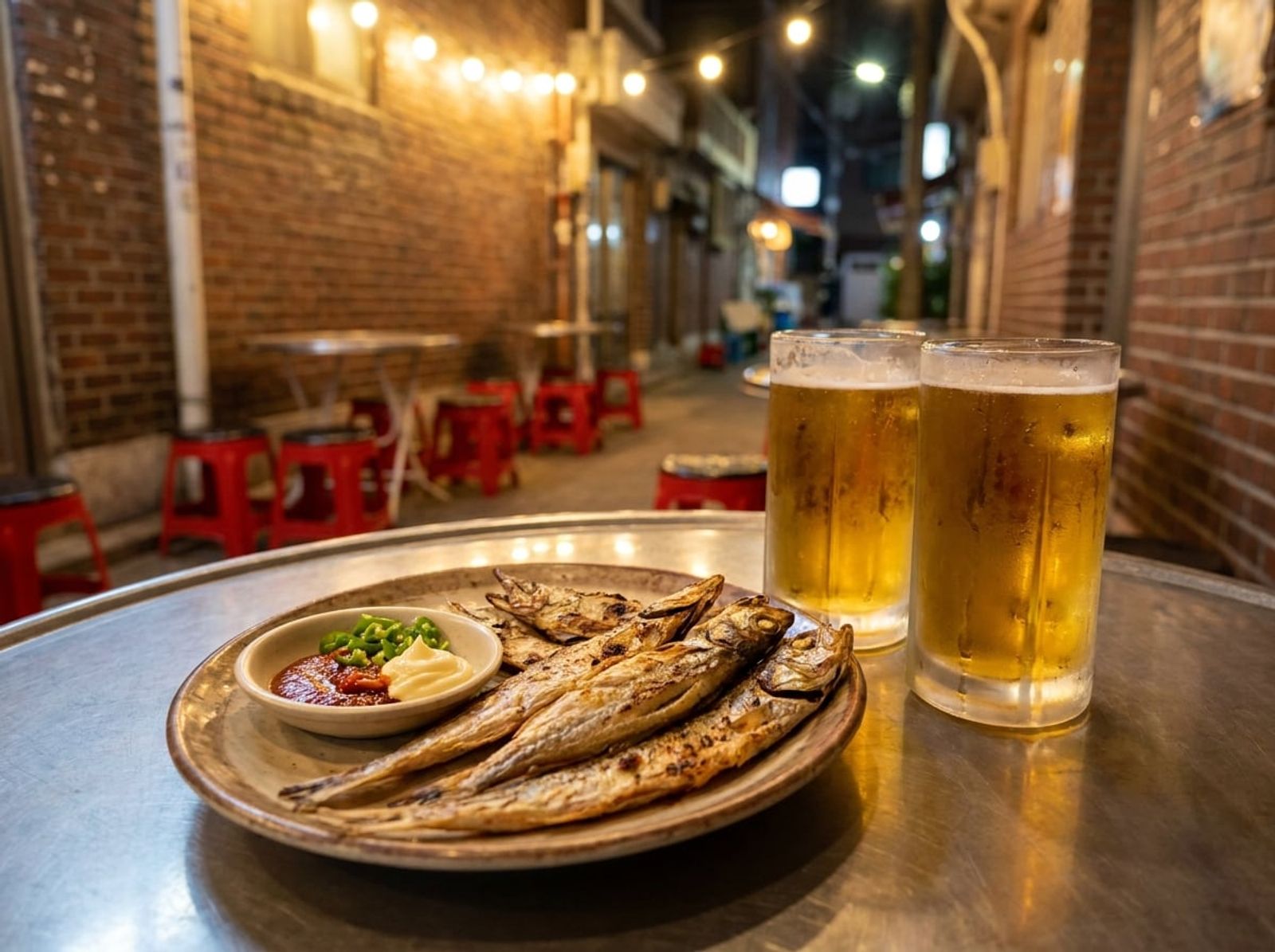
Euljiro's Nogari Alley
 KoreaSeoul
Euljiro's Nogari Alley: How Draft Beer and Dried Baby Pollack in a Printing District Became Seoul Heritage
After dark, plastic stools spill into a narrow alley in Euljiro 3-ga and trays of draft beer and grilled nogari start moving. Here is how one beer hall opened in 1980 grew into a Seoul evening institution, what nogari actually is, and what to know before you go.
A Beer Alley in the Middle of the Printing District
Nogari Alley sits off Exit 4 of Euljiro 3-ga Station on Seoul Subway Lines 2 and 3. For decades the Euljiro area has been a working district crammed with print shops and tool and lighting stores, and tourism guides describe it as once being Korea's largest printing street. Print workers who toiled late into the night to meet deadlines would stop on the way home for a draft beer with nogari, and beer halls multiplied to serve them until the street became a nogari-and-beer alley. The scene comes alive on weekday evenings. By day it is an ordinary lane with its shutters down, but once office hours end, tables spread right into the street and fill with people, which is why some call it 'Korea's Oktoberfest.'
It Started With One Beer Hall in 1980
The alley's starting point is usually traced to a draft beer hall opened in 1980 as a Seoul franchise of a beer company. Sources disagree on whether it opened in November or December. Back then ordinary people drank soju and makgeolli, draft beer was unfamiliar, and business was reportedly slow at first. According to the weekly Kyunghyang, in 1981 regulators ruled that beer companies could not supply bar snacks to their outlets, and the founder picked nogari as a snack he could sell cheaply, at 100 won a fish. Cheap nogari and cold draft beer suited the printing-district crowd, similar beer halls opened one after another, and the alley took shape. A Seoul city outlet also traces the roots further back, to a liquor wholesaler's warehouse selling cheap beer in the mid-1970s.
So What Is Nogari?
Nogari is the name for young Alaska pollock, and as a bar snack it is usually served semi-dried. In the 1940s pollock was Korea's most common fish, with hundreds of thousands of tonnes landed in the East Sea, but heavy fishing of the young nogari combined with warming seas means Korea now imports most of it. The nogari you eat in the alley is almost certainly imported. Pollock is also famous for changing its name with its condition: frozen it is dongtae, half-dried kodari, dried white baektae, and the young fish is nogari. Guides to the alley say that in the early days nogari was grilled over coal briquettes and served with gochujang. Today the grilling and the dipping sauces vary a little from bar to bar.
Becoming Seoul Future Heritage, and What Changed
In 2015 the Seoul Metropolitan Government designated Nogari Alley a Seoul Future Heritage site, a programme that picks places carrying shared memories and feelings worth passing on to the next generation. Around 2017 and 2018 a retro boom brought in crowds of young people, and Euljiro picked up the nickname 'Hipjiro.' Even the famously cheap nogari changed. According to the weekly Kyunghyang, the alley's bars sold a fish for 1,000 won for about 20 years before raising it to 1,500 won in May 2021, still below cost, they said. Around the same time the alley's first beer hall faced eviction in a lease dispute with its landlord, a sign that even a heritage-listed street is not immune to redevelopment and rising rents. The mix of bars shifts from year to year, so check the current situation before you go.
Before You Go
Nogari Alley is an evening place, so in the daytime you may find almost nothing open. Hours and closing days vary by bar, and there is no parking, so take the subway. Seats fill fast right after work on weekdays and on fine Friday evenings, so arrive a little early or late if you want a table. The standard order is draft beer and nogari. Many bars now also serve fried chicken, stews and fried snacks, so you can make a meal of it. Street tables are cramped and the lane is busy, so travel light. Take a walk through the surrounding print shops and old tool arcades of Euljiro too; it makes it much easier to feel why this alley came to be.