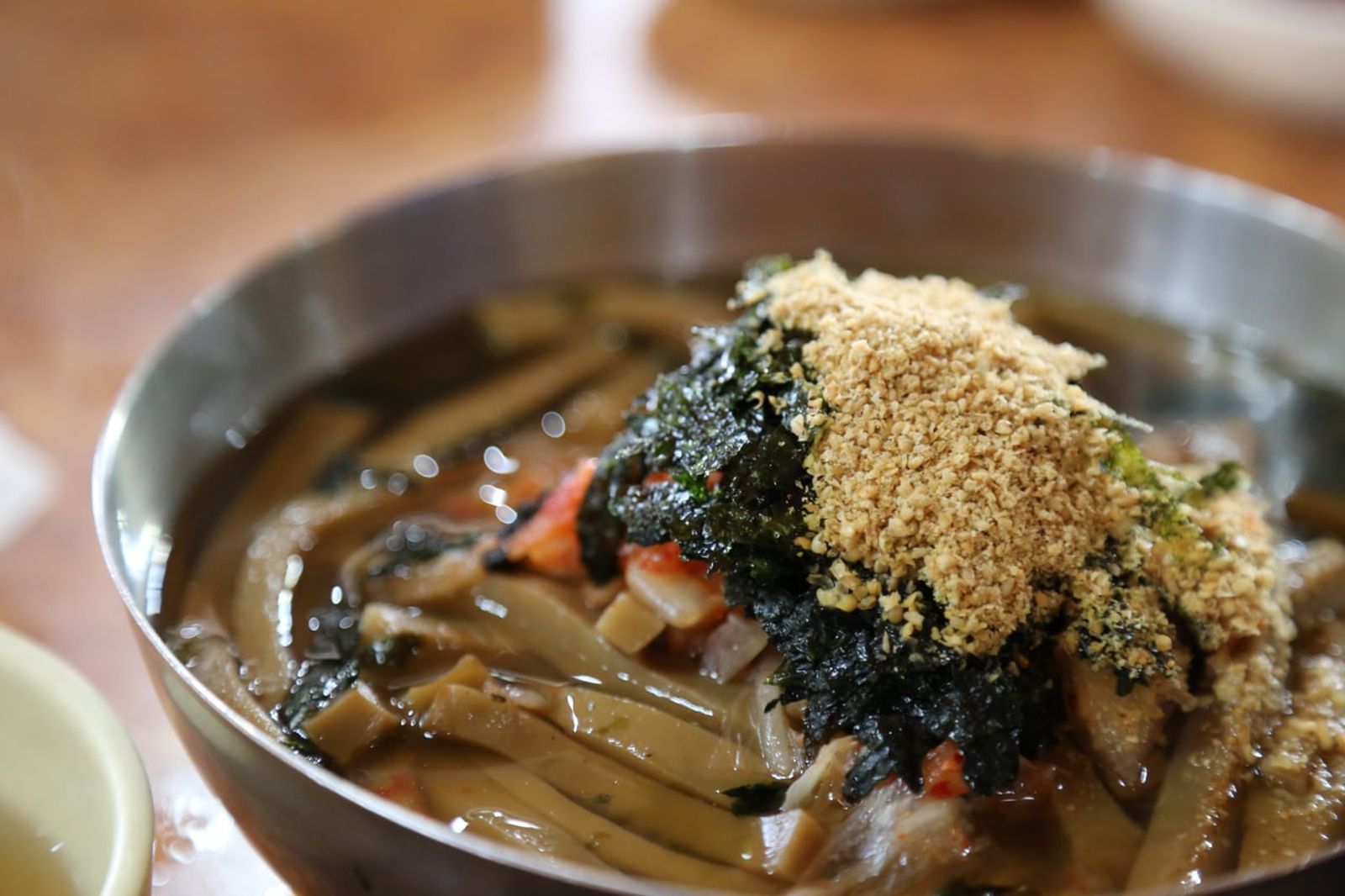
A bowl of Gujeuk acorn jelly in Daejeon · Photo: Ryan Bodenstein / CC BY 2.0 (Wikimedia Commons)
 KoreaDaejeon
Daejeon's Gujeuk Acorn Jelly: From a Poor Village's Side Job to a City Signature
In northern Yuseong-gu, Daejeon, a 'jelly village' serves acorn jelly cut into finger-thick strips in anchovy broth. Here is how Gujeuk acorn jelly grew from a 1980s farm side job into one of Daejeon's Six Flavours, how it is made and eaten, and where to find it now.
A Jelly Village Born of Hardship
Gujeuk is the old name of a village in northern Yuseong-gu, roughly today's Bongsan-dong. According to the Kyunghyang Shinmun's 'Tastes of Korea' series, villagers gathered acorns on the hills behind their homes to make jelly, selling it at market or eating it at home just to get by. That is why Gujeuk acorn jelly is described as a dish born not as a delicacy but out of poverty. From the early 1980s more households began making and selling it, and the place came to be called 'jelly village.' The local outlet DTNews24 likewise says the Gujeuk jelly village grew out of Bongsan-dong farm households making acorn jelly as a side business in the lean years of the 1980s. When the 1993 Daejeon Expo came, it was designated a local speciality, and by 2003 about 30 jelly restaurants were operating there. A neighbourhood side job had grown into a city signature.
From Acorn to Jelly
Acorn jelly takes a lot of work. According to the Kyunghyang Shinmun, the acorns are shelled, dried and pounded into powder in a mortar. The powder is soaked in water for four to five days to draw out the bitterness, and how well that astringency is removed makes or breaks the flavour. The top water is poured off, and the settled starch goes into a big pot over the fire, stirred constantly so it does not stick, until it thickens. Poured into moulds and cooled, it sets into a springy jelly. Acorns from the jolcham oak are considered the best. Grinding, days of soaking and long stirring mean a single slab of jelly takes real effort. That farm families made a side living from it also reflects a kind of thrift: turning acorns picked up on the hillside into food rather than letting them go to waste.
Gujeuk Style: A Bowl You Eat With a Spoon
Gujeuk's signature is jelly served in broth. According to the Kyunghyang Shinmun, the jelly is cut into long, finger-thick strips, placed in a broth of anchovy, kelp and radish, and topped with chopped kimchi and laver. It comes in a deep bowl so you can eat it with a spoon. Because the strips look like noodles, some call it muk-guksu, 'jelly noodles,' though menus usually just say dotorimuk. Cool anchovy broth, faintly bitter jelly, tangy kimchi and toasty laver come together in each spoonful. It is light and mild, ideal for an easy meal.
Jelly Salad, Jelly Pancakes and Dongdongju
At a jelly house you can order more than the broth bowl. The Kyunghyang Shinmun lists dotorimuk-muchim, jelly tossed in a seasoning of soy sauce, scallion, sesame oil, red pepper powder and sesame salt, and muk-buchimgae, pan-fried jelly. Gujeuk's jelly houses often served home-brewed dongdongju rice wine and tofu alongside. A broth bowl plus a jelly salad or pancake and a bowl of dongdongju makes a good spread for a group. In 2003 a broth bowl cost about 3,000 won, a measure of how cheap and everyday this food was; prices have risen since, but it is still considered an easy, affordable meal.
Where to Eat It Today
The original Gujeuk jelly village disappeared with redevelopment around Bongsan-dong, and a new jelly village was set up around Gwanpyeong-dong near the Bukdaejeon IC, where there is also a centre offering acorn-jelly-making experiences. Sources list jelly houses variously in Bongsan-dong, Gwanpyeong-dong and Songgang-dong, and businesses change from year to year, so check opening status and location on a map before you go. Gujeuk acorn jelly was one of the 'Six Flavours of Daejeon' chosen by the city in 2000: Sutgol naengmyeon, Gujeuk acorn jelly, Daecheong Lake freshwater fish stew, samgyetang, dolsot-bap and seolleongtang. In April 2026, after a public survey, Daejeon replaced them with the 'Three Tastes of Daejeon': bread, kalguksu and dubu-duruchigi. The official list has changed, but after 26 years as a city signature, Gujeuk acorn jelly still comes up whenever people talk about Daejeon's local food.