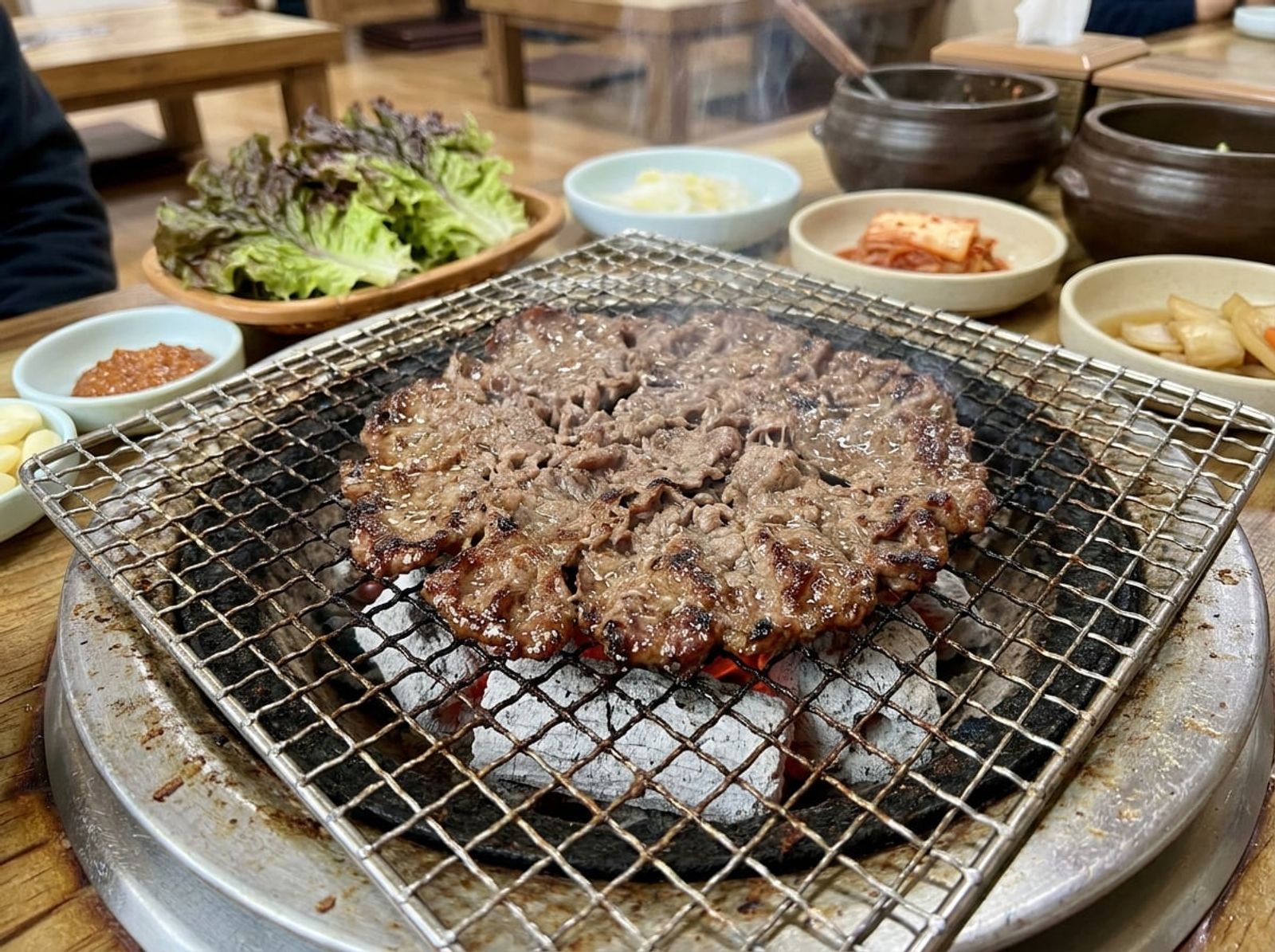
Ulsan's Eonyang Bulgogi
 KoreaUlsan
Ulsan's Eonyang Bulgogi: Broth-Free Korean Beef Grilled on a Wire Rack
In Eonyang-eup, Ulju-gun, Ulsan, a street of restaurants grills thin slices of marinated Korean beef on wire racks over charcoal. Here is how it differs from brothy Seoul-style bulgogi, why it took root in Eonyang, how to eat it and what to check when ordering.
Brothy Bulgogi vs. Grilled Bulgogi
Say bulgogi in Korea and most people picture the Seoul style, cooked on a domed pan in a shallow pool of broth. But there is also a family of grilled bulgogi, laid on a wire rack directly over charcoal, and its best-known examples are Gwangyang bulgogi from South Jeolla and Eonyang bulgogi from Ulsan. Eonyang bulgogi has no broth. Thin slices of marinated Korean beef are spread on a grill rack and cooked over charcoal, so the outside picks up a light smoky char while the inside stays tender. A 2014 Seoul Shinmun article notes that it uses as little seasoning as possible to let the beef speak, and cites the view that it developed from neobiani, a royal-court grilled beef. It shares the name bulgogi, but in Eonyang the dish wins on fire, not broth.
Why Eonyang? A Town of Cattle and Butchers
Eonyang is a town in Ulju-gun on Ulsan's western side, ringed by the mountains known as the Yeongnam Alps. According to the Korea School Meal Newspaper, Eonyang-eup had a slaughterhouse and butcher shops from the Japanese colonial period, and easy access to beef laid the groundwork for Eonyang bulgogi. A 2014 Seoul Shinmun article says Eonyang bulgogi uses beef from three- to four-year-old cows, cooked within 24 hours of slaughter. In 2006 Eonyang was also designated Korea's first special zone for Hanwoo bulgogi. Good cattle close by and fresh beef used straight away were what set Eonyang apart.
Highway Workers Spread the Word
No document shows exactly when Eonyang bulgogi began, but several sources point to the same turning point. Korea.kr and the Korea School Meal Newspaper say that from the 1960s, workers who gathered around Eonyang to build highways tasted the local beef and started spreading the word. A 2014 Seoul Shinmun article puts the tradition at about 60 years, so the starting date varies a little between sources. As bulgogi restaurants clustered in Eonyang-eup, today's Eonyang bulgogi street took shape.
Thin Slices, Pear Marinade, White Charcoal
Eonyang bulgogi is thinly sliced beef marinated and then spread on a wire rack over charcoal. The government's Korea.kr briefing describes it as a local dish of thin beef marinated in pear and onion juice and grilled over charcoal. The Korea School Meal Newspaper lists soup soy sauce, sugar, minced scallion and garlic, honey, corn syrup, sesame oil and black pepper among the seasonings, and describes grating pear over the beef and letting it sit for about 30 minutes before mixing in the sauce. The fire matters too. According to the Seoul Shinmun, Eonyang cooks grill over white charcoal (baektan) to keep the heat steady. With light seasoning and thin slices, the beef cooks in moments and toughens if left too long, so eat it as soon as the surface is done. The grill marks and charcoal aroma are what make Eonyang bulgogi its own thing.
Where to Eat It and What to Check
The Eonyang bulgogi street is around Seobu-ri in Eonyang-eup, Ulju-gun. Some guides suggest eating it with minari (water dropwort), a Ulsan speciality, so if it is on the menu, give it a try. The Eonyang Hanwoo Bulgogi Festival, suspended after 2016, returned on 9 to 11 October 2026 after a decade. It then emerged that beef raised in other regions had been sold at the festival, causing a stir, and Ulju-gun said it would secure more local hanwoo. The episode shows that the name 'Eonyang bulgogi' does not necessarily mean cattle raised in Eonyang. If origin matters to you, check the posted origin and grade labels before ordering.