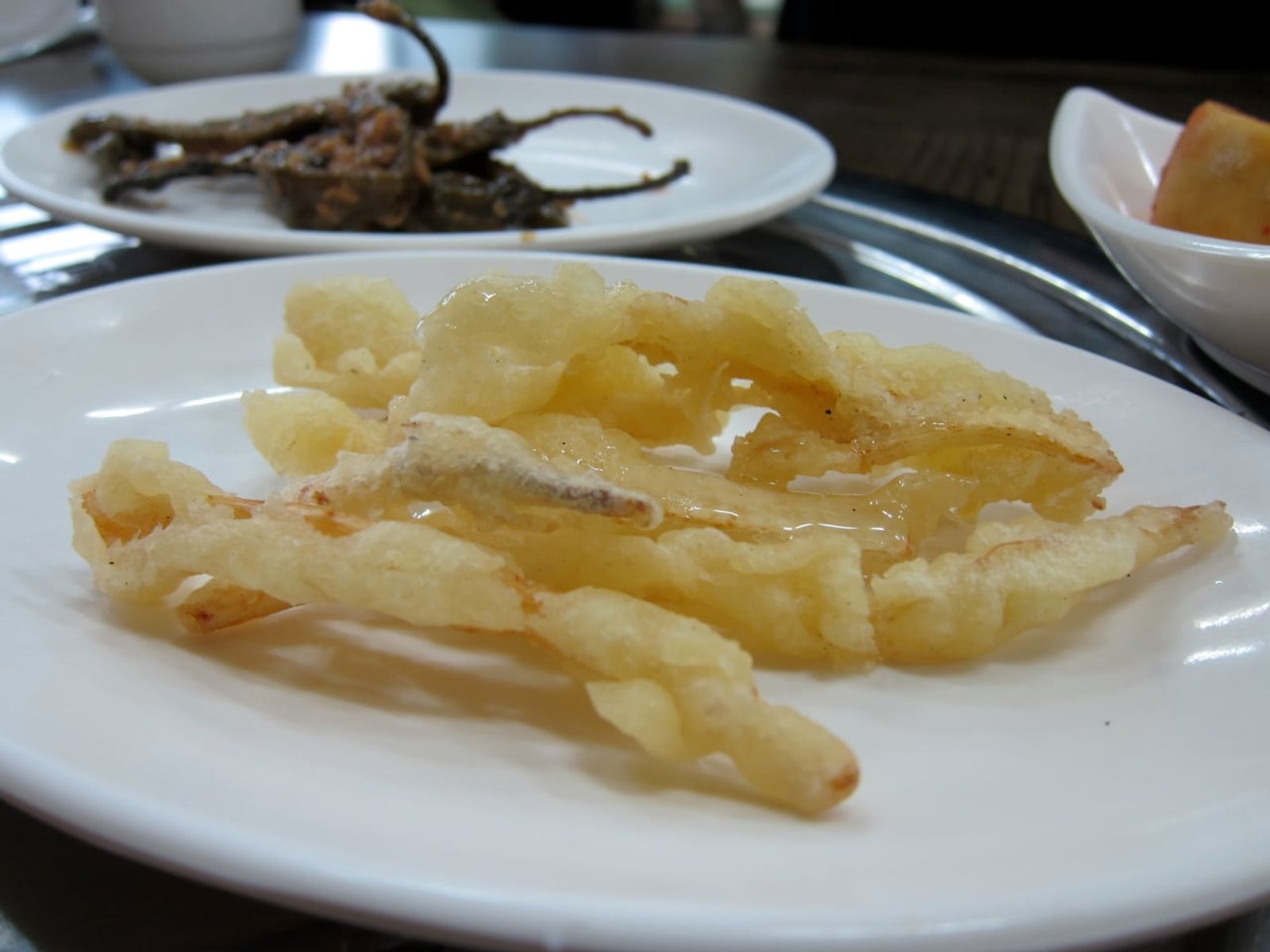
Insam twigim: whole fresh ginseng, battered and fried · Photo: Eugene Kim / CC BY 2.0 (Wikimedia Commons)
 KoreaSouth Chungcheong · Geumsan
Geumsan Ginseng: A 1,500-Year-Old Legend and a Plate of Fried Ginseng
For many Koreans, ginseng simply means Geumsan in South Chungcheong Province. Here is the legend of the filial son who first planted it, the hillside fields recognized as a Globally Important Agricultural Heritage System, the market and autumn festival where ginseng from all over the country gathers, and how to enjoy it, starting with whole fried fresh ginseng.
The Filial Son and the First Ginseng Field
Geumsan's own story of ginseng begins with a folk tale about 1,500 years old. A man known as Gang Cheosa, who lived in what is now Nami-myeon, prayed for 100 days in Gwaneumgul Cave to cure his widowed mother. A mountain spirit appeared in his dream and showed him a plant; he brewed its root for her and she recovered. He is said to have planted its seeds in the village, and that, the story goes, is how ginseng farming in Geumsan began. The spot where he first planted it is called Gaesamteo, and every year the Gaesamje rite held there opens the ginseng festival. The Rural Development Administration's webzine notes that the tale is not only about a son's devotion being rewarded but also about wanting to share a good medicinal plant with others. It is a legend, but it says a lot about how Geumsan feels about ginseng.
Hillside Fields and Shade Roofs
Drive through Geumsan and you will keep seeing fields on the hillsides covered with slanted black shade screens. According to the Rural Development Administration's webzine, Geumsan's ginseng fields usually face north or northeast, so they get less harsh sun and the breeze keeps temperatures down. The shade frames are angled to match the slope, a method old enough to appear in late Joseon records. Ginseng exhausts the soil, so after a harvest the field is rotated to other crops and green manure before ginseng is planted again, a practice called "rotational shifting cultivation." Ginseng is grown in rice paddies too; rice straw was used for the shades and fallen leaves from the hills for compost. In the past the roots were bent and dried as goksam, so people often spoke of "Geumsan goksam."
A World First for Ginseng: Agricultural Heritage
In July 2018 the UN Food and Agriculture Organization (FAO) listed Geumsan's traditional ginseng agriculture as a Globally Important Agricultural Heritage System. Korea's agriculture ministry said it was the first ginseng system in the world to be listed. The FAO praised the nature-friendly use of hillside land through rotational shifting cultivation, the shade-farming method that weighs the direction of sunlight and the flow of air, and gaegap, a traditional treatment in which seeds are layered with gravel and sand and watered to speed up germination. Village rites such as the Samjangje, held to pray for a good ginseng harvest, were also recognized for their cultural value. The Rural Development Administration's webzine adds that traditional fields keep enough moisture for amphibians and reptiles while exposing them to fewer pesticides. In other words, it was a whole agricultural landscape of fields, hills and customs that won recognition, not just a root.
The Market Where Ginseng Gathers, and the Autumn Festival
Geumsan is where Korea's ginseng comes together. In 2015 the Seoul Shinmun described its ginseng and herb market, with some 1,500 shops, as the largest of its kind in the country. How much of Korea's ginseng passes through depends on the source: the Seoul Shinmun puts it at 70% of the trade, while Korean Wikipedia says 80% of production is traded here. Autumn brings the festival. According to the Seoul Shinmun, it began on 1 October 1981 as the Geumsan Ginseng Rite, marking the rediscovery of Gaesamteo. It became the Geumsan Ginseng Festival from its 17th edition in 1997 and the Geumsan World Ginseng Festival in 2023. A record 1.15 million people reportedly came in 2024. The 2025 edition ran from 19 to 28 September around the World Ginseng Expo plaza and the ginseng and herb street, so check the dates each year.
From Fried Ginseng to Ginseng Fish Porridge
Start with insam twigim, whole fresh ginseng dipped in batter and deep-fried. In 2024 the Seoul Shinmun reported crowds at the festival lining up for fried ginseng along with ginseng makgeolli, ginseng bread and red ginseng lattes. Crisp outside and pleasantly bitter inside, it is an easy way in even if you find ginseng's bitterness unfamiliar. For a filling meal there is insam eojuk, ginseng fish porridge. The Seoul Shinmun (2015) describes it as a local dish of the Geumgang riverside around Cheonnae-ri in Jewon-myeon: freshwater fish from the upper Geumgang, such as mandarin fish, catfish, carp and crucian carp, are simmered for a long time with ginseng and thickened with hand-torn dough or noodles. There is a ginseng fish-porridge village around Cheonnae-ri, and it goes well with dori-baengbaengi, small minnows pan-fried crisp in a spicy glaze. A market stroll followed by porridge by the river covers Geumsan's flavors nicely.