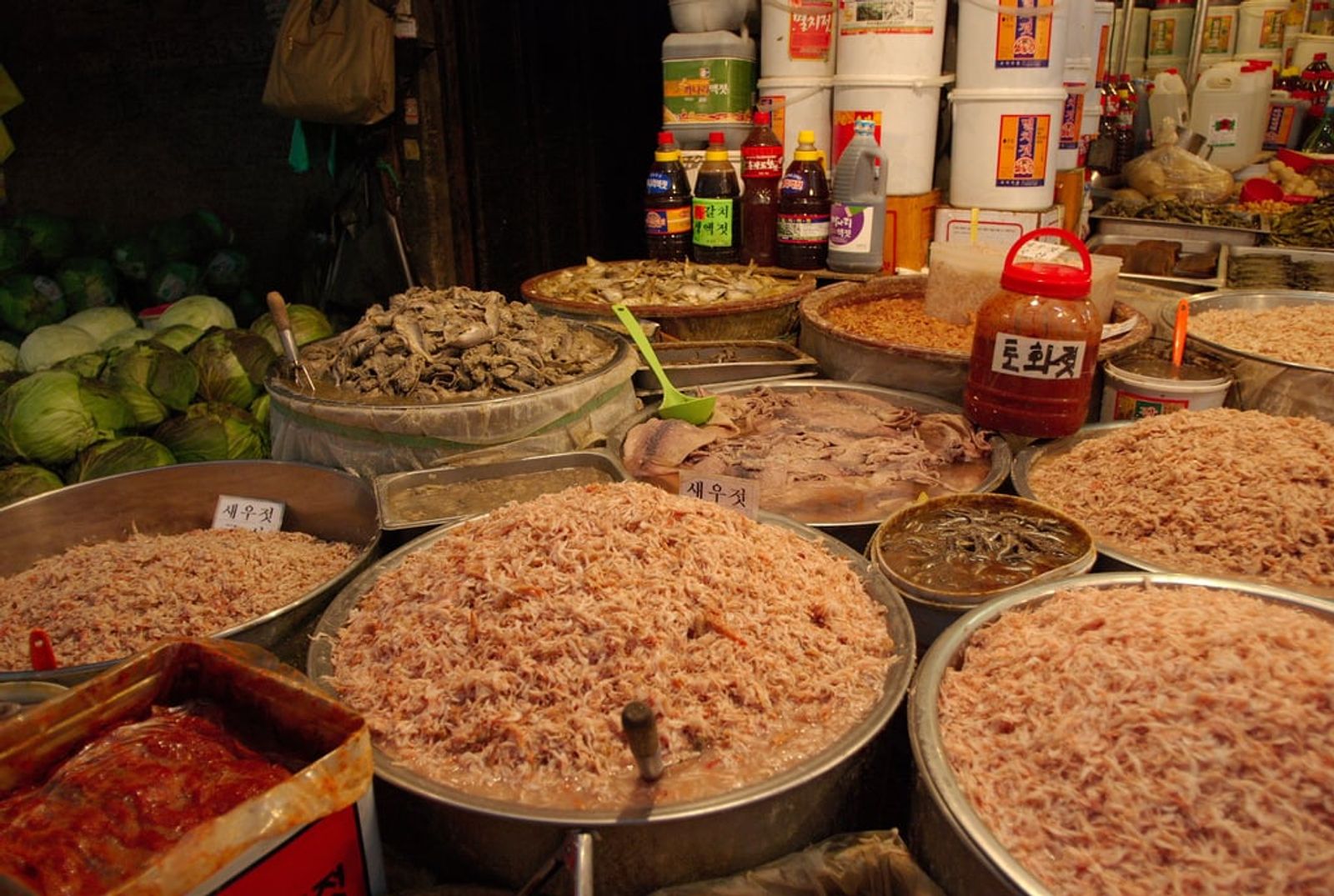
Ganggyeong Jeotgal · Photo: hwayoungjung / CC BY-SA 2.0 (Wikimedia Commons)
 KoreaSouth Chungcheong · Nonsan
Ganggyeong Jeotgal: How One of Joseon's Three Great Markets Became Korea's Salted Seafood Town
Ganggyeong-eup in Nonsan, South Chungcheong, was a river port on the Geumgang whose market was once ranked with Pyongyang and Daegu as one of Joseon's three great markets. When railways and an estuary dam cut off the river trade, its skill with fish turned into jeotgal, salted fermented seafood, and today it is the center of Korea's jeotgal trade. Here is the port's rise and fall and how to enjoy the market.
A Port Where Three Rivers Meet
Ganggyeong sits where the Nonsancheon and Ganggyeongcheon streams flow into the Geumgang River. Because the Yellow Sea tide reached all the way up to Ganggyeong, seagoing boats could sail deep inland, and the town grew early into a port linking sea routes with roads. According to Korean Wikipedia, in the Goryeo period the river carried grain collected as taxes, and in early Joseon a riverside granary here stored tax rice from Eunjin County. In late Joseon, Ganggyeong port was called one of the "two great ports of Joseon" alongside Wonsan in Hamgyeong Province; more than 100 boats a day came and went, and regular boats ran daily to Gunsan and Gongju. Seafood and salt from the Yellow Sea were unloaded here and sold across inland Chungcheong and Jeolla. The story of Ganggyeong jeotgal starts at this port.
Ganggyeong Market, Ranked With Pyongyang and Daegu
As the port thrived, so did its market. According to Korean Wikipedia, Ganggyeong market began in the late 17th century as a "lower market" beside the Ganggyeongcheon, and grew into a large market after wetland was filled in in 1808. In 1868, at residents' request, an "upper market" opened below Oknyeobong Peak; from then on the lower market mainly traded farm produce and the upper market mainly seafood. From around this time Ganggyeong was counted with Pyongyang and Daegu as one of Joseon's three great markets. In 1909 its annual turnover of about 2.17 million won reportedly ranked first among all markets in Korea. Money followed: in 1911 the Korean-owned Hanil Bank opened a Ganggyeong branch, and in the 1920s the town is said to have been the first in South Chungcheong to get electricity. The modern buildings still standing along its streets are evidence of that prosperity.
When the Boats Stopped, the Jeotgal Stayed
The glory did not last. When Gunsan opened as a treaty port in 1899, trade on the lower Geumgang shifted there, and once the Gyeongbu Line (1905) and the Honam Line (1910s) were built, goods no longer needed Ganggyeong's waterway. The market was badly damaged in the Korean War, and the Honam Expressway, opened in 1970, weakened its role as a logistics hub further. When the Geumgang estuary barrage was completed in November 1990, the river route was cut off for good. Yet from the 1970s, as the port declined, the jeotgal market began to rise. Salted seafood, long overshadowed by the fish trade in the port's heyday, became the main business, carried on by merchants who knew how to handle fish. Because the raw seafood came overland from the west coast, such as Sinan in South Jeolla, rather than from the river, jeotgal processing survived even after the boats stopped.
Ganggyeong's Jeotgal Market Today
Ganggyeong decided to revive itself through jeotgal. In 1997 the then mayor of Nonsan launched a "Revive Ganggyeong" campaign, and the first jeotgal festival was held that October. In 2002 it became a government-designated cultural tourism festival, and in 2007 the area was named a special zone for the fermented jeotgal industry. The market kept growing. According to figures compiled on Korean Wikipedia, seafood shops numbered 21 in the mid-1980s, 86 in 2003, and around 2008 there were some 130 jeotgal producers and dealers. A 2022 report counted about 140 wholesale and retail jeotgal shops and estimated that more than half of Korea's jeotgal trade passes through Ganggyeong. Shops age their jeotgal in cave-style storerooms kept at 10 to 15°C all year, and the busy season runs from mid-July to early December, ahead of kimchi-making season.
Pairing the Festival With the Old Streets
The Ganggyeong Jeotgal Festival is held every autumn around Ganggyeong port. The 30th edition in 2026 opened on 15 October and ran for four days, paired with Nonsan's Sangwol sweet potatoes and featuring kimchi-making, concerts and fireworks. Dates change every year, so check Nonsan City's notices. Don't just buy jeotgal and leave. Because the town saw little development after its decline, Ganggyeong is said to have more surviving modern buildings than anywhere else in South Chungcheong, and around ten, including the former Hanil Bank Ganggyeong branch and the former Ganggyeong Labor Union building, are registered national heritage. The old bank has housed the Ganggyeong History Museum since 2012. Climb Oknyeobong, just above the port, for a view over the Geumgang and the Nonsan plain. If you buy jeotgal, bring a cooler box.