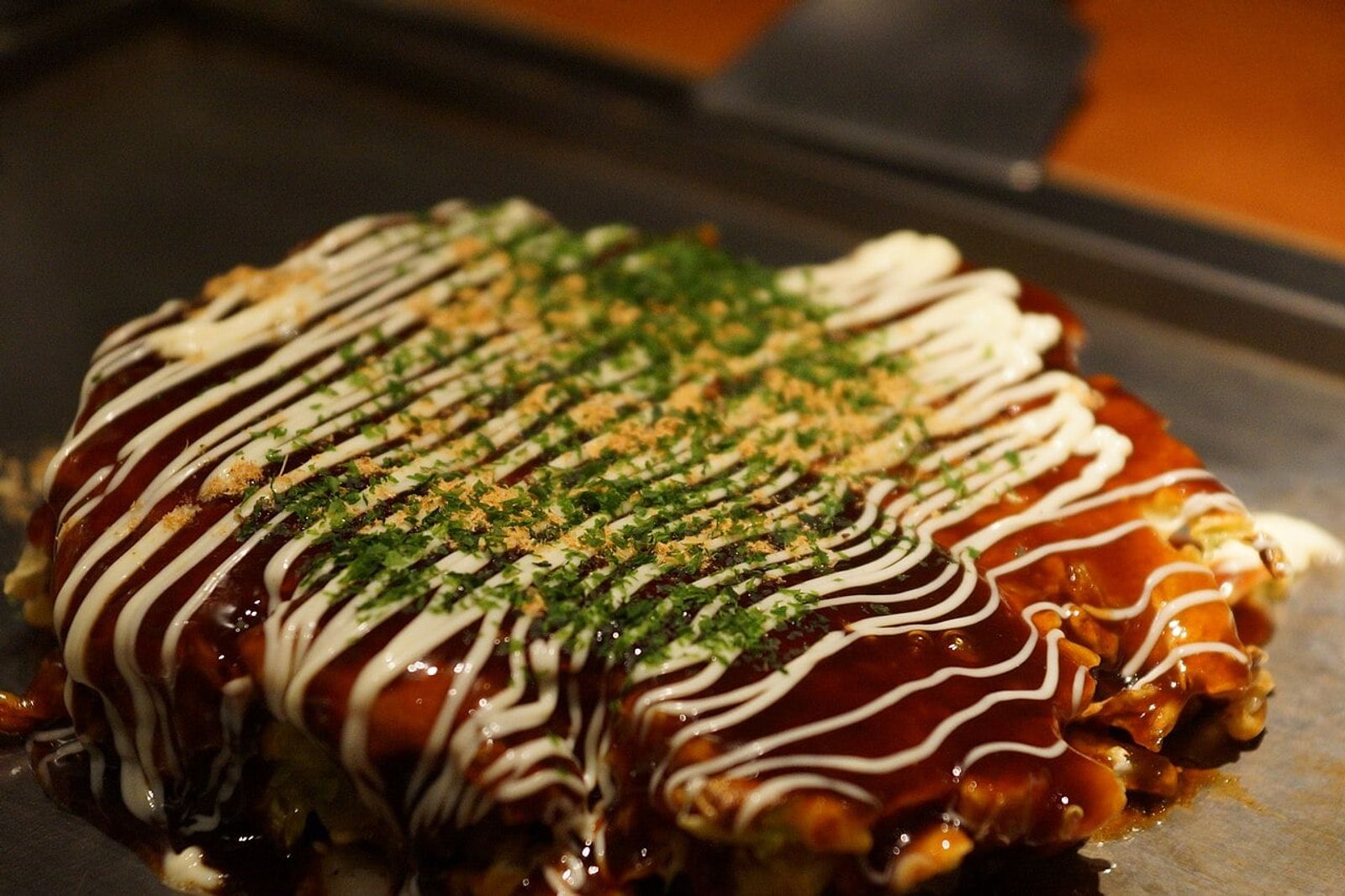
Osaka-style okonomiyaki
Okonomiyaki: Why Osaka and Hiroshima Refuse to Accept Each Other's Version
Okonomiyaki, 'grilled as you like it', splits into Osaka style, where ingredients are mixed into the batter, and Hiroshima style, where they are layered. Learn its postwar flour-food origins, how to grill it yourself, and how to eat it with a spatula.
Konamon: Kansai, Land of Flour Foods
Okonomiyaki combines 'okonomi' (what you like) and 'yaki' (grilled): a wheat-flour batter with cabbage, meat or seafood cooked on a griddle and brushed with sauce. In Osaka, flour-based foods such as okonomiyaki, takoyaki, yakisoba and ikayaki are grouped as 'konamon', the identity of the city's working-class food culture. A distant ancestor is said to be 'funoyaki', a tea-ceremony sweet from the 16th century, but the direct roots lie in 'monjayaki' and 'issen yoshoku' (one-sen Western food), snacks children bought in the Meiji and Taisho eras of the late 19th and early 20th centuries. A thin batter griddled with scallion and bonito flakes for one sen evolved into a thick dish with cabbage and meat in Osaka, and into a layered form in Hiroshima.
After the War: A National Dish Made from Flour
Okonomiyaki took its current form right after World War II. With rice desperately short, American flour aid made okonomiyaki — cheap flour and cabbage that filled the stomach — a staple for ordinary people. In the bombed-out black markets of Osaka and Hiroshima, anyone with a griddle and some flour could start a business, so shops multiplied rapidly. In Hiroshima, women who had lost their livelihoods after the atomic bombing set up griddles in front of their homes and sold okonomiyaki, and many of the city's old shops today date from that time. In the 1950s sauce companies developed the thick, sweet 'okonomiyaki sauce' (Otafuku in Hiroshima; Ikari and Oliver in Osaka), and the mayonnaise topping began at Osaka shops in the 1970s and became standard.
Osaka Style: Mix and Grill
Osaka (Kansai) style mixes everything at once — flour batter, dashi, egg, finely chopped cabbage, tempura crumbs (tenkasu) and red pickled ginger — spreads it in a round on the griddle, lays sliced pork belly on top and flips it. Once cooked it is brushed with sauce and mayonnaise and sprinkled with bonito flakes and green seaweed powder (aonori). Grated mountain yam (yamaimo) in the batter makes it fluffy and is the secret of the best shops. The signature is 'buta-tama' with pork, about 900 to 1,300 yen; others include 'mix' with squid and shrimp, 'suji' with simmered beef tendon and konjac, and 'modan-yaki' with udon or soba noodles inside. Osaka shops have griddles built into the tables where you cook yourself or staff cook for you; tourist spots around Dotonbori and Namba mostly cook for you, while neighborhood shops let you do it. Osakans sometimes eat okonomiyaki as a side dish with rice, to the surprise of people from other regions.
Hiroshima Style: Layer and Grill
Hiroshima style layers rather than mixes. A crepe-thin batter is spread on the griddle, a mountain of cabbage, bean sprouts and pork is piled on, then it is flipped and steamed until the cabbage wilts. The stack is moved onto yakisoba (or udon) fried alongside, and finally the whole thing is set on an egg cracked onto the griddle. Otafuku sauce is standard, there is far more cabbage than in Osaka style, and noodles are always included. Calling it 'Hiroshima-fu (Hiroshima-style) okonomiyaki' offends locals: to them it is simply 'okonomiyaki', and Osaka's version is the 'Kansai style'. Hiroshima city has more than 800 okonomiyaki shops, and 'Okonomimura', a building housing 25 of them, is a tourist landmark. Because Hiroshima style takes about 15 minutes and real skill, customers do not cook it themselves; the master grills it and slides it across the counter griddle to you. Expect 1,000 to 1,500 yen, with oysters or cheese as optional toppings.
Tips for Grilling It Yourself and Eating with the Spatula
At Osaka shops where you cook yourself, a bowl of batter and toppings arrives. First mix the batter at the bottom with the cabbage on top using chopsticks — lightly, as if folding in air, but thoroughly. Oil the griddle and spread the batter into a round about 2 centimeters thick without pressing. Lay the meat on top, and after 3 to 4 minutes, when the edges set, flip it in one motion with two spatulas. Cook another 3 to 4 minutes, flip once more, brush with sauce and you are done. The key is resisting the urge to press down while it cooks, which kills the fluffiness. The Osaka way to eat it is to cut bite-size pieces with the small spatula ('kote') and lift them straight to your mouth. Moving pieces to a plate and using chopsticks is fine too, but it tastes far better hot off the griddle. If you dislike mayonnaise, say 'mayo nuki' in advance. The sweet sauce pairs well with beer or a highball, and in Osaka the classic accompaniments are yakisoba or tonpeiyaki, a pork-and-egg omelet.