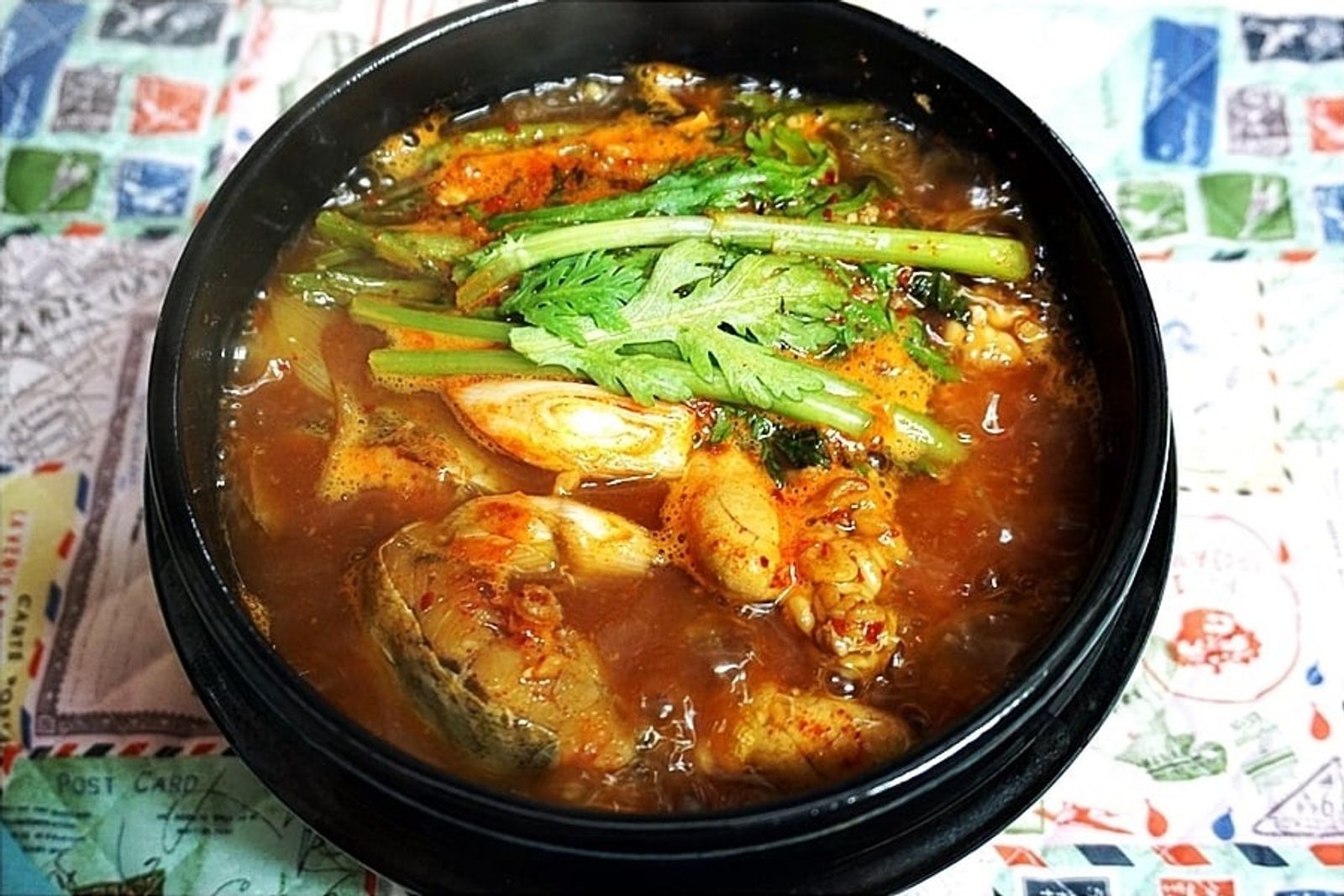
Spicy frozen pollock stew (dongtae-jjigae) · Photo: cryb9191 / CC BY 4.0 (Wikimedia Commons)
 KoreaGangwon · Goseong
Goseong Pollock: Korea's Vanished “National Fish” and the Port That Still Waits
The sea off Goseong, at the northern tip of Korea's east coast, once teemed with pollock. Here is why a fish so loved that it has dozens of names vanished from Korean waters, the effort to bring it back, the story of Geojin Port keeping its pollock festival alive without local pollock, and how to enjoy it in Goseong today.
A National Fish With Dozens of Names
Pollock (myeongtae) was the fish closest to the Korean dinner table. Until the 1980s, Korea's coastal waters yielded more than 70,000 tonnes a year on average, and because it was cheap and tasty it earned the nickname “national fish.” Its names show how familiar it was. According to the weekly Kyunghyang, pollock goes by around 40 names depending on its condition and how long it has been dried. Freshly caught and chilled, it is saengtae; frozen, dongtae; dried yellow over a winter of freezing and thawing on mountain racks, hwangtae; half-dried and strung through the nose, kodari; and the young fish are nogari. The roe becomes myeongnan-jeot and the intestines changnan-jeot. Koreans ate it from head to tail. And one of the places that caught the most was the sea off Goseong, at the northern tip of Gangwon Province.
From 160,000 Tonnes to Zero
According to Ministry of Oceans and Fisheries figures cited by the weekly Kyunghyang, Korea's pollock catch peaked in 1981 at about 165,800 tonnes, including juveniles. It fell below 10,000 tonnes in 1995 and officially hit zero in 2008. Two causes are usually cited. One is overfishing of nogari, the juveniles; by one analysis, immature fish already made up about 80 percent of the catch in the 1960s, reaching 86 percent in 1965. The other is rising sea temperatures. Surface water in the East Sea warmed by 1.43 degrees Celsius between 1968 and 2018, the most of any Korean sea, pushing the spawning grounds and habitat of this cold-water fish northward. The weekly Kyunghyang reports the view that overfishing played a part, but the northward shift of habitat mattered more.
A Pollock Festival Without Local Pollock
Geojin Port in Goseong County's Geojin-eup was famous for pollock fishing, and it hosts the annual Goseong Pollock Festival. When the fish disappeared, the festival was in a bind. In 2010 the Seoul Shinmun reported that it was being held with imported pollock from Japan or Russia, and that rising import prices made things even harder. The festival carried on anyway, built around hopes for a good catch and a future for the fishing village, with programs such as gutting demonstrations, an exhibition of old pollock photos and a pollock theme hall. The 25th festival was held along the Geojin beachfront on October 17–19, 2025, adding a new pollock food culture space where chefs and master cooks presented new dishes such as sweet-and-sour pollock, pollock bread and pollock cutlets.
The Experiment to Bring Pollock Back
In 2014 the Ministry of Oceans and Fisheries and Gangwon Province launched a project to bring pollock back. The hardest part was finding mother fish to take eggs from. Live pollock were so scarce in Korean waters that at one point a reward of 500,000 won was offered for a single live, locally caught fish. Eggs from the fish they found were hatched artificially, and in 2016 researchers announced full-cycle aquaculture, in which farm-raised pollock spawned the next generation. After the first release of 15,000 young fish off Goseong in 2015, releases grew larger. Since 2019, catching pollock of any size has been banned year-round. More research is needed to confirm whether released fish come back, and many say full recovery is still a long way off.
Tasting Pollock in Goseong Today
With pollock fishing banned in Korean waters, the pollock served in restaurants today is mostly imported. Since 2008 Korea has imported around 220,000 tonnes of pollock a year, most of it from Russia or Japan. Goseong's pollock culture lives on all the same. Around Geojin Port and along the east coast you will easily find refreshing fresh pollock soup, frozen pollock stew, braised half-dried pollock and spicy pollock salad, and hwangtae and kodari dried on Goseong's racks are sold as souvenirs. To really feel the story, time your trip for the Goseong Pollock Festival in autumn. Geojin Port is close to Hwajinpo Lake, and the Unification Observatory lies a little farther north, so they make an easy combined trip. The people of Goseong are still waiting for the day when pollock caught off their own coast returns to the table.