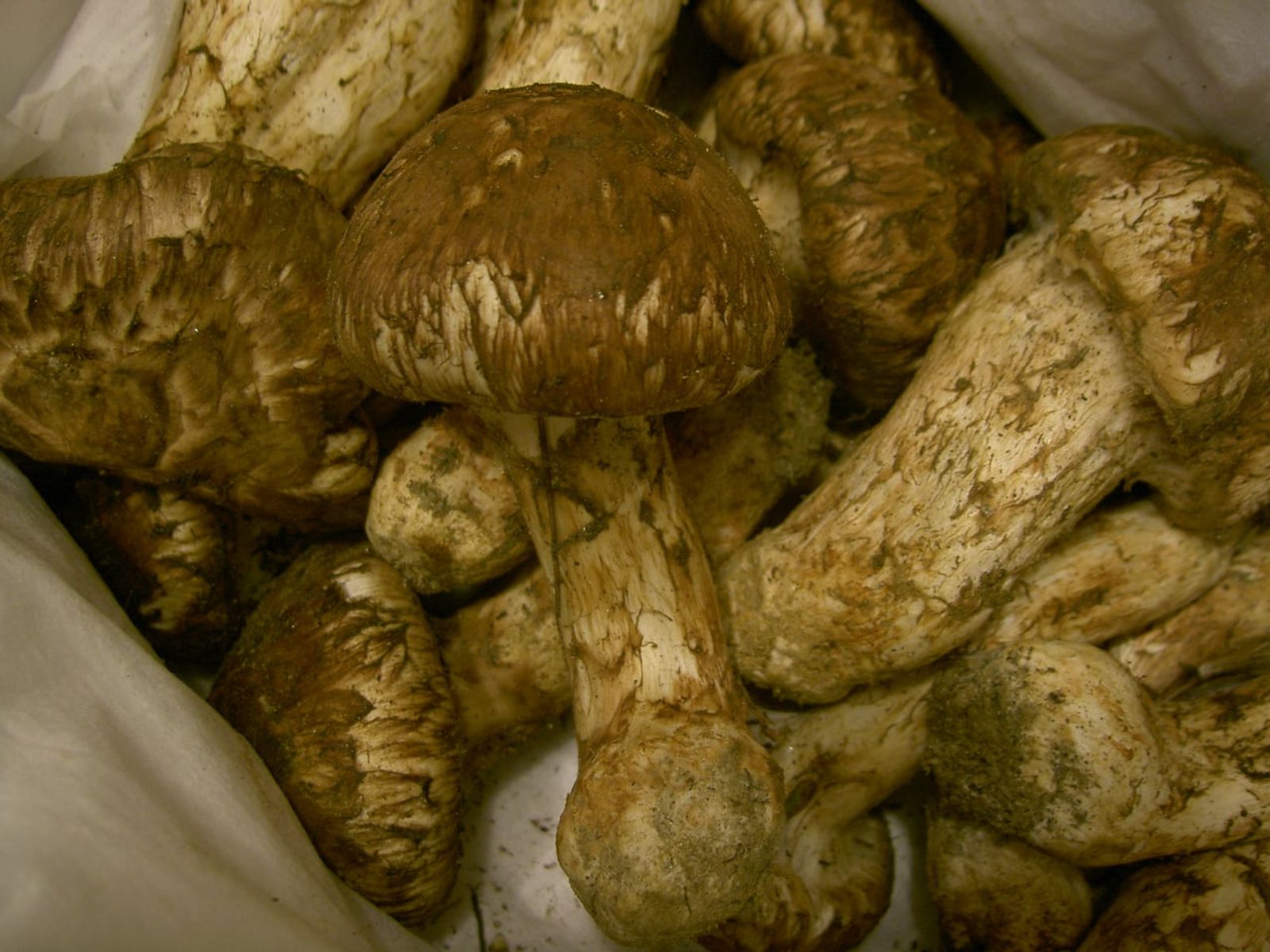
Freshly picked songi (pine mushrooms) · Photo: Stegano / Public domain (Wikimedia Commons)
 KoreaNorth Gyeongsang · Bonghwa
Bonghwa Songi: Autumn Pine Mushrooms from the Taebaeksan Pine Forests
Bonghwa in North Gyeongsang Province is known for songi, pine mushrooms gathered in the pine forests on the slopes of Taebaeksan. Here is what makes Bonghwa songi special, its geographical indication, the local songi market and origin checks, the autumn festival, and the songi dishes the county has developed.
A Mushroom of the Taebaeksan Pine Forests
Bonghwa is a mountain county at the northern tip of North Gyeongsang Province, where pine forests spread across the slopes of Taebaeksan. In autumn, songi push up through the floor of these forests, and the county has long held the mushroom up as its signature product. A 2011 local news report noted that although songi grows in several parts of the province, including Yeongdeok, Uljin and Cheongsong, Bonghwa's is still rated the best. Because songi lives in partnership with the roots of living pine trees, it still cannot be farmed commercially, and almost all songi on the market has been picked by hand in the mountains. The harvest and the price swing widely with each year's weather, and when the season arrives, both Bonghwa town and its mountain villages come alive.
Why Bonghwa's Songi Stands Out
Bonghwa, at the northern tip of North Gyeongsang Province, is a mountain county where pine forests spread across the slopes of Taebaeksan. A 2011 local news report said that songi grows on about 1,930 hectares in Bonghwa, yielding some 80 tons a year, or roughly 15% of Korea's total. The harvest varies a lot by year; in 2025 there was news of an unusually plentiful crop. Bonghwa songi grows in masato, a coarse, sandy soil formed from weathered granite, on the slopes of Taebaeksan. It is described as drier and more fragrant than songi from other regions, and it is registered with the Korea Forest Service as a geographical-indication forest product (No. 10). The county promotes it as songi that holds "a thousand years of pine scent."
The Songi Market and Guarding Its Origin
In songi season, Bonghwa's mushroom market buzzes with buyers and sellers. In 2025 local media reported more than 60 songi dealers active in the county. Prices depend heavily on shape: the less the cap has opened and the straighter and thicker the stem, the higher the price. The more famous a producing area, the more important it is to stop mushrooms from elsewhere being sold under its name. During the 2025 festival, the county carried out focused inspections of origin labeling among forest-product sellers at the festival grounds. When you buy, check the origin label, and do not hesitate to ask the seller directly.
The Autumn Bonghwa Songi Festival
Every year Bonghwa holds the Bonghwa Songi Festival during mushroom season. The 29th edition in 2025 ran for four days, October 16 to 19, along the Naeseongcheon stream in Bonghwa-eup together with the Cheongnyang Cultural Festival, and local media reported about 100,000 visitors. The songi stalls sold out from the first day, and there were long lines for 5,000-won songi ramyeon. Past festivals have also offered a pre-booked experience where visitors climbed a songi mountain, watched the mushrooms growing and picked them, then bought what they found at the official auction price. Programs change from year to year, so check Bonghwa County's announcements before you go. At the festival you can also taste Bonghwa's hanyagu, beef from cattle raised on feed mixed with medicinal herbs.
Songi Dishes to Try in Bonghwa
Aroma is everything with songi, so the basic rule is light seasoning. The most common way to eat it is songi-gui: torn along the grain or thinly sliced, lightly grilled, and dipped in sesame oil with a little salt. Bonghwa restaurants have also been known for dishes such as songi dolsot-bap (rice cooked with songi in a stone pot), songi jeongol (hot pot), beef and rice soup with songi, and songi grilled together with beef. Around 2011 the county also developed and promoted new local dishes using songi, such as songi bibimbap, songi dumpling soup, songi muk-bap (acorn jelly with rice) and songi tteokgalbi (grilled short-rib patties). In season, more restaurants in town and around the festival grounds serve songi, so if it is your first time, start with lightly grilled songi to take in the aroma, then move on to songi rice or soup.