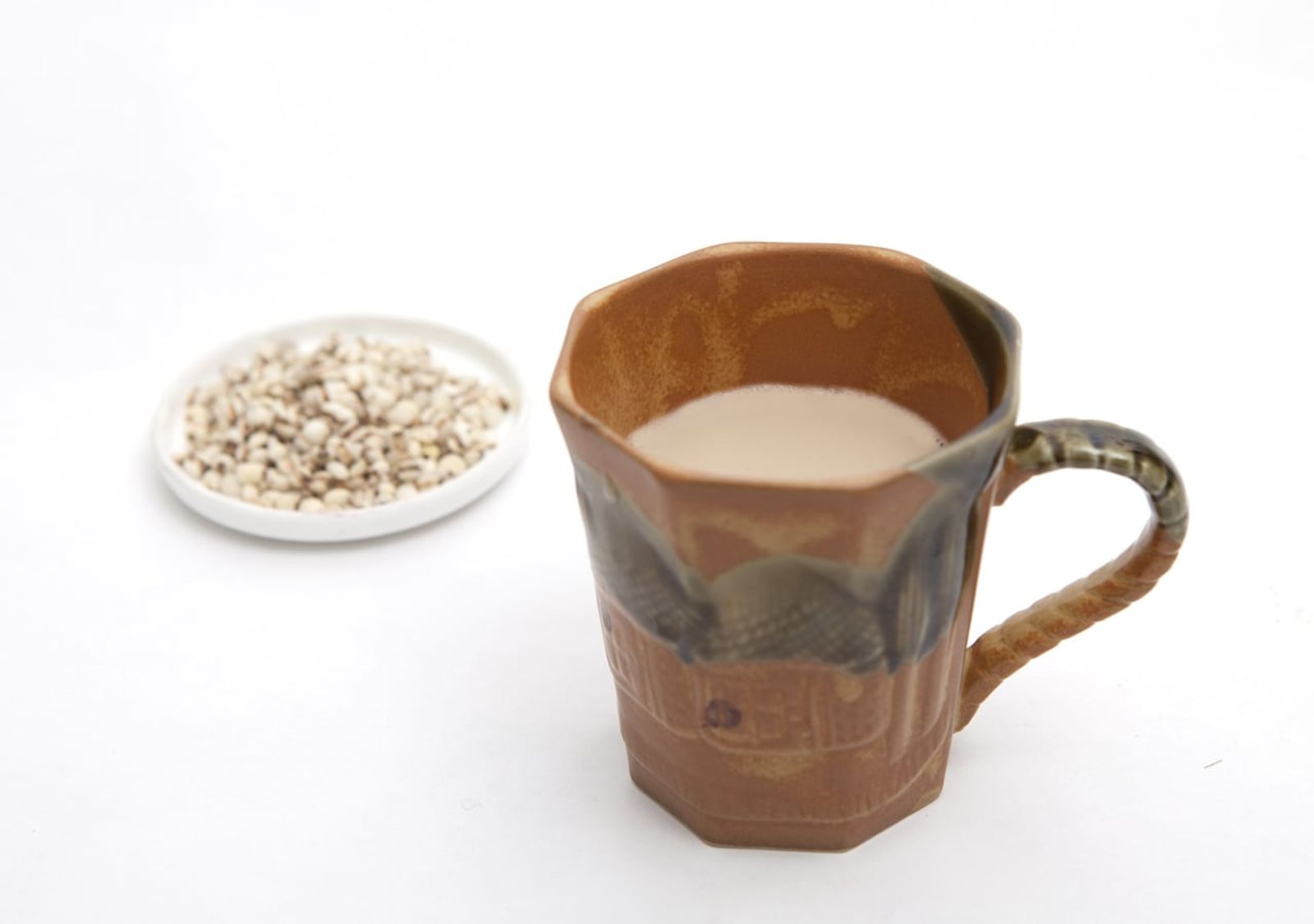
Yulmu-cha (Job's tears tea) with the grains · Photo: 국립국어원 / CC BY-SA 2.0 KR (Wikimedia Commons)
 KoreaGyeonggi · Yeoncheon
Yeoncheon Job's Tears: The Border County That Grows Most of Korea's Yulmu
Ever wondered where the grain in your cup of yulmu-cha comes from? Yeoncheon, Gyeonggi Province's northernmost county on the edge of the DMZ, grows most of Korea's Job's tears. Here is why this hardy grain took root there, the story of Korea's first yulmu factory, the autumn festival and the best ways to eat it.
What Exactly Is Yulmu?
Yulmu is an annual grass in the rice family, scientifically Coix lacryma-jobi var. ma-yuen. In English it is called Job's tears, and in Japanese hatomugi. According to Korean Wikipedia it originates in China, Southeast Asia and India, grows to about 1 to 1.5 meters and flowers in July. The seeds are used both as food and as medicine. In Korea they go into yulmu-cha (Job's tears tea), misugaru grain powder, eung-i, a porridge made from ground yulmu, and yulmu-bap, rice cooked with the grain. In traditional medicine it is known as uiiin. Thanks to the nutty yulmu tea found in cafes and vending machines, it is a very familiar grain to Koreans, yet surprisingly few know where most of it is grown. The answer is Yeoncheon, at the very northern tip of Gyeonggi Province.
Most of the Fields Are in Yeoncheon
A Rural Development Administration webzine says Yeoncheon accounts for more than 80 percent of Korea's yulmu acreage, earning it the undisputed title of 'home of yulmu'. A Gyeonggi Province magazine cites the same figure of about 80 percent, and a 2010 Kyeonggi Ilbo article put it at roughly 80 percent or more of national output. In 2022 the county governor, opening the local festival, spoke of '60 percent of Korea's yulmu cultivation and supply', so the numbers vary with the measure and the year. Either way, Yeoncheon is clearly the center of Korean yulmu. According to the 2010 article, Yeoncheon had 531 yulmu-growing households in 2008, about one sixth of all farm households in the county, harvesting 1,832 tons from 733 hectares. A large share of the fields in this border county, crossed by the armistice line, are yulmu fields.
A Grain for Tough Soil, and Korea's First Yulmu Factory
Part of the reason yulmu settled in Yeoncheon is the nature of the crop itself. A Gyeonggi Province magazine explains that yulmu resists pests and lodging, yields better than other crops even in poor, acidic soil or newly cleared land, and, since it does not compete with rice or barley, long served as a famine-relief crop. The natural environment near the civilian control line and the clean water and air of the Imjin and Hantan river basins are also cited as strengths. There was also a turning point that made it an industry. The Kyeonggi Ilbo reported in 2010 that Yeoncheon's 'first yulmu factory in Korea' grew out of a 1992 Ministry of Home Affairs pilot program to raise rural incomes, when yulmu was picked as a crop to prepare for market opening under the Uruguay Round. In 2004 the Gyeonggi agricultural research service also bred and distributed a new variety, Johyeon, which ripens early, grows short and yields well.
Autumn Harvest and the Yeoncheon Yulmu Festival
Yulmu is harvested between September and November, once the grains turn blackish brown. To coincide with the harvest, Yeoncheon holds the Yeoncheon Yulmu Festival. As the 'Big Farm Products Market' in its official title suggests, it is a market-style festival where you can buy and taste Yeoncheon's produce in one place. It is usually held around the Jeongok-ri Paleolithic Site. The 2022 festival featured displays and sales of local produce along with tastings of yulmu dishes such as yulmu tofu, plus a chrysanthemum exhibition nearby. For the 2024 festival, plans were announced for a coffee truck selling yulmu drinks. The dates shift a little each year and it often falls in late October, so check the county's announcements first. Combine it with the Paleolithic site and the Hantan River scenery and you have a good day trip.
Tasty Ways to Eat Yulmu
The easiest place to start is a warm cup of yulmu-cha. Nutty and thick, it is especially comforting on a cold day. A Gyeonggi Province magazine also suggests yulmu porridge and misugaru, plus dishes such as a salad of boiled yulmu with cherry tomatoes and paprika, or croquettes made from yulmu rice. Mix a little yulmu into your rice and you get yulmu-bap with a pleasant chewy pop. These days more places in Yeoncheon are finding new ways to serve it. A Rural Development Administration webzine introduced a Yeoncheon cafe offering yulmu lattes, yulmu shakes, yulmu rice cakes and shaved ice topped with yulmu powder. Makgeolli brewed with yulmu is also counted among the local specialties. For souvenirs, yulmu powder or yulmu tea is easy to carry. You will hear plenty of health claims about yulmu, but effects vary from person to person, so we suggest enjoying it simply as a delicious grain.