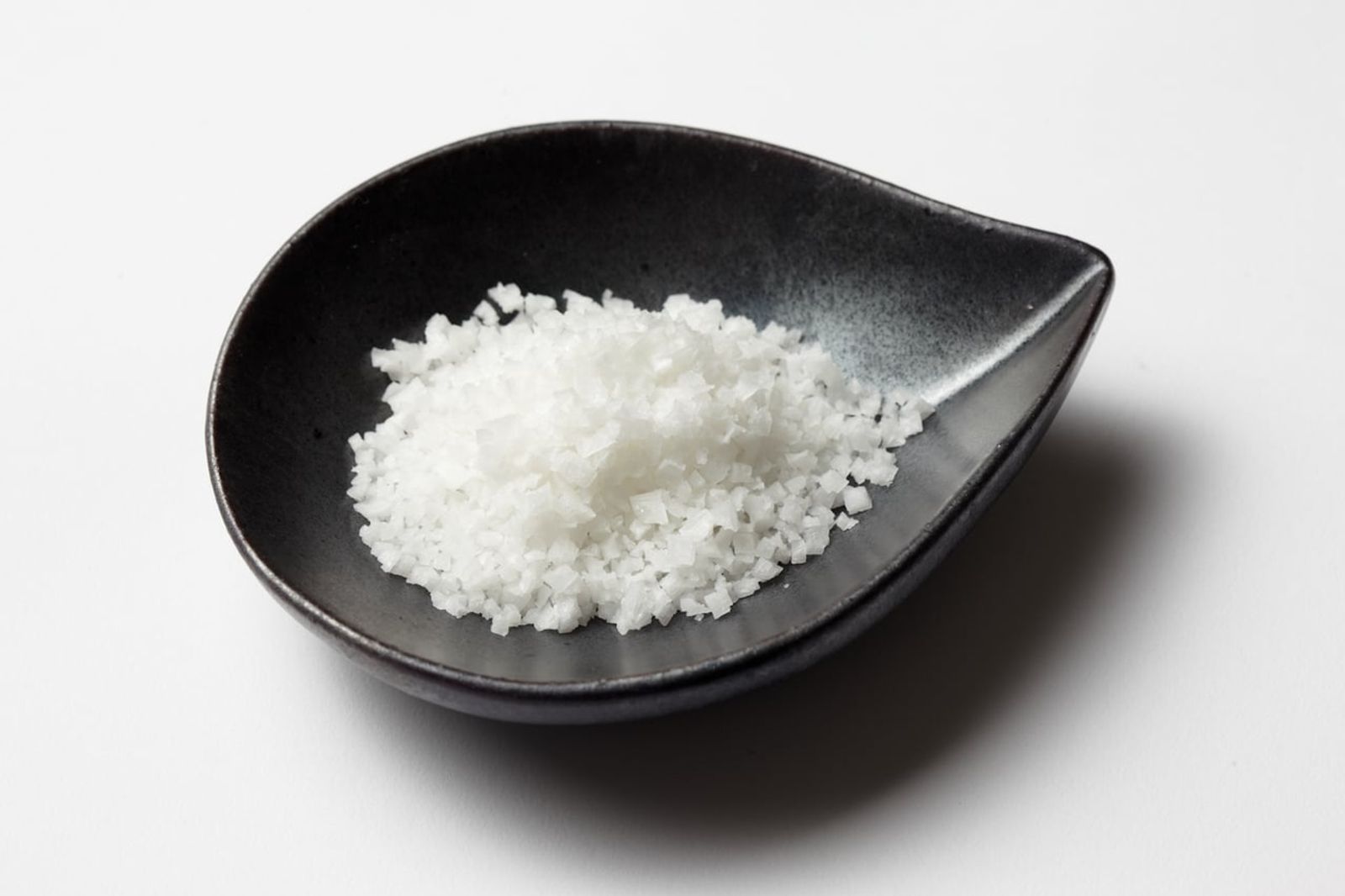
Coarse Korean sun-dried sea salt · Photo: 국립국어원 / CC BY-SA 2.0 kr (Wikimedia Commons)
 KoreaSouth Jeolla · Sinan
Shinan Sea Salt: Made by Sun and Wind in 25 Days, the Quiet Star of Korean Kimjang
The islands of Shinan in South Jeolla produce most of Korea's sun-dried sea salt. Here is how seawater becomes salt, why "June salt" is prized, how salt went from being classed as a mineral to a food, the story of the Jeungdo salt fields built after the Korean War, and shopping tips.
A Thousand Islands, Home of Korean Sea Salt
Cheonilyeom is coarse sea salt made by trapping seawater in salt ponds and letting only sun and wind evaporate the water. Unlike salt boiled or refined in factories, its crystals are large and chunky, and in Korea it is mainly used for salting napa cabbage for kimchi and for making jeotgal (salted seafood) and fermented sauces. Most of it comes from Shinan County in South Jeolla Province. Shinan is made up of more than a thousand islands large and small, and its wide tidal flats, strong sun and steady wind make it ideal for salt farming. According to a 2023 report, Shinan accounts for more than 80 percent of Korea's sun-dried sea salt, producing about 230,000 tons a year on average. No wonder that in Korea, salt means Shinan. As of a 2015 report, Shinan had 855 salt producers working about 2,600 hectares of salt ponds.
25 Days From Seawater to Salt
Salt in Shinan's ponds typically takes around 25 days to make. First, seawater is drawn into a reservoir so impurities can settle; at this point its salinity is only about 1 to 2 degrees. Next it moves step by step through a series of evaporation ponds. Since salinity rises by roughly one degree a day, salt workers call this "shaving the water." Once the brine is concentrated enough, it flows along a channel the workers call a jago into the crystallization ponds. According to a 2008 Seoul Shinmun article, when brine is let in around 6 a.m., "salt flowers" begin to form on the surface three or four hours later and grow into salt. Workers rake it together with a long wooden pusher called a dapa. The harvested salt is piled in warehouses for close to a year so that the bitter brine (gansu) drains away before it is shipped.
Why "Early Summer Salt" Is Prized
Because they need strong sunshine, Shinan's salt ponds usually harvest from mid-March to mid-October. Of all that salt, salt makers rate the batch made around June as the best. A local official quoted in a 2008 article put it poetically: salt ripens most deliciously "when a breeze just strong enough to flutter a skirt hem in May or June brushes past the salt fields." In other words, that is when sun and wind are just right. There is also a reason people look for well-aged salt. Salt that hasn't drained enough bittern tends to taste bitter, so for kimjang (the annual kimchi-making) many people prefer salt that has rested in a warehouse long enough. In a 2008 report, the local salt museum explained that unlike refined salt, which is almost pure sodium chloride, sea salt keeps minerals from the sea such as calcium and magnesium.
From Mineral to Food, and Salt Fields Built by Refugees
Here is a surprising fact: for a long time Korean law classed sea salt as a mineral, not a food. According to a 2008 report, it spent 45 years in that category before a legal amendment took effect in March 2008 and finally recognized it as food. Since then sea salt has been managed under food safety standards. On Jeungdo Island in Shinan you can see this history up close. In 1953, after the Korean War, the gaps between islands were dammed to create what is now Korea's largest single salt farm, built to resettle war refugees and boost salt production. It covers about twice the area of Seoul's Yeouido and is listed as a registered national heritage site from the modern era. A stone salt warehouse built when the farm was created now serves as a salt museum, and the long row of dark salt sheds lining the ponds is a sight in itself.
Choosing and Enjoying Shinan Salt
Coarse sea salt is ideal for foods that are salted or fermented over time: salting cabbage for kimjang, making jeotgal, or brewing doenjang and soy sauce. Sprinkled on fish before grilling or used as a dip for grilled meat, it also tastes mellow rather than harsh. For dishes that need even seasoning, like soups or seasoned greens, finely ground salt is easier to use. Demand for salt soars in late autumn, kimjang season, so many households buy ahead. When shopping, check the production year and origin label, and choose products that state how long the salt has been aged. If you visit Shinan, tour the Jeungdo salt fields and salt museum, and check Shinan County's tourism information to see whether salt-farm experience programs are running. Walking along the ponds, you will understand why salt making is called "farming with sun and wind."