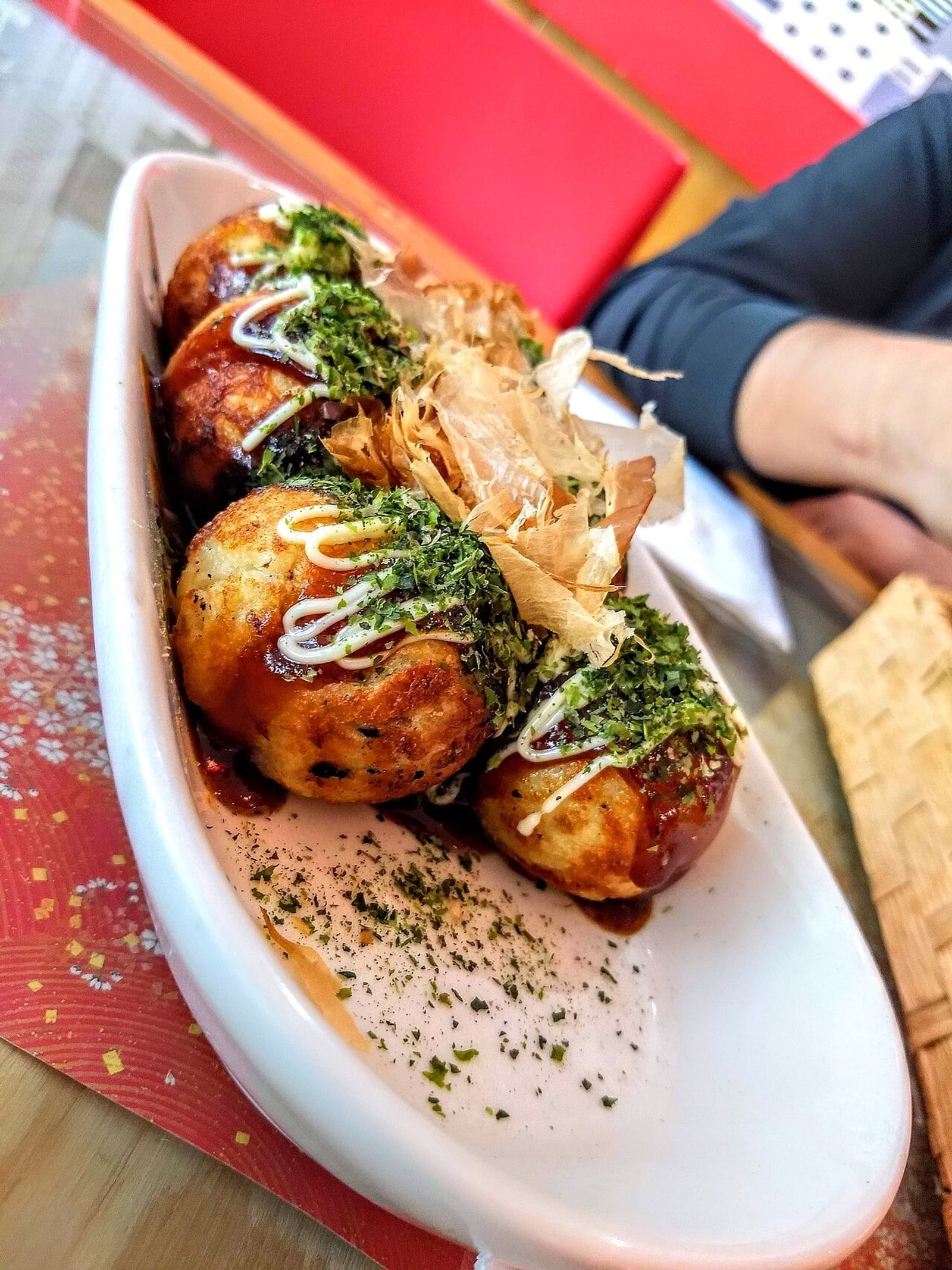
Takoyaki
Takoyaki and Osaka, the City of 'Kuidaore': Why Every Home Has a Takoyaki Pan
Born at an Osaka street stall in 1935, takoyaki is now Japan's signature snack worldwide. Follow its evolution from 'radio-yaki', the secret of crisp-outside-molten-inside, how to pick a stall in Dotonbori, and Osaka's spirit of 'eating until you drop'.
What Takoyaki Is
Takoyaki means 'octopus (tako) grill (yaki)': a thin wheat batter with dashi is poured into a griddle of hemispherical molds, filled with octopus pieces, scallion, red pickled ginger and tempura crumbs, and turned with a pick into balls as it cooks. They are brushed with sauce and mayonnaise, sprinkled with bonito flakes and green seaweed, and sold in sixes or eights for 500 to 700 yen. Good takoyaki is lightly crisp outside and creamy, almost molten, inside. Fresh off the griddle the center is scalding, so split one with the toothpick to let out steam rather than popping it whole into your mouth. In Osaka takoyaki is not just a snack but also a side dish or a meal, and some households eat it with rice. Akashiyaki from Akashi in Hyogo Prefecture, eaten dipped in dashi instead of sauce, is takoyaki's close cousin.
1935: From Radio-yaki to Takoyaki
Takoyaki's ancestor was 'radio-yaki', sold in Osaka in the early 1930s: balls of wheat batter filled with konjac and beef tendon, a children's snack named after the radio, the cutting-edge gadget of the day. In 1935 Tomekichi Endo, who ran a stall in Osaka's Nishinari ward, heard a customer say 'in Akashi they put in octopus', swapped the tendon for octopus and began selling it as 'takoyaki'. His shop, Aizuya, still operates and is recognized as the birthplace. Early takoyaki was seasoned with soy sauce in the batter and eaten without sauce. Around 1948 thick Worcestershire-style sauce spread and takoyaki began to be brushed with it, and in the 1980s and 90s shops such as Tsukuruya added mayonnaise, completing today's form. Osakans' devotion is such that one survey found more than 90 percent of households in Osaka Prefecture own a takoyaki pan. The 'takopa' (takoyaki party), where family or friends gather to grill their own, is an everyday Osaka event.
Kuidaore: The City That Eats Itself into Ruin
Osaka has a word, 'kuidaore', meaning to spend yourself into ruin on food — paired with the sayings that Kyoto ruins itself on clothes (kidaore) and Kobe on shoes. In the Edo period Osaka was 'the nation's kitchen' (tenka no daidokoro), where rice and goods from across Japan converged, and as a merchant city it developed a practical food culture that prized satisfaction for the money. That is the background to its cheap, filling, delicious konamon (flour foods). The giant mechanical crab sign of Kani Doraku in Dotonbori, the drumming 'Kuidaore Taro' doll and the Glico running man are emblems of this spirit. Osaka food is marked by a deep dashi culture and a friendly atmosphere in which customers and owners trade jokes. Takoyaki, okonomiyaki, kushikatsu, ikayaki, kitsune udon, Osaka-style curry and the pork buns of 551 Horai are the must-eats, and most cost under 1,000 yen.
How to Choose a Stall in Dotonbori
Dotonbori and Namba have takoyaki stalls on every corner, which makes choosing hard. A few rules help. First, pick a shop that grills to order or is constantly grilling; places that reheat pre-cooked balls will not have a molten center. Second, check that the octopus pieces are big. Third, if there is a choice of sauce (standard, soy, salt, ponzu, scallion-mayo), try a different one on your second visit. Famous names include the birthplace Aizuya (Tamade main shop, sauce-free original style), Kukuru in Dotonbori (big octopus), Wanaka (Namba main shop, a local favorite), Juhachiban (creamy center) and Takoyaki Doraku Wanaka, which also sells akashiyaki. Tourist-strip shops charge 700 to 900 yen for eight, a bit steep, but one station away it drops to the 500s. Frozen takoyaki from supermarkets and convenience stores is also good, so reheating some at your lodging works too. They come in a paper boat; rather than eating while walking, eat in front of the shop or on a bench and drop the tray in the shop's bin.
Grilling at Home: The Takopa
A takoyaki pan costs 2,000 to 4,000 yen at Japanese electronics stores or Don Quijote. Japan runs on 100 volts, so if your home uses a different voltage you will need a transformer — check before buying. For batter, whisk 100 grams of flour with 350 milliliters of dashi, one egg and a little soy sauce until thin; store-bought 'takoyaki flour' is foolproof. Cut boiled octopus into 1 to 1.5 centimeter pieces and prepare scallion, red pickled ginger and tempura crumbs. To grill: heat the pan well, oil it generously and pour batter until it overflows the molds. Drop octopus and toppings into each mold; after 1 to 2 minutes, when the edges set, use the pick to cut the batter between molds, fold it in and turn each ball 90 degrees. Turn a few more times to round them off, and when the outside is golden they are done. The keys are overfilling the molds and not turning too often. Swapping octopus for cheese, sausage, rice cake or kimchi is part of the fun, and chocolate with banana makes a dessert version.