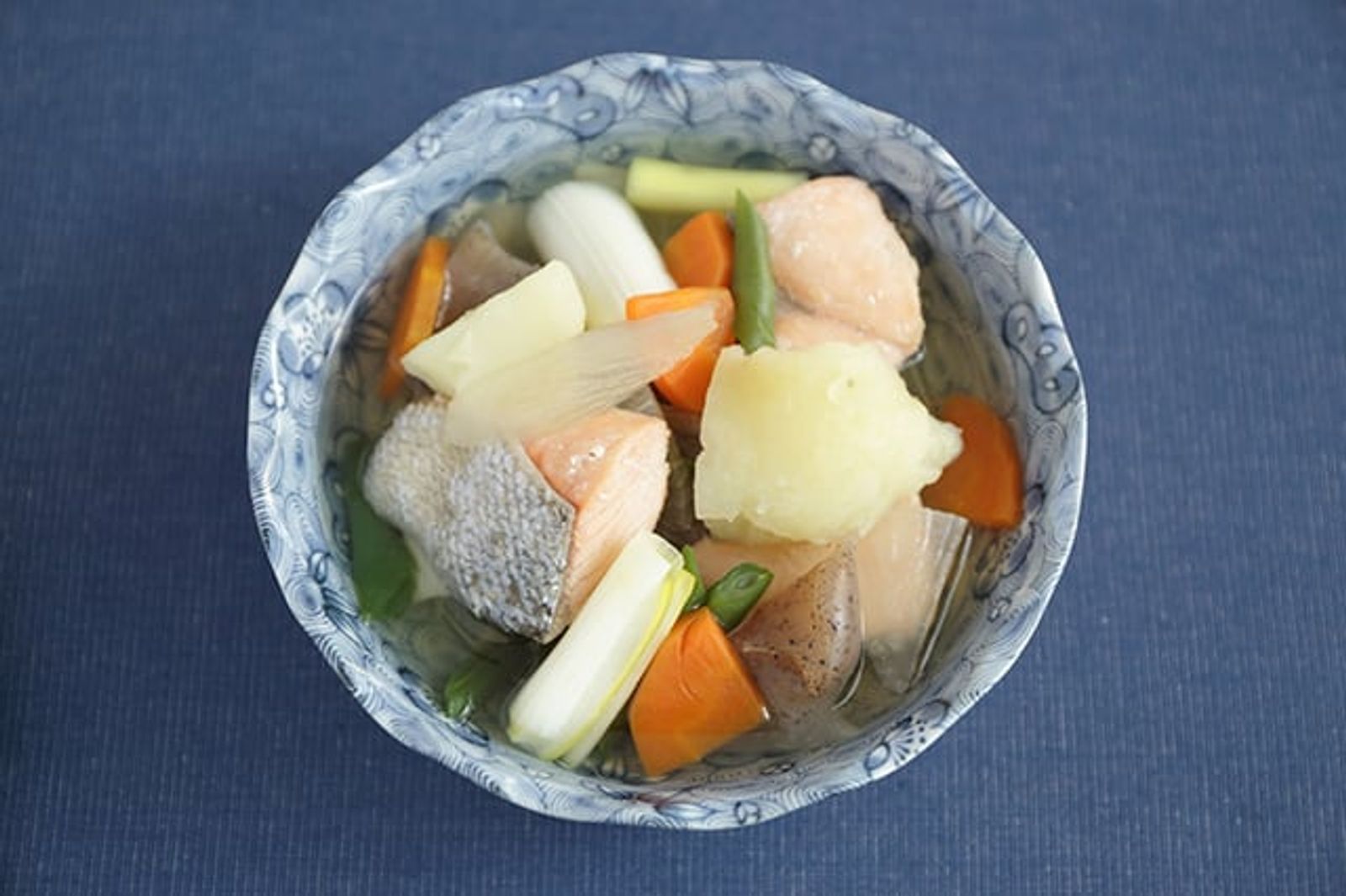
Sanpei-jiru with salmon and vegetables · Photo: 農林水産省 / CC BY 4.0 (Wikimedia Commons)
 JapanHakodate
Sanpei-jiru: Hokkaido's Winter Soup Seasoned by Salted Fish, and Its Southern Origin Stories
Sanpei-jiru is a Hokkaido soup of salt- or rice-bran-cured salmon, herring or cod simmered with root vegetables and seasoned mainly by the salt in the fish. Here are the name's origin stories tied to the Matsumae domain and Okushiri Island in southern Hokkaido, the fish used in each area, and how it differs from Ishikari nabe.
A Soup Seasoned Only by the Fish
Sanpei-jiru (三平汁) is a famous Hokkaido winter soup. Kombu stock is simmered with salt-cured (shiobiki) or rice-bran-cured fish such as salmon, herring, cod or Atka mackerel, along with root vegetables like daikon and carrot, and potatoes. The Ministry of Agriculture, Forestry and Fisheries' local-cuisine site lists it as a Hokkaido dish. Its defining trait is that the flavor is built on the salt that comes out of the fish itself; the ministry's Hokkaido office recipe advises adding any extra salt only a little at a time, tasting as you go. The saltiness and savory depth that seep out of the cured fish soak into the vegetables, giving a simple yet deep taste. It is often confused with Ishikari nabe, another salmon soup, but Ishikari nabe uses fresh salmon and miso, while sanpei-jiru relies on the salt of cured fish.
The Mystery of the Name "Sanpei"
No one knows for sure where the name Sanpei comes from, and several stories are told. The best known involve a man named Saito Sanpei and the Matsumae domain. In one tale, a Matsumae lord out hunting was served a soup of whatever was on hand at the fisherman Sanpei's house and loved it; Japanese dictionaries also record that Sanpei, a cook in the domain's kitchen, created it. Another story credits Saito Sanpei, a retainer of the Nanbu domain who went to develop Ezo, with serving the soup on Okushiri Island to people who later crossed the Tsugaru Strait, but this is rejected because sanpei-jiru existed before his time. Other theories say it was served on "Sanpei plates" made by Ri Sanpei, the founder of Arita porcelain, or that it comes from an Ainu salmon-offal soup containing the heart, called sanpe in Ainu.
Sanpei-jiru in Old Records
The oldest written record is said to be in Toyuki (東遊記), a travel account of Hokkaido from around 1784, where it appears as "sanhei." In 1789 the travel writer Sugae Masumi also mentions sanpei-jiru, but references note that the soup of that time was wild greens simmered in a fish sauce made from fish innards, quite different from today. The same writing also mentions other fish soups, such as one made by simmering herring that had begun to ferment with wild greens. In the Meiji era, cod caught in Hokkaido was filleted and the meat shipped to Honshu, while the leftover milt went into sanpei-jiru. Sanpei-jiru carries the know-how of northern coastal people who salted fish to keep it through the year, and it has changed shape over the centuries.
Different Fish in Different Places
Hokkaido is large, so the fish in sanpei-jiru varies by region. Salted salmon is used mainly in central (Doo) and eastern (Doto) Hokkaido, salted cod in the north (Dohoku), and rice-bran-cured herring (nuka-nishin) along the Sea of Japan coast. Some add parts such as salmon head cartilage (hizu) to the salted salmon pieces, and some households add other vegetables, sake lees or miso. The Hiyama area in southern Hokkaido is especially interesting. There, the miso-seasoned version is called miso-sanpei and the salt-seasoned version shio-sanpei, with salmon often used for the former and Alaska pollock for the latter. The same soup takes on many faces depending on region and family.
The Southern Origin Stories, and How to Try It
Where sanpei-jiru first appeared is also uncertain, but most of its stories are set in southern Hokkaido. The Sanpei tales are set in the Matsumae area of the Oshima Peninsula, west of Hakodate, and materials such as Sapporo school-lunch guides also mention a theory that it began on Okushiri Island, off the Hiyama coast, and spread across Hokkaido from there. Either way, it is a dish closely tied to coastal life in Donan. Today it is closer to an everyday winter home dish across Hokkaido, and some local-cuisine restaurants and izakaya in Hakodate and elsewhere serve it on winter menus. If you spot it, taste a spoonful of broth first to appreciate the salt drawn from the fish. Try it alongside Ishikari nabe and the difference between Hokkaido's two salmon soups, miso and salt, becomes very clear.