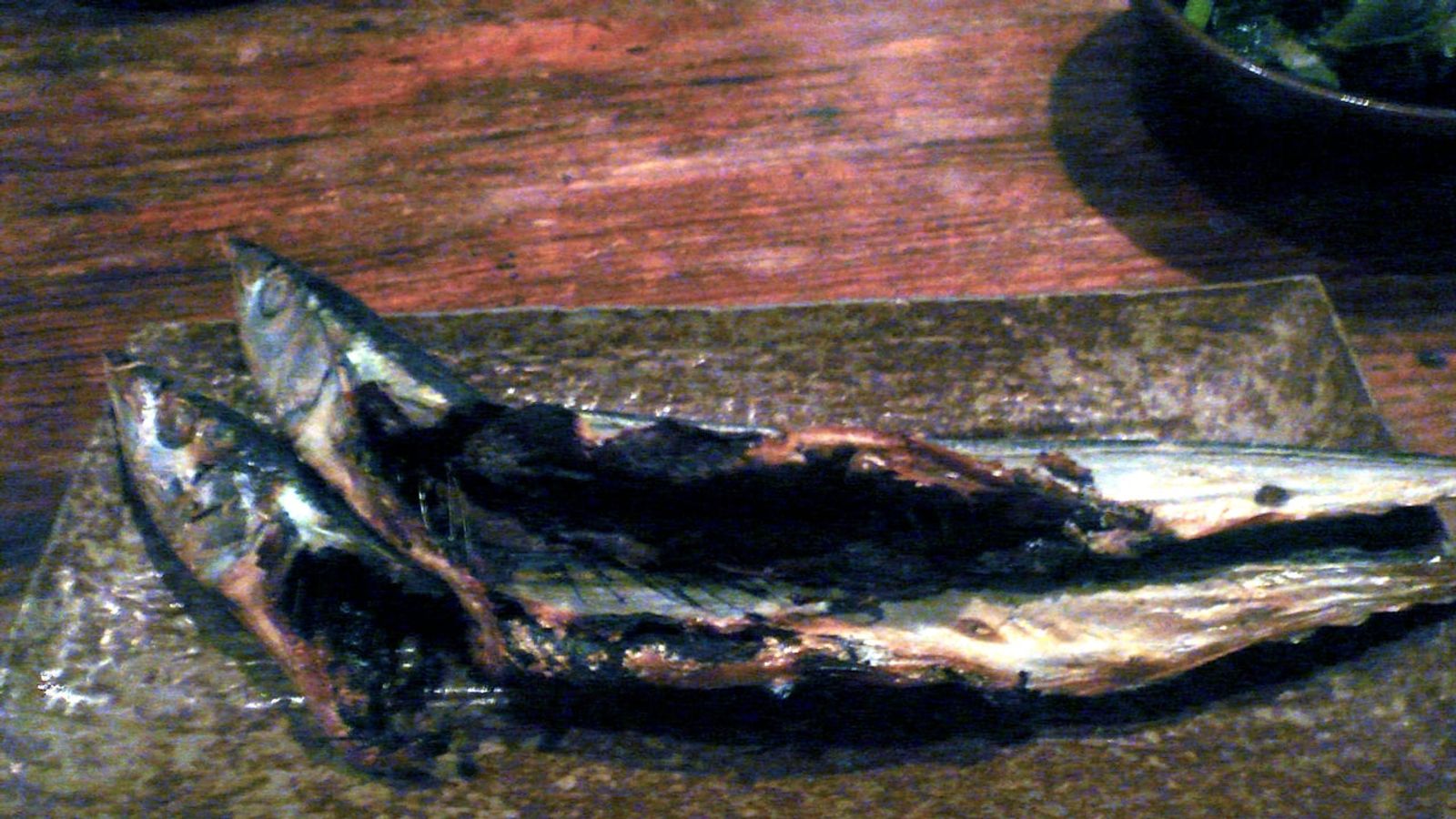
Freshly grilled kusaya on Izu Oshima · Photo: Nesnad / CC BY 3.0 (Wikimedia Commons)
 JapanTokyo
Kusaya: The Famously Pungent Fermented Dried Fish of Tokyo's Izu Islands
Tokyo Metropolis stretches out to sea to include the Izu Islands. Their specialty, kusaya, is fish soaked in a fermented brine kept going for centuries and then dried, and it is famous for its powerful smell. Here is its history born of a salt tax, the secret of kusaya brine, its smell and flavor, and tips for travelers.
Yes, Tokyo Has Islands
Tokyo brings skyscrapers to mind, but Tokyo Metropolis as an administrative area reaches far out into the southern sea. The Izu Islands, including Izu Oshima, Niijima and Hachijojima, all belong to Tokyo. And the specialty that represents these islands is kusaya. Kusaya is fresh fish soaked in a fermented liquid called kusaya brine and then dried. The main fish used is a type of scad known locally as kusaya-moro (muroaji), along with flying fish and mahi-mahi. Because it uses a fermented liquid instead of plain salt water, it is classed as a fermented food. There are two theories about the name: that it comes from kusayo, since fish are called yo in the Niijima dialect, or from kusai ya, roughly "it stinks!", because of the strong smell.
Born on Islands Where Salt Was Precious
Kusaya was born from the circumstances of island life. In the Edo period, the Izu Islands were tenryo, land ruled directly by the shogunate, and salt was very precious on the islands. On top of that, islanders had to pay part of their taxes in salt, so the brine used for salting fish could not simply be thrown away after one use; it had to be reused again and again. As the brine was reused, components of the fish and the action of microbes made it ferment into a distinctive liquid, and this is thought to be the origin of kusaya brine. There are various theories about its birthplace, including one linking it to a fish preserve mentioned in the ancient chronicle Nihon Shoki, but the most widely accepted view is that it began on Niijima. Frugal island know-how ended up creating a specialty that has lasted for centuries.
Kusaya Brine, Kept Alive for Two or Three Centuries
The heart of kusaya lies less in the fish than in the brine. Kusaya brine is generally said to be around 10 to 15 percent salt, and the older it is, the deeper its savoriness is thought to become. Producers hand their brine down through the generations as a closely guarded secret, and some batches are said to have been kept going for centuries. It is also said to have antibacterial properties, and there are stories of it once being used in place of medicine. The process goes like this: the fish is split, gutted and washed, soaked in the brine for half a day or more, then rinsed and dried in the sun and wind for two days or so. The brine is so precious that on Miyakejima, whose residents evacuated after the 2000 eruption, kusaya production has since stopped, yet the brine itself is said to be kept alive.
What the Smell Is, and What It Tastes Like
What surprises first-timers most is, of course, the smell. Overall it resembles the smell of ginkgo nuts, and its main components are said to be butyric acid, propionic acid, trimethylamine and ammonia. The smell spreads especially strongly when it is grilled, so kusaya is often shipped vacuum-packed or in jars to keep it contained. The taste, though, is not as fierce as the smell. It is usually grilled, but can also be eaten half-dried. It is salty with deep savoriness and is said to go very well with island shochu and sake. Grilled kusaya torn into strips by hand and served as a drinking snack is a typical sight in island izakaya. Many people who wrinkle their noses at first become fans after one bite, which is why kusaya is often described as strong in smell but mild in taste.
Kusaya Tips for Travelers
The main kusaya producers are Niijima, Hachijojima and Izu Oshima. From central Tokyo you can reach the islands by ship from Takeshiba Pier, and there are also flights from Haneda Airport to Hachijojima. Some restaurants on the islands serve set meals that include kusaya, which is a low-pressure way to try a little the first time. When buying kusaya to take home, choose vacuum-packed or jarred products that keep the smell sealed in. If you grill it at home or where you are staying, the smell can linger indoors for a long time, so make sure there is good ventilation, and if the kitchen is shared, it is polite to warn others first. Products that are already grilled and shredded, or packed in jars, are convenient because you can eat them straight away. If your Tokyo trip has been all skyscrapers and back streets, this unique taste, preserved by Tokyo's own islands, shows you another face of the city.