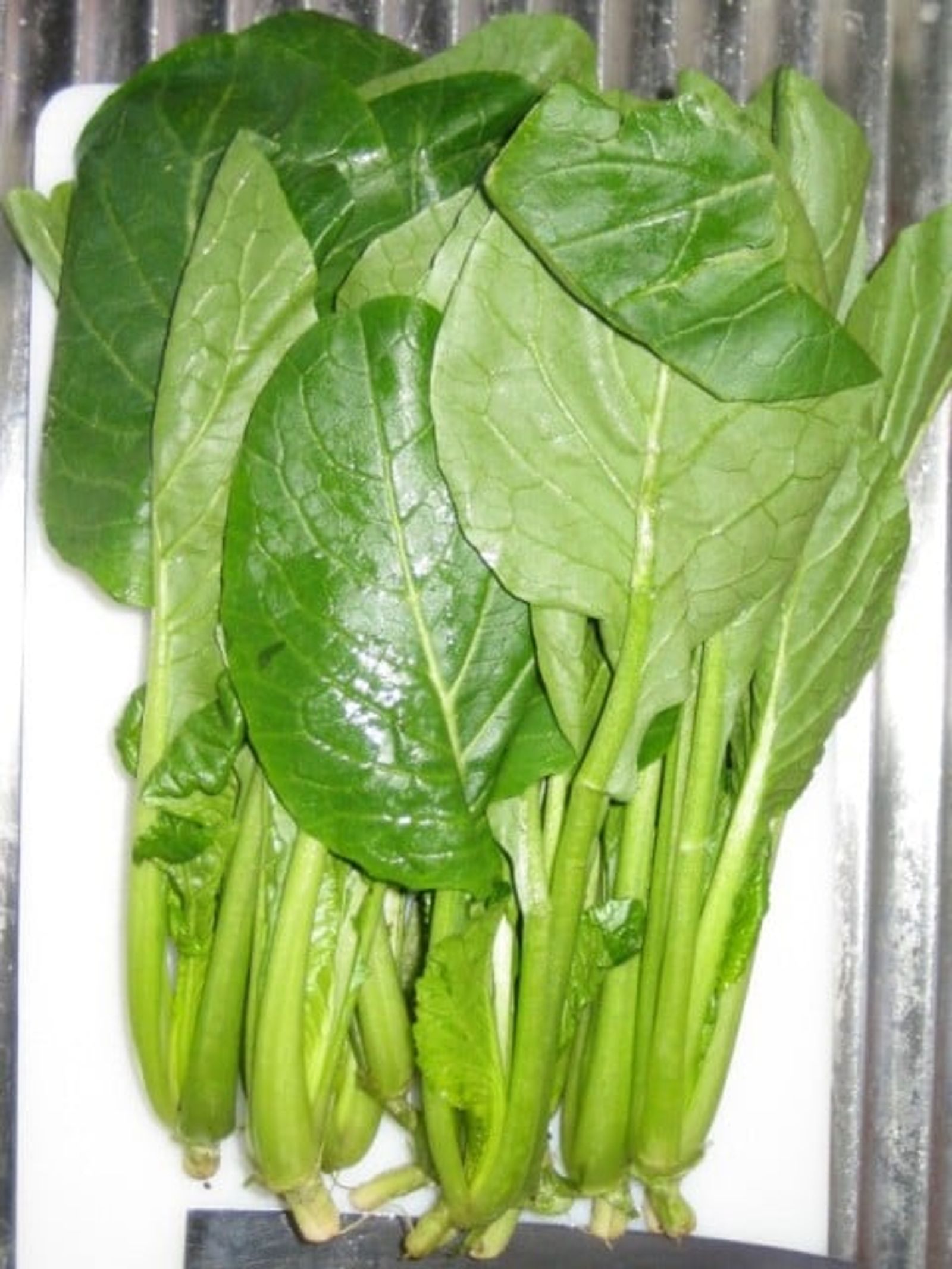
Komatsuna · Photo: 日陰猫Joga at Japanese Wikipedia / CC BY-SA 3.0 (Wikimedia Commons)
 JapanTokyo
Komatsuna and Edo-Tokyo Vegetables: The Winter Green a Shogun Is Said to Have Named
Komatsuna, found in every Japanese supermarket, actually takes its name from Komatsugawa, an old place name in Tokyo's Edogawa Ward. Here is the legend of how a shogun named it on a falconry trip, Edogawa's place as Tokyo's top producer to this day, and the wider family of Edo-Tokyo vegetables such as Nerima daikon and Senju negi.
A Name Taken From a Tokyo Place Name
Komatsuna (小松菜) is one of the most commonly eaten leafy greens in Japanese homes. It is blanched and dressed, stir-fried, added to miso soup and hot pots, and while it looks a bit like bok choy or spinach, its leaves are smoother and its flavor milder. Its name comes from a place. It is said to have first been grown in the early Edo period around Komatsugawa (小松川), in what is now Edogawa Ward on Tokyo's eastern edge, and to have been named komatsuna after that area. Its direct ancestor is said to be kasai-na, a green of the Edo period, and one theory holds that it is a cross between a turnip-type green introduced from China and rapeseed. So this everyday vegetable carries the name of a neighborhood at the eastern end of Tokyo.
A Shogun's Falconry Trip and a Bowl of Mochi Soup
The name komatsuna comes with a legend featuring a shogun. In 1719, Tokugawa Yoshimune, the eighth shogun, was hawking at Nishi-Komatsugawa and stopped for a meal at the nearby Katori Shrine. With little food on hand, the shrine's priest served him a clear soup with mochi and a handful of greens. Yoshimune liked it so much that he named the greens komatsuna after the place. This is a legend, though. Edogawa Ward itself notes that there are several theories about the naming, and that besides Yoshimune, some credit the third shogun Iemitsu or the fifth shogun Tsunayoshi. The shrine episode, too, is best seen as one story among others. Still, the tale of a humble winter-field vegetable winning over a shogun shows how familiar it was to the people of Edo.
Edogawa, Still Tokyo's Top Producer
Edogawa, komatsuna's home, still grows more of it than anywhere else in Tokyo. According to figures released by Edogawa Ward in 2025, the ward harvested 2,631 tonnes of komatsuna in fiscal 2023, about 40 percent of Tokyo's total of 6,465 tonnes, and it has long ranked first in the metropolis. Most of the ward's 266 farming households (as of fiscal 2024) grow komatsuna. It is surprising that so many vegetables are grown inside Tokyo's urbanized 23 wards, but it continues a tradition of suburban farming that has fed the great city since the Edo period. Leafy greens, which depend on freshness, were best grown close to where they were eaten. Edogawa promotes komatsuna almost as a ward symbol, regularly introducing products and events that feature it.
The Heirloom Family Called Edo-Tokyo Vegetables
Komatsuna is also a leading member of Edo Tokyo Yasai (Edo Tokyo vegetables), a group of traditional vegetables. During the Edo period, the system of alternate attendance brought seeds from all over Japan to Edo, and the term covers open-pollinated varieties long grown in Tokyo, including ones adapted to Edo's climate and older local strains. They were first called Edo vegetables, but the group has since been broadened to include varieties from the Tama area and the Izu Islands, as well as ones developed from the Meiji era to the mid-Showa era, and the JA Tokyo group now certifies several dozen items. Komatsuna varieties on the list include Goseki Okute Komatsuna and Jonan Komatsuna, long grown in Setagaya, Meguro and Ota wards. Even within komatsuna, these old open-pollinated varieties differ slightly in taste and shape, and farmers and chefs continue working to preserve them.
From Nerima Daikon to Yanaka Ginger, and Tokyo's New Year Soup
Many Edo-Tokyo vegetables carry Tokyo place names, so their names alone conjure up the farm fields that once surrounded Edo. Typical examples are Nerima daikon from Nerima Ward, Kameido daikon from Kameido in Koto Ward, Senju negi from Adachi Ward, Terajima eggplant from Sumida Ward and Yanaka ginger from Arakawa Ward. Kameido daikon has been grown in Kameido since the late Edo period and is said to be short and tapered, with dense, relatively dry flesh. Because komatsuna has been loved as a winter green in Kanto and Tokyo since the Edo period, it is counted among the essential vegetables in zoni, the New Year mochi soup, in the Kanto and Tokyo area, a scene that recalls the mochi soup of the Yoshimune legend. If you spot an Edo-Tokyo vegetables label or a vegetable named after a place at a supermarket or farm stand while traveling in Tokyo, think of the neighborhood story hidden in its name.