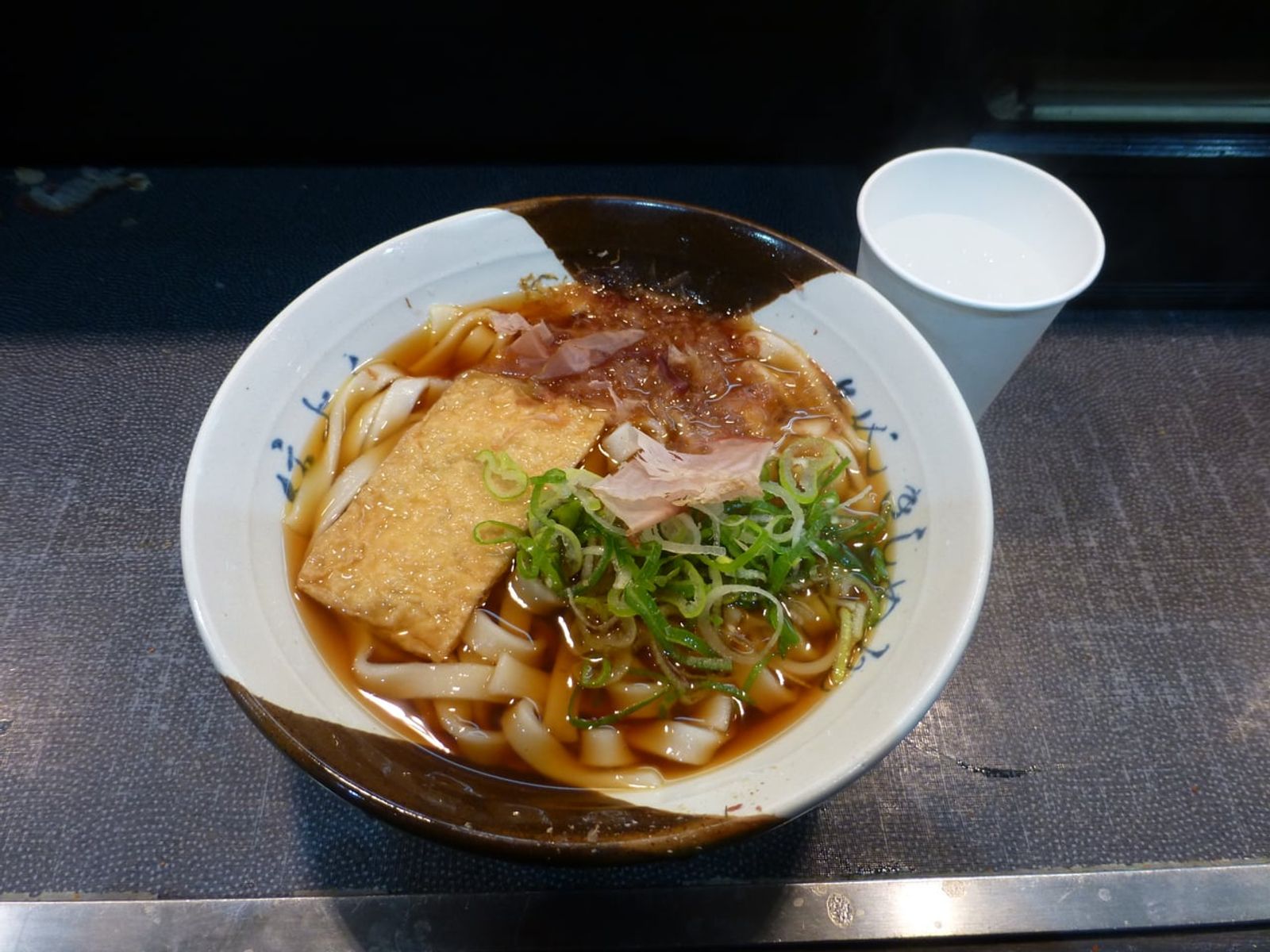
Kishimen with fried tofu and bonito flakes at Nagoya Station · Photo: Kos88 / CC BY-SA 4.0 (Wikimedia Commons)
 JapanNagoya
Kishimen: Nagoya's Flat, Thin Noodles, the Mystery of the Name and How to Eat Them
Kishimen are flat noodles about 1 mm thick and 7–8 mm wide, a soul food of Aichi Prefecture. Here are the theories behind the name, roots traced to "imokawa" noodles from Kariya, the rich broth and toppings, and tips for eating them at Nagoya Station.
Aichi's Flat, Thin Soul Food
Kishimen is a kind of udon, but it looks distinctly different. The Ministry of Agriculture's local cuisine guide describes it as a flat noodle about 1 mm thick and 7 to 8 mm wide. Japan's food labeling standards even allow noodles 4.5 mm or wider and 2 mm or thinner to be labeled "kishimen" — being wide and thin is its identity. The ministry presents kishimen as a dish eaten all over Aichi Prefecture, easy to buy in supermarkets and served in school lunches. It boils faster than udon and has a smooth surface, so it slides down easily, and its broad surface carries plenty of broth with every mouthful.
The Name Mystery: Pheasant, Kishu or Go Stones?
There are several theories about the name. The Ministry of Agriculture cites one tracing it to a Chinese snack called kishimen (棊子麺): dough rolled flat, stamped into go-stone shapes, boiled and dusted with soybean flour. The characters 棊子 mean "go stone." Other theories say it comes from kijimen, noodles with pheasant (kiji) meat, or from kishumen, noodles made by someone from Kishu, today's Wakayama. Nagoya's Board of Education has introduced the idea that pheasant noodles from Chiryu, a post town on the Tokaido, were passed on to Nagoya. None is settled, so feel free to imagine how a flat noodle and a go-stone snack might be connected.
Roots in Kariya's "Imokawa" Noodles
Whatever the name, kishimen's roots lead to present-day Kariya City in Aichi. The Ministry of Agriculture says it grew out of himokawa, a flat udon that was a Kariya specialty. According to Japanese Wikipedia, the Edo-period guidebook Tokaido Meishoki already lists flat noodles as a specialty of Imokawa in Mikawa Province. The late-Edo encyclopedia of customs Morisada Manko notes that the "himokawa" of Edo (Tokyo) was a corruption of "Imokawa," and that in Nagoya the same noodle was called "kishimen." In other words, the flat noodles eaten by Tokaido travelers in Mikawa became himokawa in Edo and kishimen in Nagoya.
Rich Broth and a Mound of Bonito Flakes
Kishimen broth tends to be rich. According to the Ministry of Agriculture, the traditional version uses stock from muroaji, a fish of the jack family, seasoned with tamari, a soy sauce made almost entirely from soybeans. Flat noodles can taste mild in the mouth, so the broth was made strong, which also suited the local love of bold flavors. Many shops now use ordinary dashi and soy sauce. Typical toppings are fried tofu, green onion, blanched greens and Nagoya's distinctive red kamaboko fish cake, often crowned with a heap of bonito flakes. As in the photo, watching the flakes dance over the hot broth is part of the fun.
Where and How to Eat It
The easiest place for travelers to try kishimen is Nagoya Station, where stand-up kishimen counters on the platforms and inside the station let people slurp a bowl in the few minutes before a shinkansen. Udon shops around the city usually list kishimen separately on the menu, too. There are many versions. The Ministry of Agriculture says chilled "koro" kishimen is popular in summer, and that variations such as curry kishimen and kishimen with mochi are common. The thin noodles soften quickly, so eat them as soon as they arrive. Start with a sip of broth to taste its depth, then eat while letting the bonito flakes soak into the soup.