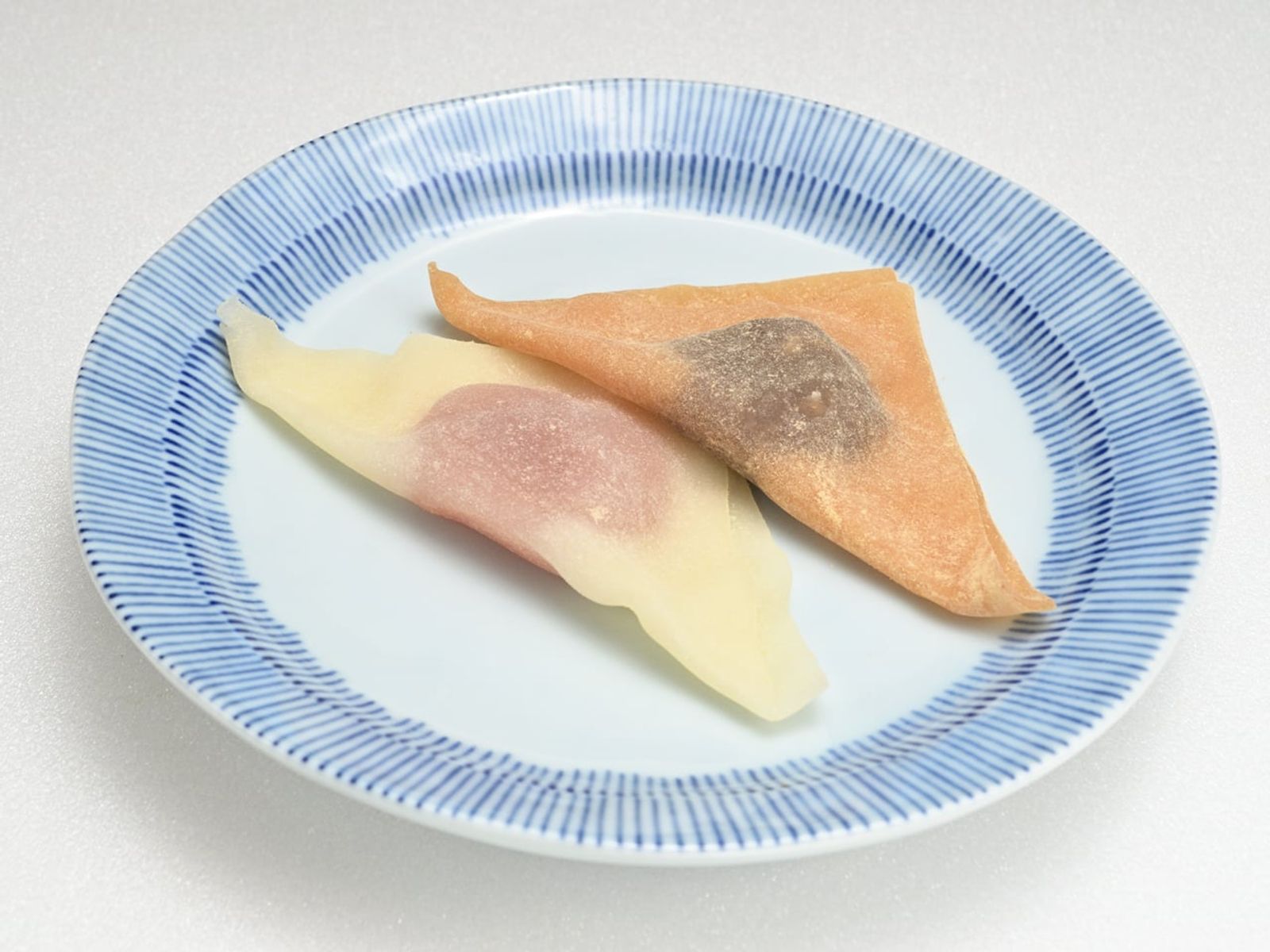
Triangular nama yatsuhashi filled with bean paste · Photo: Ocdp / CC0 (Wikimedia Commons)
 JapanKyoto
Yatsuhashi: Baked or 'Raw,' the Two Faces of Kyoto's Top Souvenir Sweet
Ask about Kyoto souvenirs and yatsuhashi comes up first. How does the crisp, cinnamon-scented baked kind differ from soft nama yatsuhashi wrapped around bean paste? Here are the two theories behind the name, how it became a souvenir and tips for choosing.
Yatsuhashi Was Originally a Baked Sweet
Yatsuhashi is one of Kyoto's best-known wagashi. Rice flour is mixed with sugar and cinnamon (nikki), steamed, rolled thin and baked, giving something close to a hard senbei cracker. Its gently curved rectangle is said to imitate a koto, the Japanese zither, or a bridge. Bite in and a crisp crunch comes with a burst of cinnamon. Today many people picture a soft triangle when they hear "yatsuhashi," but that is the later nama yatsuhashi ("raw" yatsuhashi). The original is a baked sweet, sometimes called yaki yatsuhashi to tell the two apart. Both share the same basic ingredients: rice flour, sugar and cinnamon. Bake the dough and you get crisp yaki yatsuhashi; cut it without baking and you get chewy nama yatsuhashi.
Two Theories Behind the Name: A Koto Master or a Bridge From a Classic Tale
There are two main theories about the name. The first links it to Yatsuhashi Kengyo, a 17th-century musician regarded as the founder of modern koto music: the koto-shaped sweet was named in his honor. His grave lies at a temple in Kurodani, Kyoto. The second points to The Tales of Ise, a Heian-era classic that mentions Yatsuhashi ("eight bridges") in Mikawa Province, a spot where eight plank bridges crossed the water; the sweet's shape is said to copy those bridges. Even the members of Kyoto's yatsuhashi trade association reportedly differ on which theory they favor. Either way, the original form is said to have appeared in the Genroku era (late 17th century) and something close to today's shape in the Kyoho era (early 18th century).
Sold at the Station, Shown at a World Expo: Becoming a Souvenir
Yatsuhashi is often said to date from around the late 17th century, but there is reportedly no clear record that pins down an exact year. It made its name as a souvenir in the Meiji era. After the railway reached Kyoto, it began to be sold to travelers at Kyoto Station, and it is said to have won a silver prize at the 1900 Paris World's Fair. Then, when Emperor Taisho's enthronement ceremony was held in Kyoto in 1915, it became known nationwide. Today it is Kyoto's leading souvenir sweet. In the souvenir-purchase survey in Kyoto City's 2006 tourism statistics yearbook, nama yatsuhashi was the top sweet at 24.5 percent, followed by baked yatsuhashi at 21.1 percent.
Enter Nama Yatsuhashi: The Unbaked Version of the 1960s
Nama yatsuhashi, today the star of Kyoto's souvenir shops, is said to have been created in the 1960s. The steamed dough is rolled thin and cut into squares without baking, giving a soft, chewy texture. In the survey above, it was chosen a little more often than the baked kind. The most common form is a square folded in half around bean paste into a triangle. Some are filled with matcha, cinnamon or fruit paste, and some have matcha or black sesame worked into the dough, with new flavors appearing each season. Baked yatsuhashi is crisp and keeps for a long time, while nama yatsuhashi is a moist "fresh" sweet with a short shelf life. Two very different sweets sold side by side under one name: that is what makes yatsuhashi fun.
Tips for Choosing and Enjoying It
When buying yatsuhashi as a gift, check the best-before date first. Nama yatsuhashi is a fresh sweet and usually lasts only a few days to about a week, so think about when you fly home and when you will hand it over. For gifts you will keep and share over time, the long-lasting baked kind is the safer choice. The key flavor is cinnamon. For people who do not like it, matcha or fruit-flavored nama yatsuhashi is a safe bet. If you want the true Kyoto taste, go for the classic cinnamon version. Souvenir shops at Kyoto Station and around the main sightseeing spots display yatsuhashi from several makers side by side, which makes comparison easy. Many offer samples, so try one baked and one nama before deciding. A cup of hot green tea or Uji matcha brings out the cinnamon beautifully.