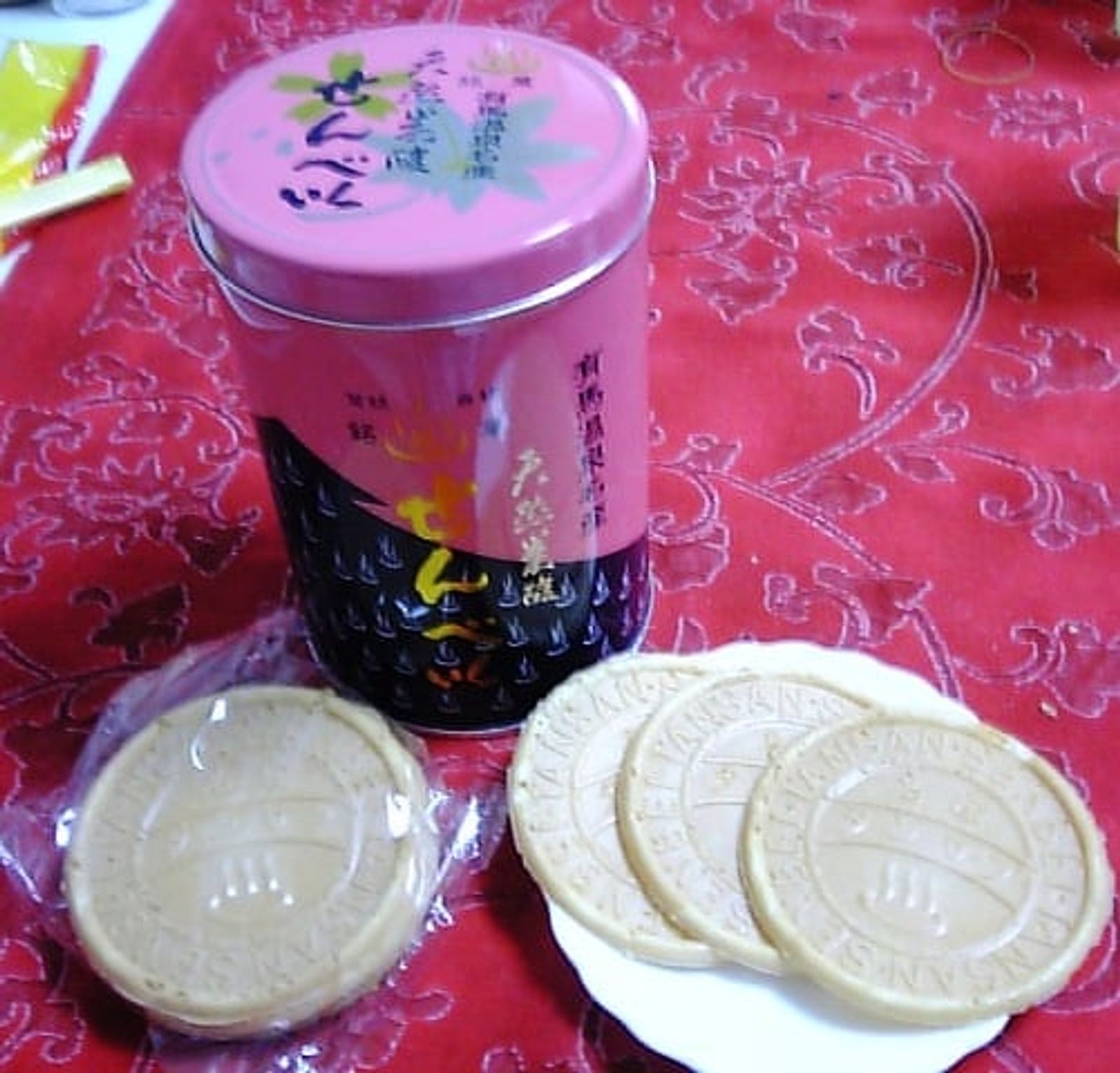
Thin tansan senbei stamped with the mold pattern · Photo: Aska27 / CC BY-SA 3.0 (Wikimedia Commons)
 JapanKobe
Arima Tansan Senbei: How a Feared "Poison Spring" Became a Crisp Onsen Wafer
The classic souvenir of Arima Onsen, in the hills north of Kobe, is the paper-thin, crisp tansan senbei. Here is how a carbonated spring once feared for killing insects and birds was rediscovered in the Meiji era and turned into wafers and cider, and how to enjoy it in the hot spring town.
Arima Onsen and the "Poison Water"
Arima Onsen is a hot spring town in Kobe's Kita Ward, tucked into the hills on the north side of Mount Rokko, and the Kobe Shimbun describes its history as stretching back nearly 1,500 years. It is about an hour from central Kobe by bus or train, so it fits easily into a Kobe trip. Besides its famous iron-rich brown water, Arima has cold carbonated springs full of CO2. According to the Kobe Shimbun, though, these springs only drew attention in the Meiji era. Before that, locals feared them as "poison water" because the gas killed insects and birds nearby. Stone markers carved with "Insect Hell" (mushi-jigoku) and "Bird Hell" (tori-jigoku) still stand near the Arima Onsen ropeway station as reminders of those days.
1875: Declared Fit to Drink
Things changed in the early Meiji era. According to the Kobe Shimbun, in 1875 (Meiji 8) a local innkeeper who was also the town head had the Home Ministry's testing laboratory analyze the water, and it was shown to be a useful mineral spring. Japanese Wikipedia likewise notes that a national inspection in 1875 found the carbonated spring suitable for drinking. A photo from the late 1870s or 1880s reportedly shows people paying one sen a cup to drink the fizzy water. In 1901 a mineral water company was set up near the spring to sell bottled carbonated water, and in 1908 it added sweeteners and flavorings to create "Arima Cider". That is why Arima is often mentioned as one of the birthplaces of Japanese cider (a clear lemon-lime soda in Japan). Production moved elsewhere in 1926, but in 2001 local shopkeepers revived the bottled cider, so you can still drink it in the onsen town.
The Birth of Tansan Senbei
Tansan senbei are wafers baked with that very spring water in the batter. Japanese Wikipedia explains that they were devised after the 1875 finding that the spring was fit to drink, and several guides say they began in the late Meiji era. Shops make differing claims about the exact year and the original maker, so it is hard to pin down. Another intriguing theory is that they were modeled on the thin spa wafers sold in the Czech spa town of Karlovy Vary (formerly Karlsbad). Indeed, similar thin baked wafers exist at many Japanese hot springs, including Isobe Onsen in Gunma, Unzen Onsen in Nagasaki and Dogo Onsen in Ehime. Within Hyogo, besides Arima, they are also a specialty of Takarazuka Onsen and Kinosaki Onsen.
What Does It Taste Like?
A tansan senbei is a round wafer about 10 cm across and only around 1 mm thick. It ranges from pale yellow to light brown, with the pattern of the baking mold pressed into the surface. According to Japanese Wikipedia, it is made from wheat flour, potato starch, sugar, salt and baking soda, mixed with carbonated spring water and baked in a mold. It shatters lightly with a crisp snap, and its gentle sweetness keeps you reaching for another. Some shops describe theirs as a simple sweet made without butter or eggs. Recipes vary slightly from shop to shop, so comparing two or three is fun. Because they go soft in humidity, they are usually sold in cylindrical tins or individually wrapped, and bags of broken pieces are sold cheaply, perfect as a snack for yourself. There are also versions sandwiched with cream.
Enjoying It in the Onsen Town
Walking the streets of Arima Onsen you will pass several shops making tansan senbei, and at some you can watch them being baked one at a time on iron molds. A warm wafer straight off the mold has a toasty richness that the tinned ones cannot match. Up the hill is Tansan Gensen Park, where the carbonated spring rises, and according to the Kobe Shimbun you can still taste the water from a tap. Try its distinctive, slightly metallic flavor and gentle fizz, then eat a senbei and you will really feel "so this is what they bake it with". Pairing it with the revived bottled cider is a very Arima combination.