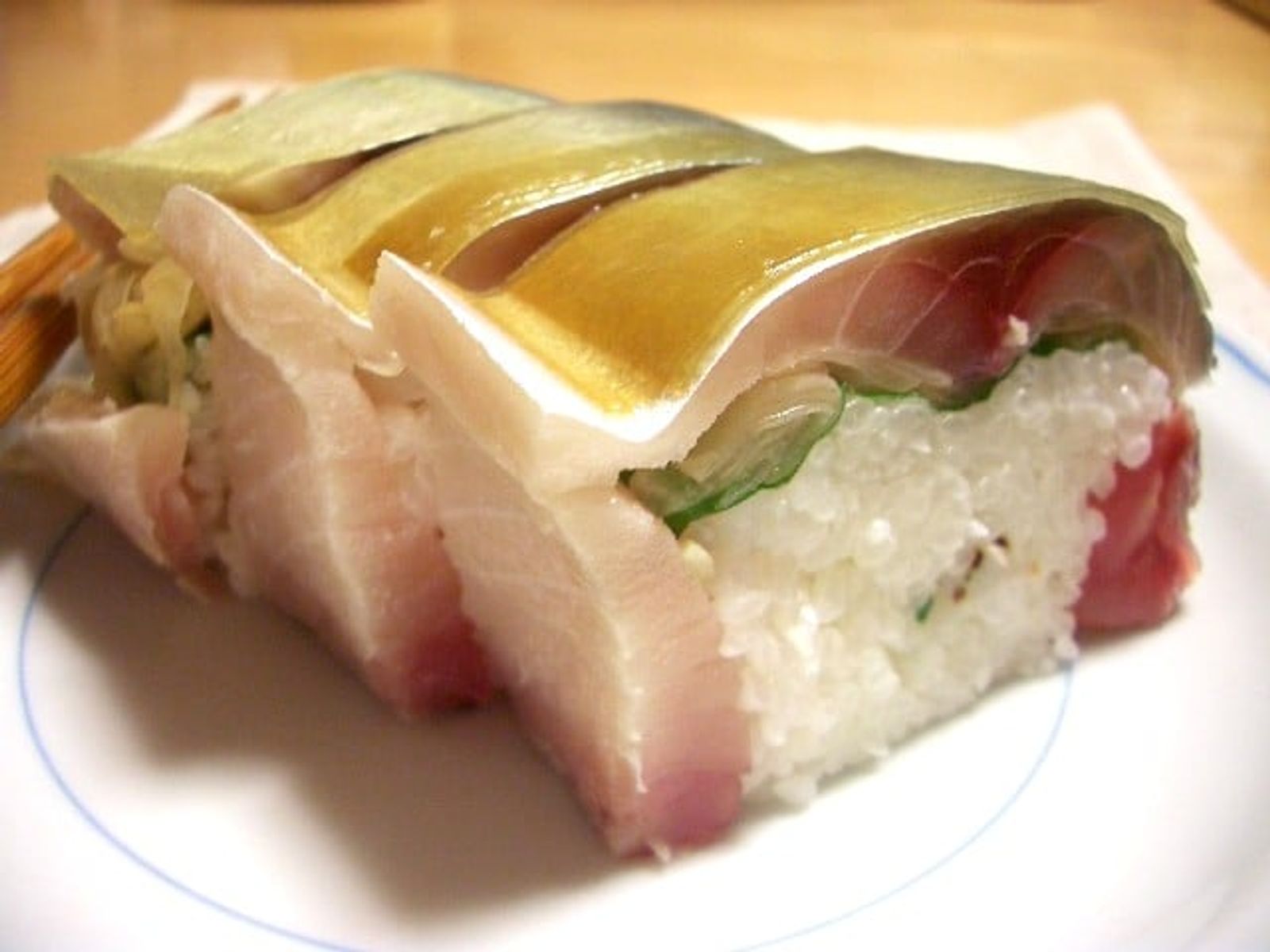
Mackerel battera topped with white kombu · Photo: Kanko* from Nagasaki, Japan / CC BY 2.0 (Wikimedia Commons)
 JapanOsaka
Battera and Hakozushi: Osaka's Pressed Sushi, and Why It Is Named After a Little Boat
In Tokyo, sushi means hand-formed nigiri, but in Osaka the classic is oshizushi, rice and toppings pressed in a wooden box. Here is where battera, vinegared mackerel under a sheet of kombu, and colorful hakozushi came from, and how to enjoy them.
Osaka Sushi Is Pressed, Not Hand-Formed
Japan's Ministry of Agriculture describes Osaka-zushi as the umbrella term for the sushi made in Osaka. It includes pressed sushi (oshizushi), rolled sushi and steamed sushi, but the signature style is oshizushi, made by layering rice and toppings and pressing them firmly together. That is a clear contrast with Tokyo, where sushi usually brings hand-formed nigiri to mind. Pressed sushi goes back a long way. A cookbook published in 1728, Ryori Komoku Chomisho, mentions 'pouring vinegar on hakozushi', showing that boxed sushi made with vinegar was already established by then. When introducing battera, the Ministry describes this Kansai pressed sushi as a separate lineage from Edo's hand-formed sushi.
Battera: A Name From the Portuguese Word for 'Little Boat'
Battera (バッテラ) is vinegared mackerel (shime saba) laid on sushi rice, covered with a thin, translucent sheet of white kombu (shiroita kombu) and pressed in a wooden mold. The Ministry of Agriculture says it was invented in the Meiji era by a sushi shop in Minami-Senba. It dates this to 1891, while other sources say around 1893, so accounts differ. The first version used gizzard shad (konoshiro) caught in Osaka Bay. Laying a split fish on the rice made one end taper toward the tail, giving the sushi a pointed shape that looked like a small boat, so it was named after the Portuguese word bateira, meaning 'little boat'. Later the fish was replaced by mackerel, which was more stable in price, and the mold became a square box.
A Sheet of White Kombu and Osaka's Kombu Culture
The translucent kombu on top of battera is also called battera kombu in Osaka. It was originally the core left over after kombu is shaved into fine oboro kombu, and since there is not enough to meet demand, sheets made from compressed kombu powder are sold too. Moistened with vinegar and laid on top, it adds savory depth and a soft texture while taming any fishy smell. That single sheet carries Osaka's kombu history. According to the Osaka Convention and Tourism Bureau, kombu from Hokkaido was shipped to Osaka and Sakai in the Edo period by kitamaebune trading ships sailing the Sea of Japan route, and Sakai's famous knife-making skills helped develop shaved products like oboro kombu. Osaka is still described as Japan's top consumer of kombu.
Hakozushi: The 'Kaiseki in a Small Box' Loved by Senba's Merchants
If battera is the people's sushi, hakozushi is sushi for entertaining guests. According to the Ministry of Agriculture, ordinary people had long enjoyed pressed sushi made with everyday fish like mackerel and horse mackerel, but in the Meiji era a sushi shop in Senba, Osaka's merchant district, created hakozushi using luxury ingredients such as sea bream, shrimp and conger eel. Cut into bite-sized pieces and lined up in bright colors, hakozushi was ideal as a lunch box between acts at the theater or as a gift, and it won over Senba's wealthy merchants. It even earned the nickname 'kaiseki in two sun six bu' (about 8 cm). Osaka sushi rarely uses raw fish, relying instead on vinegared mackerel, kombu-cured sea bream, grilled conger eel, boiled shrimp and rolled omelet, and the rice is cooked with kombu stock so it tastes good even cold.
How to Eat It and Where to Buy It
Battera is seasoned enough to eat as is, without soy sauce, and the Ministry of Agriculture notes it is served with sweet pickled ginger. Because pressed sushi is made by squeezing out the air, it keeps well, and it is said to taste even better after a short rest as the rice and toppings meld, which makes it a good take-out lunch or gift. You can buy battera not only at Osaka sushi shops but also cheaply at supermarkets and convenience stores. Hakozushi, on the other hand, takes a lot of work, from curing fish in vinegar to simmering shiitake, and fewer shops make it now. Its home is the old merchant district of Senba and Minami-Senba in central Osaka, so look for 'Osaka-zushi' or 'hakozushi' on sushi menus around there.