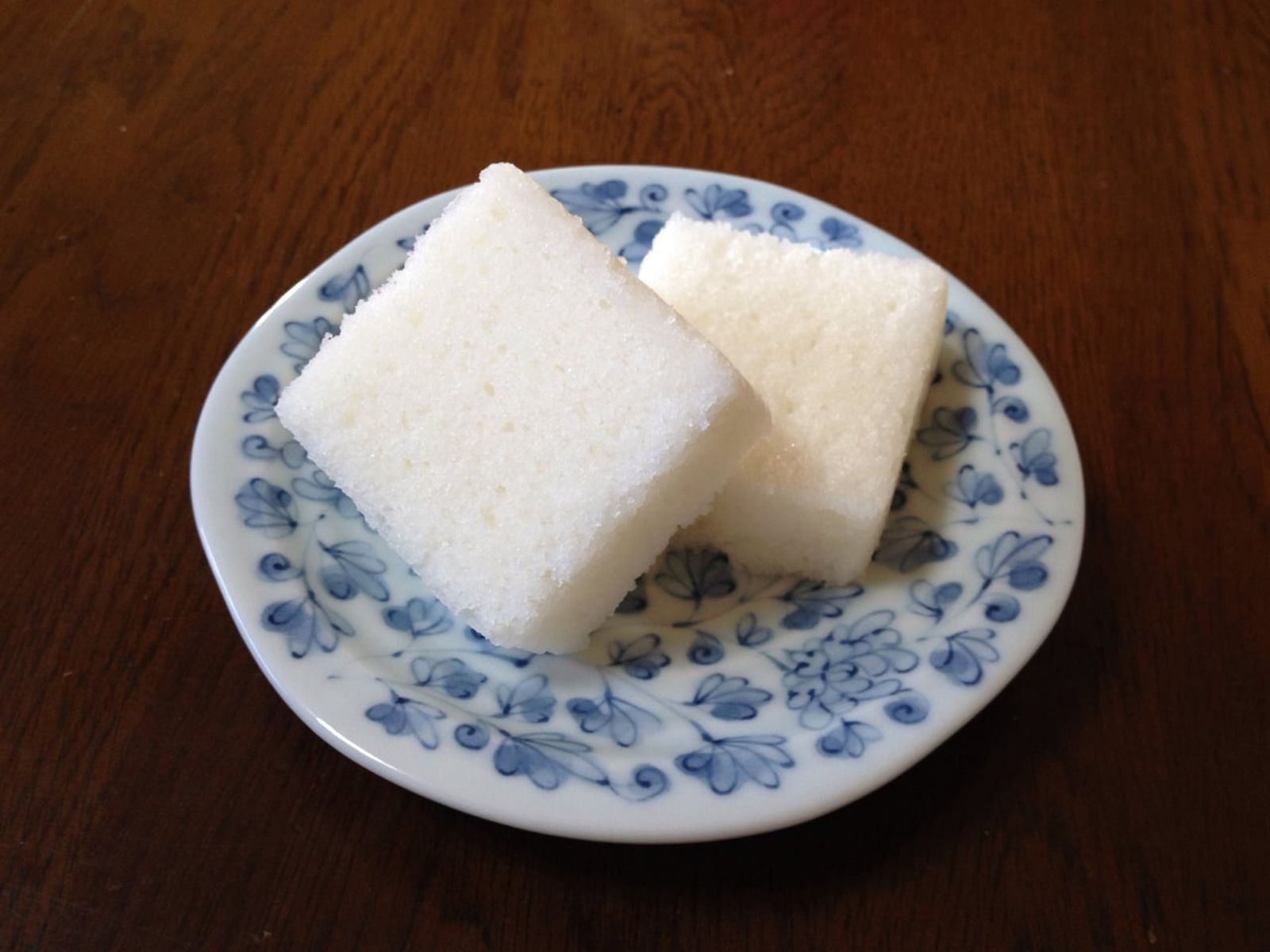
Slices of karukan · Photo: Σ64 / CC BY 3.0 (Wikimedia Commons)
 JapanKagoshima
Karukan: Satsuma's Steamed Yam Cake Once Reserved for Lords
Karukan, Kagoshima's famous sweet, is snow white, fluffy and slightly springy. Made only from grated mountain yam, rice flour and sugar, it comes with several origin stories. Here is why it took root in Satsuma and how the bean-filled karukan manju came about.
What Karukan Is
Karukan is Kagoshima's signature sweet: a batter of grated mountain yam (wild jinenjo or yamato-imo), rice flour, sugar and water, steamed. It uses a special coarse flour, karukan-ko, made from rice that is washed, dried and roughly ground. Kagoshima Prefecture's local food certification describes it as a simple traditional Satsuma sweet made only from wild yam, rice flour and sugar. It is written 軽羹, said to mean 'light yokan'. According to the Ministry of Agriculture the name comes from the way the batter becomes lighter after steaming than before. It looks like snow-white sponge cake, but one bite reveals a fluffy texture with the slight springiness of yam, a gentle sweetness and the yam's aroma.
Who Invented It? Conflicting Origins
Accounts of karukan's origin differ. The long-favoured theory is that it was devised by Yashima Rokubei, a confectioner from Akashi whom Shimazu Nariakira, 11th lord of the Satsuma Domain, invited from Edo to research preserved foods. The Ministry of Agriculture also presents this as the leading theory, and the date has traditionally been given as 1854. Kagoshima Prefecture, however, says the oldest record is the banquet for Lord Shimazu Tsunataka's 50th birthday in 1699, and research indicates it was already being made in Satsuma between 1686 and 1715, appearing beside yokan in a lord's meal record of 1715. Some therefore see Yashima as having improved an existing sweet. Either way, it has been part of Satsuma life for well over two or three centuries.
Why Satsuma? Yams From the Shirasu Plateau and Sugar From the Southern Islands
Karukan took root in Satsuma largely because its ingredients were close at hand. Wild jinenjo yam grew abundantly on Kagoshima's shirasu volcanic plateau, and the Satsuma Domain could obtain sugar fairly easily from the Amami Islands and Ryukyu. Sugar was still precious, so karukan was at first a tonosama-gashi, a 'lord's sweet' eaten by the ruling family. Even after sweet prices were cut in 1786, a record says one box of karukan cost about as much as one to (about 18 litres) of sake. It was a formal sweet for weddings, New Year and other celebrations, and it is said to have spread widely among ordinary people only from the Meiji era.
Karukan Manju, With Sweet Bean Paste Inside
Karukan was originally steamed as a square block and sliced. According to Kagoshima Prefecture, about 150 years after it was born the bean-paste-filled karukan manju appeared, making it a popular everyday snack as well. Today the manju form is actually more common and is what you see most often as a Kagoshima souvenir. Dough for manju uses less water and is kneaded firm, wrapped around sweet bean paste, shaped and steamed. The Ministry of Agriculture notes that autumn into winter, when wild yams come into season, is sometimes called 'karukan season', when you can taste it made with freshly dug yam. A similar Kagoshima sweet, fukure-gashi, is a fluffy steamed cake of brown sugar and wheat flour said to have been inspired by karukan.
Where to Buy It and How to Choose
Karukan is easy to buy at Japanese confectioners and in the shopping arcades of Kagoshima City, and at souvenir counters in Kagoshima-Chuo Station and Kagoshima Airport. It is still widely used as a return gift at weddings and funerals, so for locals it is also a taste of special occasions. Some families make it at home, and cooking classes teach the method. When choosing, check the ingredients. As in the prefecture's local food certification, versions made only from wild yam, rice flour and sugar have the traditional flavour. Block-style karukan is good for enjoying the pure aroma of yam, while karukan manju adds the sweetness of bean paste and is easy for first-timers. Paired with green tea, its gentle sweetness comes through even more.