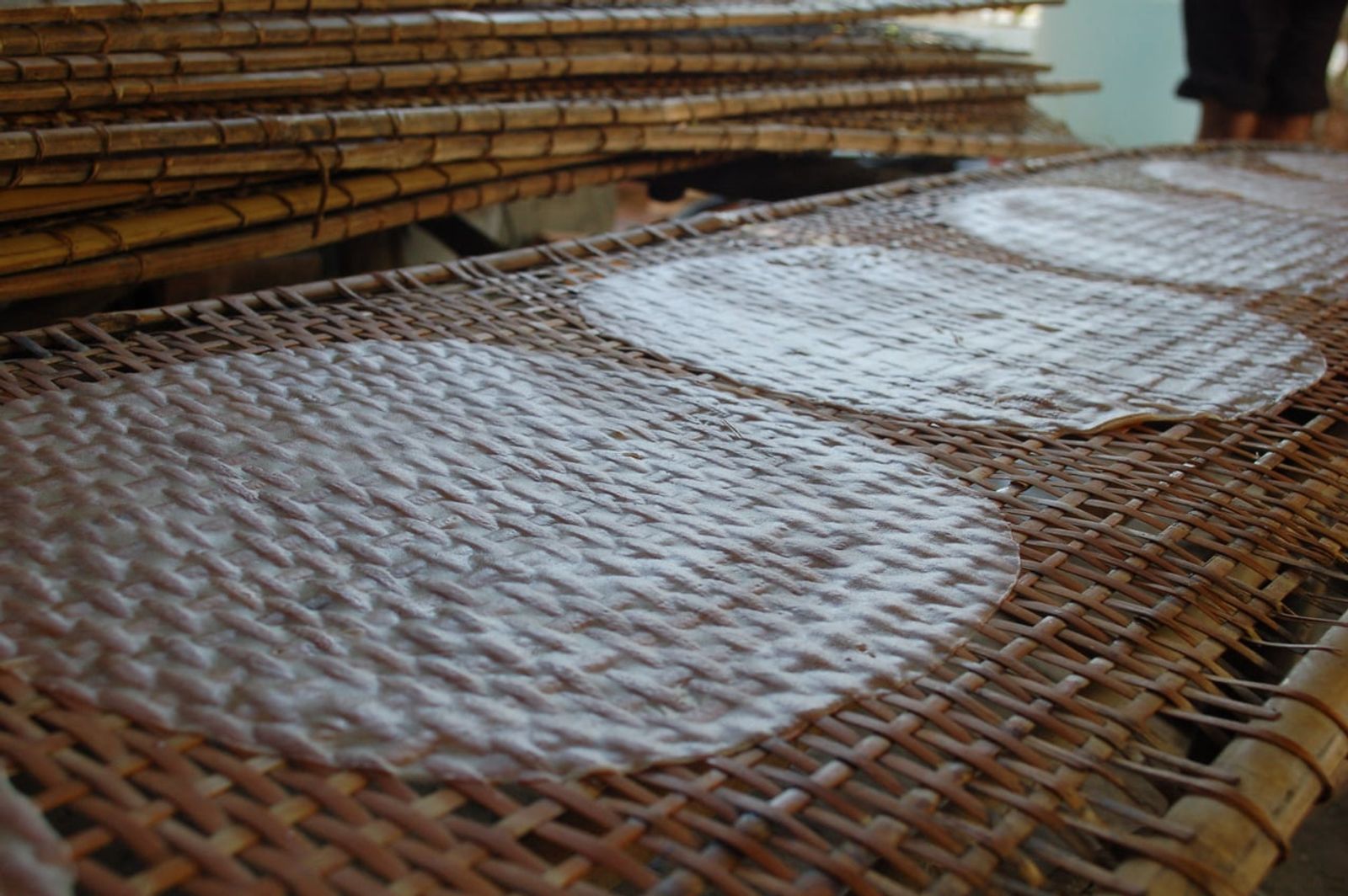
Handmade rice paper drying in the sun on bamboo mats · Photo: Wanderingspoon / CC BY-SA 4.0 (Wikimedia Commons)
 Vietnam
Rice Made Into Everything: Phở, Bún, Hủ Tiếu, Mì and Rice Paper Explained
Vietnamese menus are full of noodle names: phở, bún, hủ tiếu, mì, bánh canh. They may all look like rice noodles, but the ingredients, shapes and ways of eating differ. Here is a simple map of Vietnamese noodles that makes ordering easier, plus the story of rice paper.
The Noodle Name Is the Menu
In rice-growing Vietnam, rice is not only eaten as grains; it is ground into flour and turned into noodles, cakes and even paper-thin wrappers. That is why Vietnam has so many noodle dishes, and why the noodle comes first in a dish's name. Bún bò Huế, for example, means "bún noodles + beef + Huế style". Noodles are also divided into fresh (tươi) and dried (khô), but for travellers the ingredient and shape matter more. Flat rice noodles are phở, thin round ones are bún, the chewy southern kind is hủ tiếu, wheat or egg noodles are mì, thick springy ones are bánh canh and clear glass noodles are miến. Learn these six and you can make a good guess at almost any unfamiliar menu item.
Phở and Bún: Flat Noodles and Round Noodles
Phở noodles are flat strips cut from thin sheets of steamed rice batter, and they come in a range of widths. The signature dish is the beef noodle soup of the same name, and they are also stir-fried as phở xào. Bún are thin, round white rice noodles, the most widely used noodle in Vietnam. They go into soups, but very often they are served without broth, at room temperature, topped with grilled meat and fresh greens, with nước chấm poured over or for dipping. Hanoi's bún chả with chargrilled pork, the spicy beef soup bún bò Huế, the tangy crab soup bún riêu and southern bún thịt nướng with grilled pork and peanuts are all bún dishes.
Hủ Tiếu and Mì: Noodles From China
Hủ tiếu was brought to Vietnam by the Teochew people of Guangdong, and its name comes from the Teochew word for 粿條 (kway teow). It began as a soft, flat rice noodle like phở, but in the South it developed into a chewier noodle and became hugely popular in 1960s Saigon. Its broth, made from pork bones, dried squid and dried shrimp, is slightly sweet, and you order it as hủ tiếu nước (in soup) or hủ tiếu khô (dry, tossed, with the broth on the side). Hủ tiếu Nam Vang, "Phnom Penh style", is especially famous. Mì are yellow noodles made from wheat flour or egg, used in Chinese-influenced dishes such as mì hoành thánh, wonton noodle soup. Central Vietnam's mì Quảng, despite its name, is made with rice noodles.
Bánh Canh, Miến and Bánh Cuốn: Thick, Clear and Steamed
Bánh canh are thick noodles made from rice flour mixed with tapioca or wheat flour, plump and chewy like Japanese udon. Varieties include translucent, bouncy bánh canh bột lọc made with tapioca and bánh canh Trảng Bàng made with rice flour, and the broth tends to turn slightly thick. Miến are thin, clear, slightly chewy glass noodles, used mostly in soups such as miến lươn with eel or miến gà with chicken. Not a noodle, but worth knowing alongside them, is bánh cuốn: rice batter spread thinly over cloth and steamed into broad sheets, then rolled around minced pork and wood ear mushroom and dipped in nước chấm.
Paper Made of Rice: Bánh Tráng
Rice paper, familiar abroad as the wrapper for fresh spring rolls, is bánh tráng in Vietnamese. A batter of rice flour, tapioca starch, water and salt is steamed into thin rounds and then sun-dried, often on bamboo mats that leave a crosshatch pattern on the surface. In the North it is called bánh đa nem, and very thin sheets made with rice flour alone, without tapioca, are also used. Rice paper wraps gỏi cuốn, fresh rolls of greens, shrimp, pork and bún, and chả giò, fried rolls known as nem rán in the North. In the South a popular snack is bánh tráng trộn, strips of rice paper tossed with dried shrimp and other toppings. At home, the trick is to dip it in water only very briefly so it does not tear.