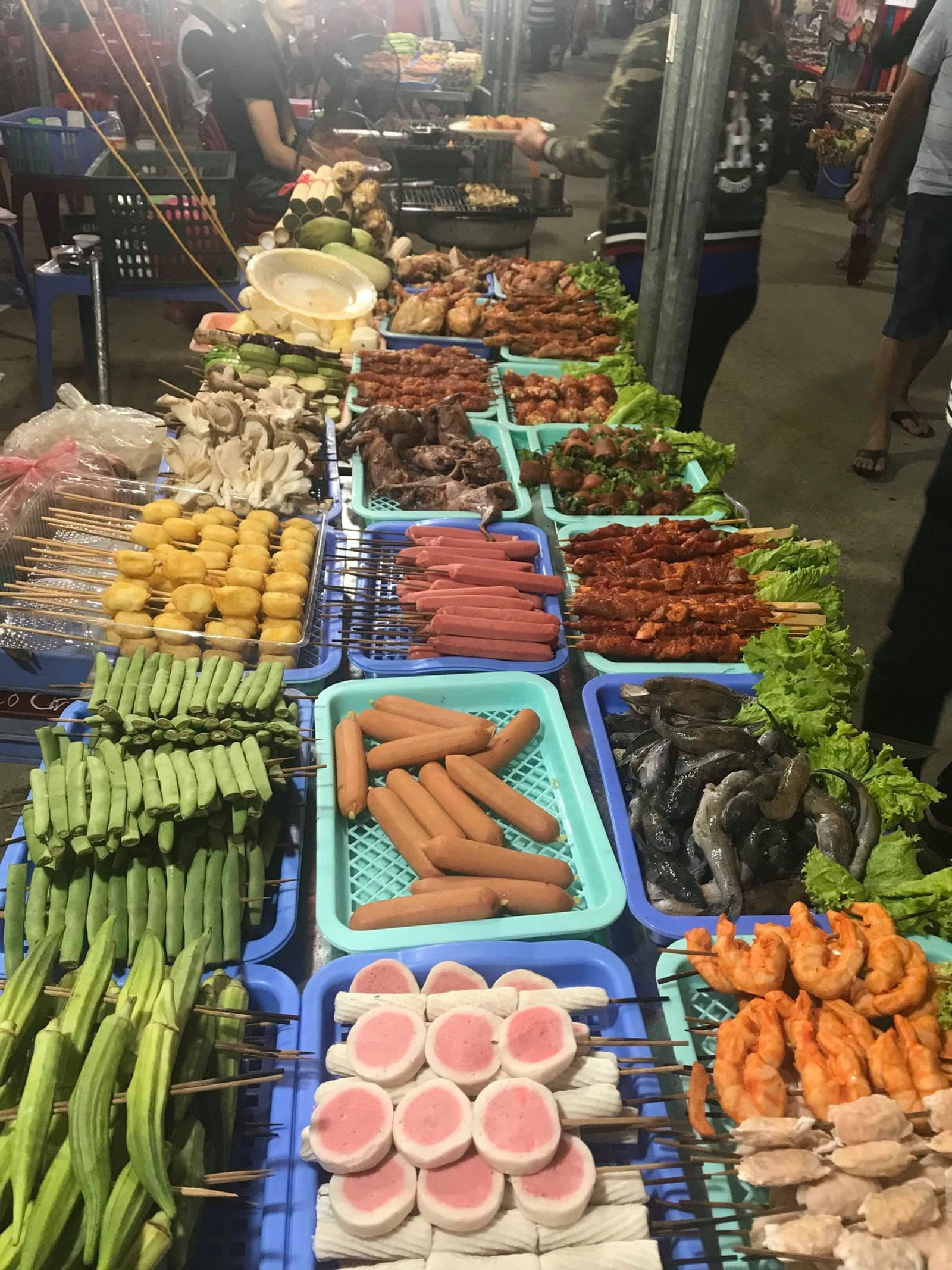
Skewers ready for the grill on a Sa Pa grill street · Photo: Buihaidang192 / CC BY-SA 4.0 (Wikimedia Commons)
 Vietnam
The Pig You Carry Under Your Arm: Lợn Cắp Nách and Bamboo-Tube Rice in Sa Pa
The lợn cắp nách you see on Sa Pa menus literally means "pig carried under the arm." Here is how this small free-range mountain pig got its name, how it is cooked, and the bamboo-tube rice served alongside.
Literally, "the Pig Under Your Arm"
In lợn cắp nách, lợn means pig and cắp nách means "to tuck under the arm." The pig is small enough to carry in a basket or under one arm, and Vietnamese Wikipedia stresses that the name is literal, not a figure of speech. Villagers really did carry these pigs under their arms on the way to market. Depending on the area it is also called lợn Mường Sapa, lợn lửng or lợn còi. Wikipedia describes it as a traditional breed descended from a cross between wild boar and Mường pigs. Sources vary widely on size, from about 4 kg to just under 25 kg, but 10 to 20 kg is the range most often given.
Raised Free in the Hills
Lợn cắp nách is said to owe its flavour to the way it is raised. According to Vietnamese Wikipedia, the Dao, Thái and H'Mông of Lào Cai have traditionally kept these pigs, often without pens, letting them roam forests and hillsides. The pigs forage for wild roots, tubers and leaves, and people add only the occasional handful of corn or cassava. Some families even release a breeding pair into the forest to raise a litter. Growing this way is slow; one source says they gain at most about 10 kg a year. The result is firm meat with only a thin layer of fat. Vietnamese travel media likewise describe it as a native pig grazed freely on mountain slopes, with firm, sweet meat and little fat. Today some farms fence off parts of the forest to raise them commercially.
A Fixture of Highland Markets
Lợn cắp nách is tied to market-day life in the Lào Cai highlands. Vietnamese Wikipedia names Bắc Hà, Sín Chéng, Cán Cấu and Mường Khương among the markets where it is traded, and notes that at some of them the pigs are sold by the head rather than by weight. Similar pigs are raised across the northwestern highlands, not only in Sa Pa and Lào Cai but also in Lai Châu, Yên Bái and Hoàng Su Phì in Hà Giang. So it is better thought of as a pig of Vietnam's whole northwestern mountain region than as the specialty of a single village. Still, Sa Pa is one of the easiest places for travellers to try it. Grilled lợn cắp nách is a common sight on menus in town and along the evening grill streets.
Grilled, Steamed and Served With Bamboo Rice
Lợn cắp nách is most often grilled over charcoal or roasted whole (quay) until the skin crackles. The rest of the animal is steamed, stir-fried, boiled, made into sausage and turned into bone broth. The dish Vietnamese Wikipedia rates as the best is sausage (lòng dồi) and belly meat still on the ribs, steamed in a water bath and dipped in pounded lá nhội leaves mixed with hạt xẻn or hạt dổi seeds and green chilli. On Sa Pa's grill streets the meat is usually marinated with local pepper-like spices such as mắc khén and hạt dổi and Mường Khương chilli sauce, then cooked over charcoal. The ideal partner is cơm lam, bamboo-tube rice. Upland sticky rice is packed into a bamboo tube and roasted, then eaten with sesame salt or crushed peanuts, or alongside grilled meat. It does not keep well, so eat it warm. To drink, it is often paired with táo mèo wild apple liquor or corn liquor.
Spotting the Real Thing and Ordering Tips
As lợn cắp nách became famous, so did imitations. Vietnamese Wikipedia warns that crossbred or corn-fed pigs are often sold under the name, and says the genuine article is mountain-raised, firm and lean with thin fat. It is hard for a traveller to check the breed in a restaurant, but if the fat is thick and the meat soft, the name may be all that is borrowed. Judge it by crisp skin and springy meat rather than by the menu label and you are less likely to be disappointed. A good order for a group is a plate of roast pork with cơm lam and stir-fried mountain greens. On Sa Pa's grill streets you usually pick skewers and have them grilled on the spot, so add some mushroom and vegetable skewers too.