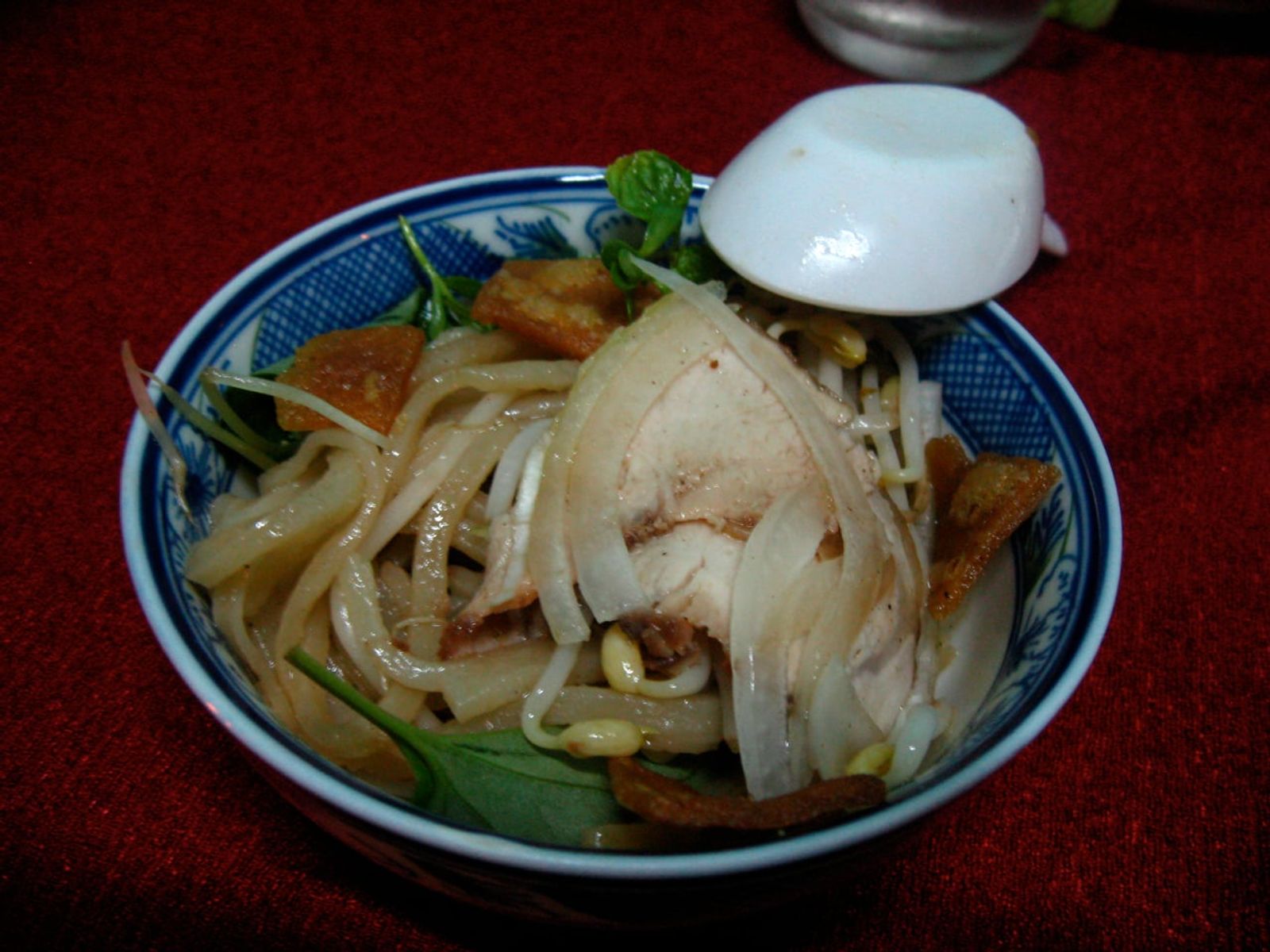
A bowl of cao lầu in Hội An · Photo: Dragfyre / CC BY-SA 3.0 (Wikimedia Commons)
 VietnamHoi An
Cao Lầu: The Legend and Reality of Hội An's Lye-Water Noodles
They say you cannot get the real thing outside Hội An. Here is the story of cao lầu: chewy noodles made with wood-ash lye, the legend of an ancient well, how it differs from mì Quảng, and how to mix and eat it properly.
The Noodle Eaten Upstairs
The name cao lầu corresponds to the Chinese characters for "high" (高) and "pavilion" or "upper storey" (樓). The usual explanation is that it was a fine dish that Hội An's merchants ate upstairs in their shophouses, looking down over the trading street below. Hội An was an international port frequented by Japanese and Chinese traders around the 16th and 17th centuries, and its whole old town was inscribed as a UNESCO World Heritage Site in 1999. Cao lầu is often said to have appeared around the 17th century. Its origins, however, are told in several ways: brought by Chinese merchants, influenced by the Japanese trading community, or linked back to the earlier Champa era, and sources disagree. What is certain is that it is a noodle shaped by a port town where many cultures met.
Wood-Ash Lye and the Legend of the Old Well
Everything about cao lầu starts with the noodles. The rice is treated with lye water made from wood ash (nước tro), which gives the noodles their chewy, springy bite and a greyish-brown or yellowish tint. The noodles are soaked for several hours, washed and then boiled. A famous legend comes attached. The lye, it is said, must come from the ash of particular trees on the Cham Islands (Cù Lao Chàm) off Hội An, and the water must be drawn from Bá Lễ, an ancient well in town, or it is not real cao lầu. That is why people say you will rarely find it outside Hội An. Even Vietnam's tourism board notes that most restaurants probably no longer follow this purist recipe. Enjoy the legend as a legend, and simply remember that the lye-noodle texture is what defines this dish.
How It Differs From Mì Quảng
Because both come from the former Quảng Nam area, many people confuse cao lầu with Da Nang's mì Quảng, but they are quite different. The biggest difference is the noodle. Mì Quảng uses wide, soft noodles cut from steamed rice sheets and often tinted yellow with gardenia or turmeric, while cao lầu noodles are treated with lye, making them much firmer and chewier and closer to greyish-brown. The toppings differ too. Cao lầu uses pork marinated with five-spice, sugar, soy sauce and garlic, so it tastes similar to Chinese-style char siu (xá xíu). A signature touch is the crisp "noodle croutons": squares of raw noodle dough deep-fried until crunchy. The broth is made from pork bones, and only enough is poured to moisten the noodles.
How to Eat Cao Lầu Properly
A bowl of cao lầu is usually built in layers. Fresh greens and herbs such as lettuce, bean sprouts, mint, perilla and coriander go in first, the noodles go on top, and then thin slices or shreds of pork. A small splash of broth moistens the noodles, and the crunchy fried noodle squares and more herbs finish it off. Before eating, always mix from the bottom up. The dish only comes together once the greens underneath have soaked up the broth and seasoning and mingled with the noodles. Squeeze in lime and add chilli or chilli jam to taste. Cao lầu is not served piping hot; it usually arrives warm or close to room temperature, so do not worry that it has gone cold. A small trick: eat a few of the crispy squares first, before they soften.
Where to Eat It and Ordering Tips
Cao lầu is easy to find all over Hội An's old town: in the food halls in and around the central market near the Thu Bồn River, in small eateries along the lanes and at riverside restaurants. The market is the place for a quick local-style bowl; the riverside is better for a slow meal with a view. To order, "Cao lầu" is all you need to say, and some places also offer a version with shrimp instead of pork. Elsewhere, in Da Nang or Hồ Chí Minh City, it is much harder to find, which is why people say you should eat it at least once while you are in Hội An. Try a bowl of mì Quảng on the same day and you will clearly feel the difference between the two noodles, which makes for a fun comparison.