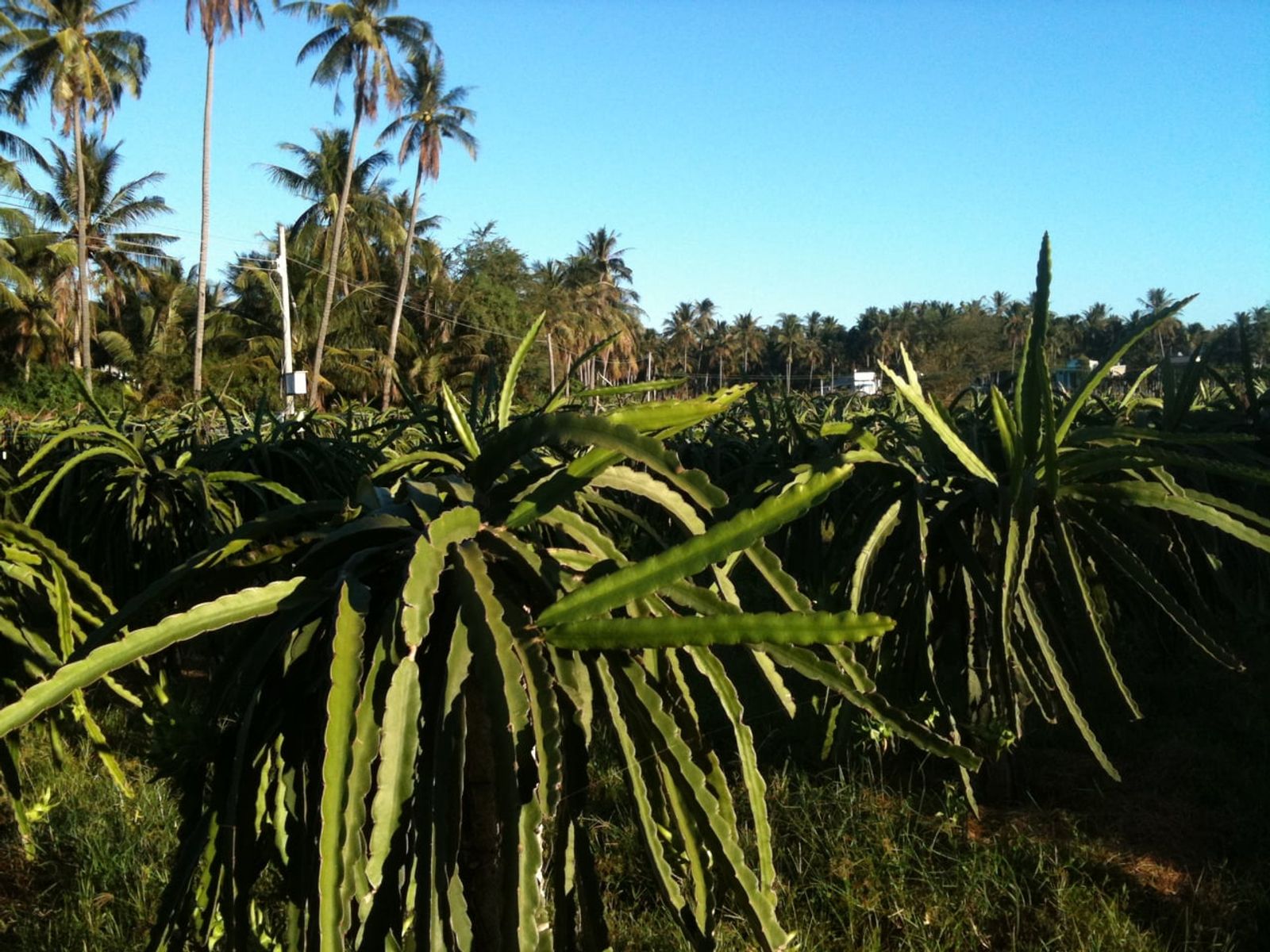
A dragon fruit farm in Phan Thiết · Photo: Dragfyre / CC BY-SA 3.0 (Wikimedia Commons)
 Vietnam
Bình Thuận Dragon Fruit: Vietnam's Signature Growing Region and Its Lit-Up Night Fields
The endless rows of cactus along the road to Mũi Né are dragon fruit, thanh long in Vietnamese. Here is how this area became one of Vietnam's leading producers, what its geographical indication protects, why farmers light the fields at night, and how to enjoy the fruit locally.
One of Vietnam's Leading Dragon Fruit Regions
The former Bình Thuận province, home to Phan Thiết and Mũi Né, is one of Vietnam's biggest dragon fruit growing areas. A 2018 report by the business outlet VnBusiness put the planted area at about 27,700 hectares and annual output at more than 540,000 tonnes, with some 9,500 hectares meeting the VietGAP good-practice standard. In 2023 the Communist Party daily Nhân Dân gave the area as nearly 30,000 hectares, so the figures vary by year and source. According to the same report, the main growing districts are Hàm Thuận Nam, Hàm Thuận Bắc and Bắc Bình. Driving along the highway and between villages there, you pass field after field of cacti climbing concrete posts in long rows. Bình Thuận was folded into Lâm Đồng province in the July 2025 provincial merger, but the fruit is still sold under the Bình Thuận name.
A Cactus Fruit From the Americas
Dragon fruit is the fruit of a climbing cactus native to Mexico and Central and South America. It is now grown across Southeast Asia, and Vietnam is one of the world's leading producers. The most common Vietnamese type has pink-red skin and white flesh (Hylocereus undatus), and a red-fleshed variety improved by the Southern Fruit Research Institute (SOFRI) is also widely planted. When dragon fruit first came to Bình Thuận is unclear; one local article simply says that at some point no one quite remembers, the fruit and the land of Phan Thiết and Bình Thuận found each other. What does seem clear is that the region's dry climate, with little rain and strong sun, suits a cactus like dragon fruit. As the red sand dunes around Mũi Né suggest, Bình Thuận is one of the driest stretches of Vietnam's coast.
The ‘Bình Thuận’ Geographical Indication
Bình Thuận dragon fruit is a protected geographical indication in Vietnam. According to the province's management regulations, Vietnam's Intellectual Property Office registered the appellation of origin ‘Bình Thuận’ for dragon fruit under Decision No. 786 on 15 November 2006. A geographical indication recognises quality that comes from a place's natural conditions and farming methods, and lets only producers in that area who meet the standards use the place name, much like Champagne or Darjeeling. At the time of the 2018 report, 88 organisations and individuals were certified to use the indication, and it was also registered for protection in the European Union. In 2021 it gained protection in Japan as well. Most of the crop is exported to China, and a 2023 Nhân Dân article put that share at about 95%, describing market diversification as an ongoing challenge.
Fields That Light Up at Night
The most striking sight in Bình Thuận's dragon fruit fields comes after dark. The plant tends to flower when days are long, so farmers switch on lamps at night to make it bloom out of season. The practice is called chong đèn, literally lighting the lamps. It lets growers avoid the price slump of the main harvest and pick fruit all year round. State broadcaster VOV quoted a local official calling night lighting the decisive factor for off-season yields, and reported that the power company was urging farmers to replace all their incandescent bulbs with energy-saving compact fluorescent lamps. A newspaper also profiled a farmer who cut his electricity bill sharply by swapping 60W incandescent bulbs for 20W fluorescents. That is why, on nights in the cooler months, the outskirts of Phan Thiết are said to glow with countless lamps over the fields.
Enjoying Dragon Fruit Locally
Dragon fruit is easy to buy at markets and roadside fruit stalls in Mũi Né and Phan Thiết, and being the growing region, prices tend to be gentler than in the big cities. The simplest way is to halve it and scoop it with a spoon, or cube it and eat it chilled. White flesh has a soft, refreshing sweetness, while red flesh is deeper in colour and sweeter. Be careful with red flesh: its juice stains clothes stubbornly. In Bình Thuận dragon fruit is not only dessert. VnExpress lists seafood salad with dragon fruit (gỏi hải sản thanh long) among the region's dishes worth trying, where the fruit's light sweetness pairs nicely with shrimp and squid. Dragon fruit juices and smoothies are everywhere at resorts and cafés. On the road from Phan Thiết to Mũi Né or towards Hàm Thuận Nam, you can watch endless rows of cactus pass by the window, so the journey itself becomes a tour of the region's specialty.