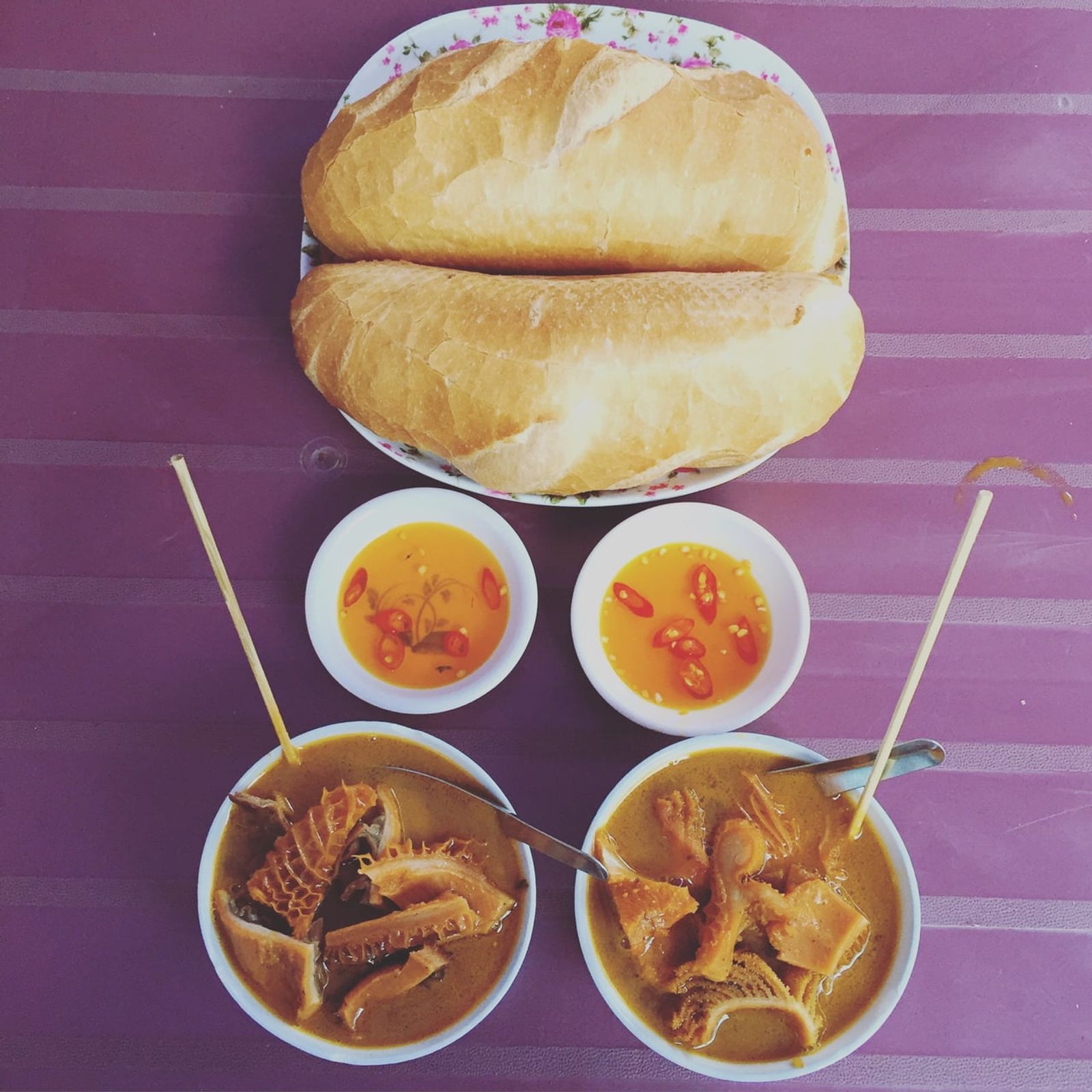
Two bowls of phá lấu served with baguettes · Photo: Policyandinternet / CC BY-SA 4.0 (Wikimedia Commons)
 VietnamHo Chi Minh City
Phá Lấu: How a Teochew Braise Became Saigon's After-School Snack
Offal simmered in a rich, coconut-scented broth and eaten with a baguette, phá lấu is a nostalgic street snack for Ho Chi Minh City locals. Here is how a Teochew Chinese braise turned into a Saigon classic, and how to eat it.
Everyone's Afternoon Snack
Phá lấu is beef or pork offal simmered for a long time in a spiced broth. VnExpress, Vietnam's most-read newspaper, writes that no one remembers when phá lấu first appeared, yet calls it a Saigon street food that has kept generations of students and office workers company. The classic time for phá lấu is late afternoon, when you are hungry between lunch and dinner or want something hot on a rainy day. People who went to school in Saigon often recall squatting on the sidewalk outside the school gate with a bowl of phá lấu noodles. It is less a meal than a treat, which is exactly why people love it.
Roots in Teochew Lou Braising
Phá lấu is said to come from the cooking of Teochew Chinese immigrants who settled in southern Vietnam, known in Vietnamese as người Tiều. VnExpress International likewise describes it as an offal stew of Chinese origin. According to the Saigon culture site Saigoneer, lấu refers to the Teochew technique of braising (滷) with soy sauce and spices, and Teochew braises are seasoned with five-spice powder and soy sauce. In China the method was often used for meats such as duck. There is, however, no clear record of when or how the braise took root in Saigon. As VnExpress put it, nobody remembers when phá lấu first appeared; it is known less for its beginnings than for the long years it has been loved on Saigon's streets.
What Saigon Changed: Offal and Coconut
What sets Saigon's phá lấu apart from Chinese braises is the ingredients and the broth. According to Saigoneer, cheap beef offal became the go-to ingredient on Saigon's streets, and versions made with pork offal are common too. That is why a single bowl usually mixes several cuts, such as tripe and intestine. The other change is coconut. Southern cooks often deepen soups with coconut water or coconut milk, and that is where phá lấu gets its rich, slightly sweet broth. VnExpress International also describes Ho Chi Minh City phá lấu with a broth made richer by coconut milk. Some see today's flavor as a blend of the tastes of the many communities that have long lived side by side in the south, and there are now versions that lean on black bean sauce (tương đen).
How to Eat It: Bread or Noodles
There are two main ways to eat phá lấu. One is to tear a baguette (bánh mì) and dip it into the bowl of offal and broth. The other is mì phá lấu, with yellow egg noodles added to the broth so it becomes more of a meal. If it is your first time, try it with bread. The bread soaks up the rich, coconut-scented broth, and you will understand right away why people love it. The condiments matter too. Pieces of offal are dipped in muối tiêu chanh, a mix of salt, pepper and lime juice, sometimes alongside a chili sauce. Some places also serve pickled bok choy or cucumber to cut the richness.
Where to Find It and How to Order
Phá lấu is mostly sold from small sidewalk stalls and carts. A big pot of broth bubbles away, and when you order, the vendor cuts the offal into bite-size pieces and ladles it into a bowl with the broth. Many stalls near schools, in residential alleys and around markets open from the afternoon, so a late-afternoon walk through any neighborhood will usually lead you to one. When ordering, just say whether you want it with bread (phá lấu bánh mì) or with noodles (mì phá lấu). A bowl usually mixes several cuts such as tripe and intestine, and some stalls let you choose. If offal is new to you, start with a small bowl, and pick a busy stall where the pot empties fast. Phá lấu can now be found in Hanoi too, but the coconut-rich Saigon taste is best enjoyed in Ho Chi Minh City.