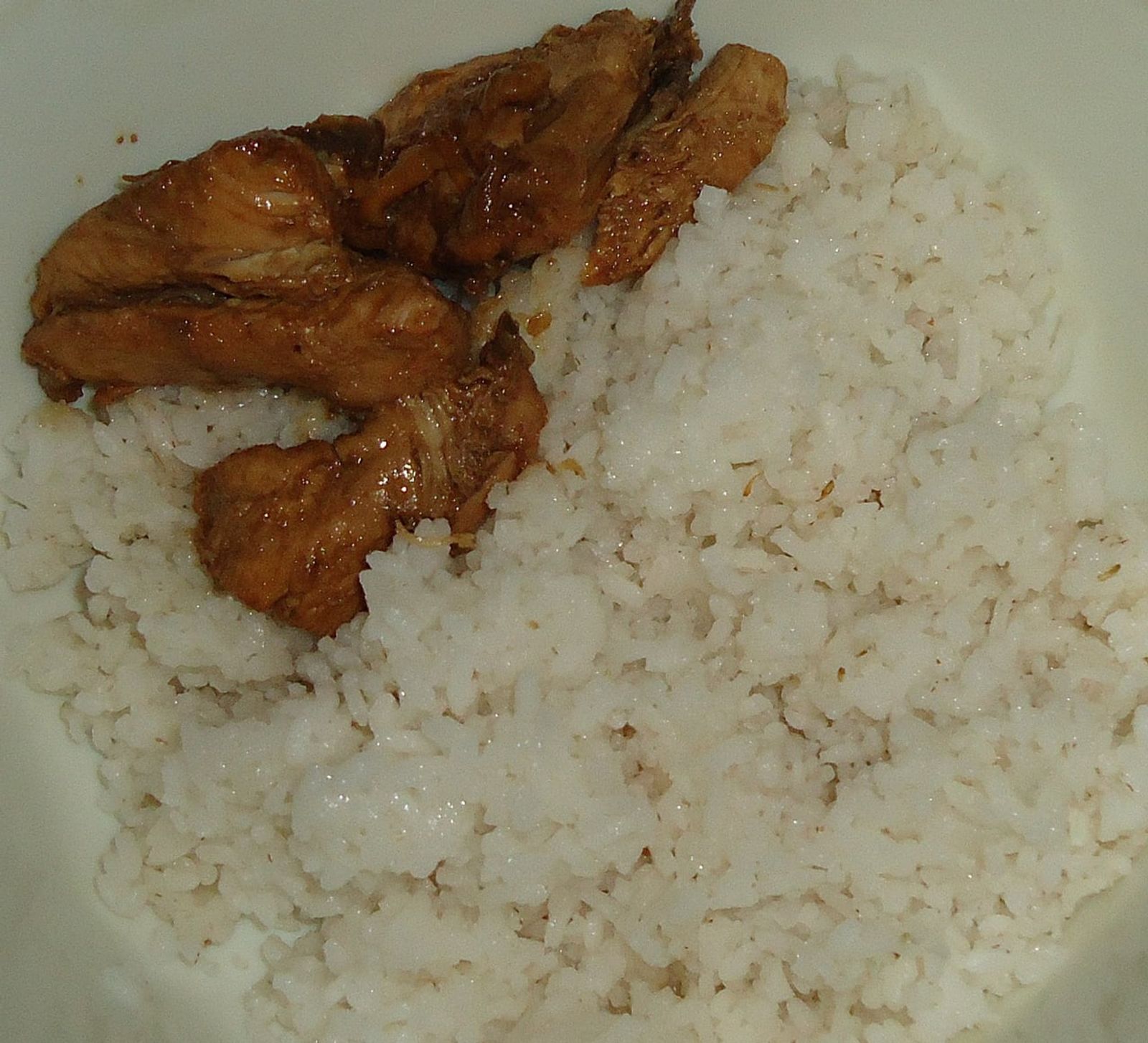
Chicken adobo served with rice · Photo: Obsidian Soul / CC BY-SA 3.0 (Wikimedia Commons)
 Philippines
Adobo: The Vinegar-Braised Dish Filipinos Call Their Own
Ask Filipinos to name the most Filipino dish and many will say adobo. The name is Spanish, but the technique of braising meat in vinegar is widely believed to be older. Here is where it came from, what goes into it, how it changes from home to home, and how to try it on the road.
The Unofficial National Dish
Adobo is chicken or pork braised with vinegar, soy sauce, garlic, whole peppercorns and bay leaves, and it is often described as the unofficial national dish of the Philippines. No law makes it so, but it turns up everywhere: on family tables, at neighbourhood eateries, in packed lunches and on holiday spreads. Its flavour rests on the balance between the sharpness of vinegar and the saltiness of soy sauce. The meat is marinated or simply simmered in the vinegar mixture, and as the liquid reduces, a rich, garlicky sauce clings to it. Filipino cooking is often said to prize the interplay of sweet, sour and salty, and adobo is where sour and salty come through most clearly. That is why people say it is only complete with a bowl of plain rice.
A Spanish Name for an Older Technique
The word adobo comes from the Spanish adobar, "to marinate". It first appears in writing in a Tagalog dictionary compiled in 1613 by the Spanish Franciscan missionary Pedro de San Buenaventura, which mentions "adobo de los naturales", the adobo of the natives. Because of that phrase, many researchers believe a local dish of meat cooked in vinegar already existed before the Spanish arrived and was simply given a Spanish name. The Spanish applied the same word to other vinegar-based dishes, so what the dish was originally called locally is unknown. The Filipino food historian Doreen Fernandez also raised the possibility of influence from Mexican adobo, while noting that the two dishes are quite different.
Vinegar: Keeping Food in the Tropics
Keeping food in a hot, humid climate is not easy. Before the Spanish era, people in the Philippines are known to have preserved food with vinegar and salt, and adobo shows that know-how well. Because vinegar inhibits bacterial growth, adobo keeps relatively longer than many other meat dishes. That is why it is commonly packed for hikes and long trips where there is no refrigerator. The vinegar is often coconut or cane vinegar, and soy sauce is usually explained as having taken over the role once played by salt. The "bay leaves" were traditionally leaves from a Cinnamomum tree, though today the ordinary bay laurel is the usual choice.
Every Home Has Its Own Adobo
There is no single fixed recipe for adobo. One household cooks chicken adobo dark brown with plenty of soy sauce, while another lets the vinegar lead for a sharper taste. Some add potatoes or boiled eggs. There are also many named variations. White adobo, made with salt instead of soy sauce, is called adobong puti, while Batangas and Laguna have adobong dilaw, turned yellow with turmeric. Adobo sa gata, made with coconut milk, is common in the Bicol region and Zamboanga, and there are seafood versions such as adobong pusit, squid braised with its ink. If you see "adobong ..." on a menu, the word that follows usually tells you the main ingredient or the style.
Trying Adobo on the Road, and the Standard Debate
Adobo is one of the most common dishes at a carinderia, the Philippines' everyday eatery, so you will find it without looking hard. Point to the pot on display, add rice, and you have a meal. Many people spoon the sauce over their rice, so feel free to ask for extra. It is so loved that it has even caused controversy. In 2021, when the Bureau of Philippine Standards under the Department of Trade and Industry announced plans to standardise adobo and other signature dishes, critics asked why a dish that tastes different in every home should be pinned down. The department clarified that the standard was not mandatory and was only meant as a benchmark for promoting Filipino food abroad. That there is no single right answer is, in the end, the most adobo conclusion of all.