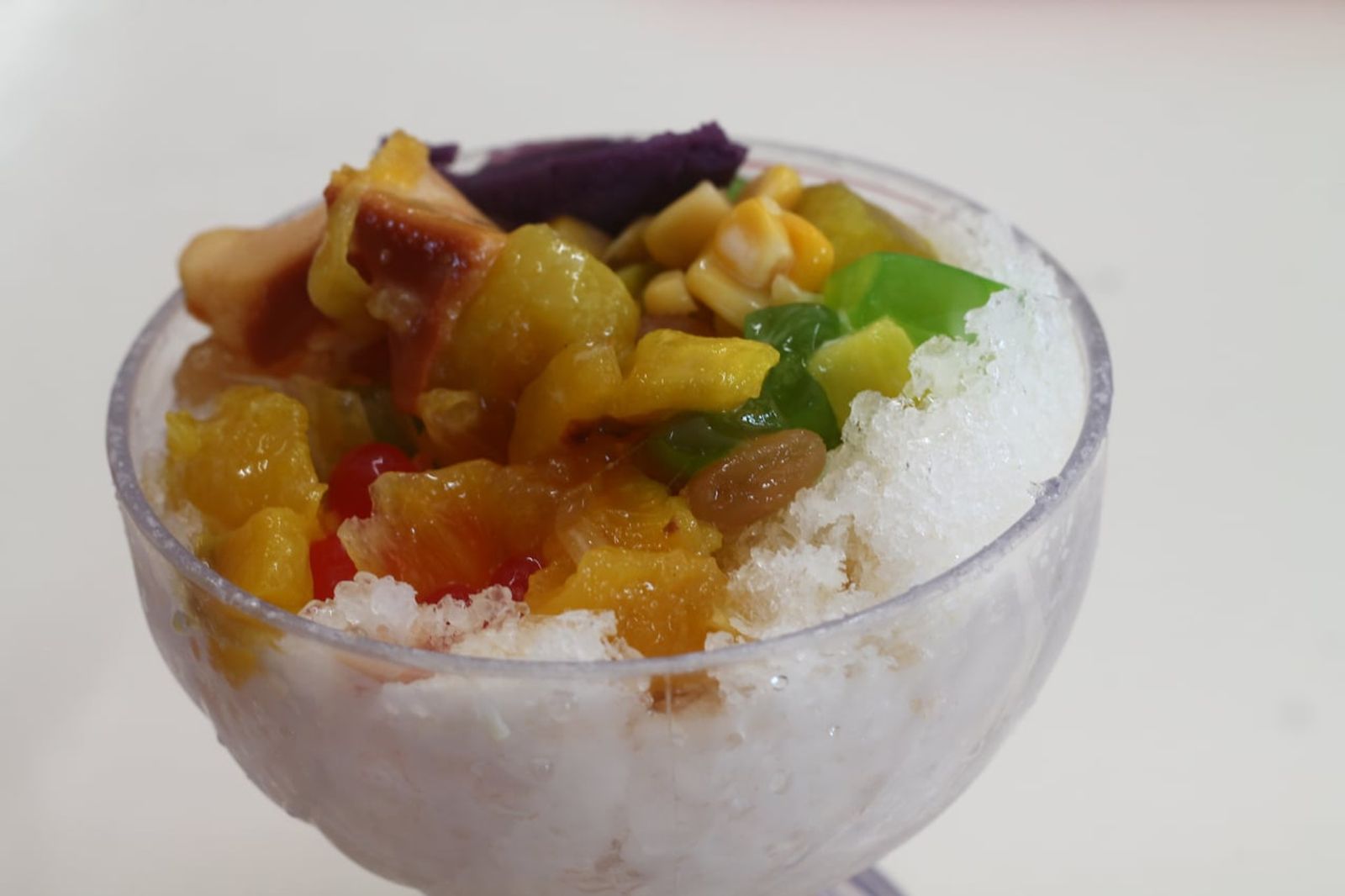
Halo-halo topped with fruit, jelly, beans and ube over shaved ice · Photo: Elmer B. Domingo / CC BY-SA 4.0 (Wikimedia Commons)
 Philippines
Halo-halo and Filipino Sweets: Mix-Mix Shaved Ice, Purple Ube and Rich Leche Flan
Halo-halo, the dessert of the Filipino summer, is shaved ice you are meant to "mix-mix" before eating. Here is its origin in the sweet-bean ice of Japanese migrants, the ingredients hiding under the ice, and the stories of the purple ube halaya and leche flan that crown it.
A Shaved Ice Called "Mix-Mix"
Halo-halo is Filipino shaved ice: sweet beans, fruit, jellies and more go in the bottom, shaved ice on top, and evaporated milk is poured over it. The name doubles the Filipino verb halò, "to mix", and is often translated as "mix-mix". The official spelling of the Commission on the Filipino Language is halúhalò. As the name suggests, eating it is simple. As soon as it arrives, take the long spoon and mix the ice, toppings and milk thoroughly from the bottom up. The colourful ingredients blend with the milk and ice so that every spoonful has a different texture. It resembles Korean patbingsu, but it holds far more ingredients, including tropical fruit and root crops.
Born from Japanese Migrants' Bean Ice
Halo-halo traces back to Japanese migrants living in the pre-war Philippines and to the Japanese kakigōri family of shaved ices. Its earliest local ancestor is said to be monggo con hielo, or mongo-ya: mung beans boiled in syrup served over crushed ice with milk and sugar. Some writers link the modern dessert to shaved ice sold by Japanese migrants around Quinta Market in Quiapo, Manila, in the 1920s or 1930s; the market was near an ice plant built by the Americans in 1902. Filipinos then added the tropical fruits and sweets they knew best, one by one, until it became the riot of colour it is today. Accounts differ a little on dates and places, so treat this as the commonly told story.
What Hides Under the Ice
There is no fixed recipe, but certain ingredients turn up again and again: saba bananas in syrup, jackfruit (langka), kaong palm fruit, macapuno coconut, gulaman jelly, tapioca pearls, nata de coco, sweet potato, sweetened beans, and pinipig, young glutinous rice pounded flat and toasted. These go into the bottom of the glass, shaved ice is piled high on top, and the whole thing is crowned with leche flan, ube halaya and/or ice cream before evaporated milk is poured over. Some places use coconut milk instead, and many leave out the ice cream. Think of it as a tropical assortment box in a glass. In the Visayas there is also binignit, a dessert with similar ingredients that is served hot.
Ube, the Star of Purple Desserts
The vivid purple that stands out in Filipino dessert shops comes from ube, the purple yam Dioscorea alata. It is a different crop from taro and from purple sweet potato. The basic form is ube halaya: peeled, boiled ube is grated and mashed, then stirred with butter and condensed milk (originally sweetened coconut milk) until thick, a kind of jam that is cooled and shaped. It may be topped with toasted grated coconut or latík, coconut cream cooked down into curds. Ube halaya is the base for ube ice cream, cakes and breads, and it also crowns halo-halo. You will also see it sold in jars and tubs at markets and bakeries.
Leche Flan, Made Rich with Yolks
The yellow custard that often sits on top of halo-halo is leche flan. The name comes from the Spanish flan de leche, "milk flan", but the Filipino version is denser and sweeter than the Spanish one, because it uses condensed milk and only egg yolks. As for the yolks, the story goes that during the 16th-century Spanish colonial period egg whites were mixed into mortar for buildings, and the leftover yolks went into flan. It is traditionally made in oval tin moulds called llaneras, lined with caramel, filled and steamed over a flame; baking it in an oven is less common. It is a fixture at birthdays, holidays and feasts, and it also appears in snacks such as puto flan, small steamed rice cakes topped with flan.