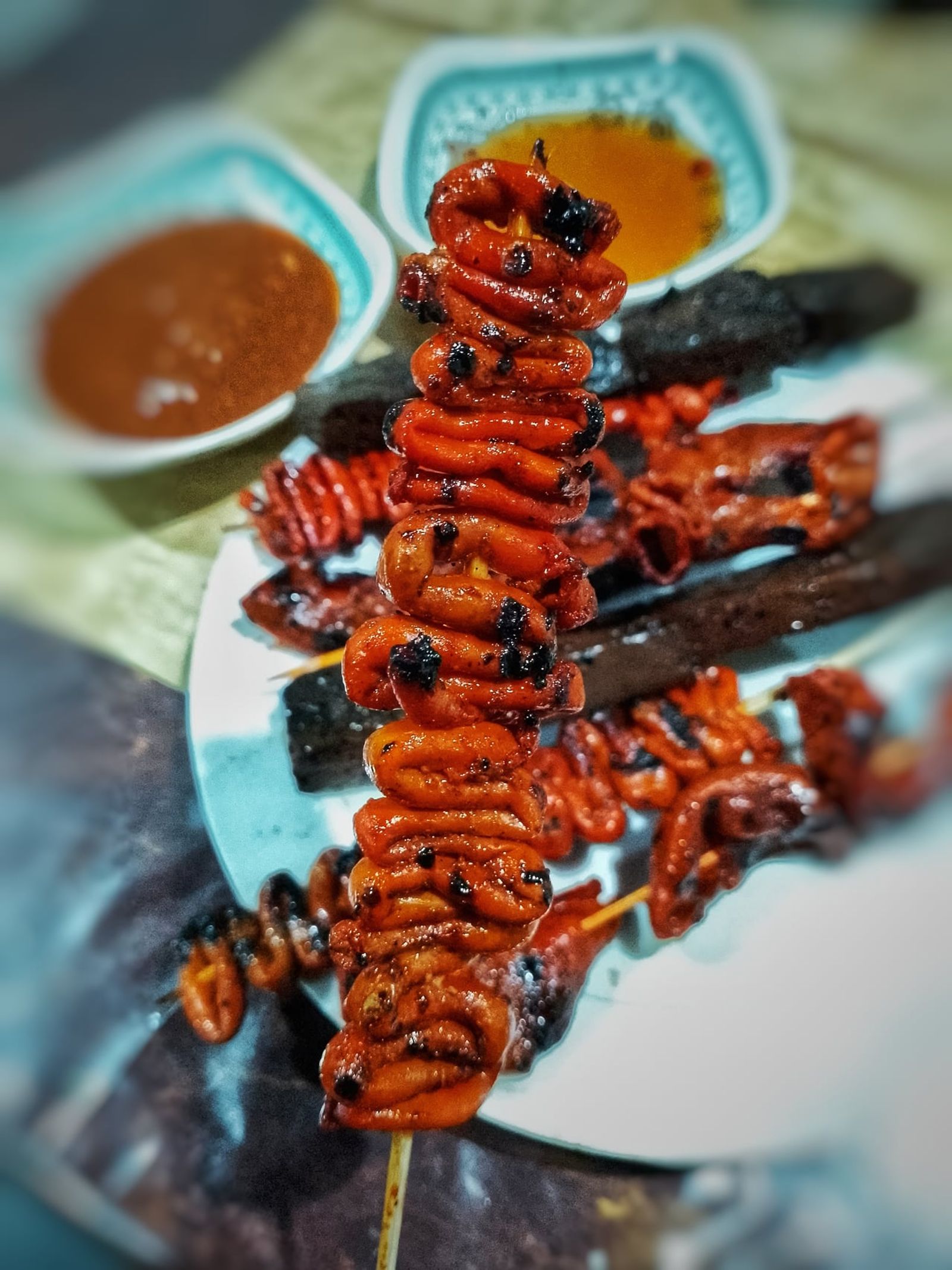
Isaw: grilled chicken intestine skewers · Photo: Roderick Suñaz Sumalinog / CC BY-SA 4.0 (Wikimedia Commons)
 Philippines
Filipino Street Food 101: Isaw, Fish Balls, Kwek-kwek and Balut
As evening falls, charcoal grills and frying carts appear on Filipino side streets. Here are the street foods you will find all over the country: isaw offal skewers and their funny nicknames, fish balls with dipping sauces, orange-battered kwek-kwek, and the much-debated balut.
Evenings of Grills and Frying Carts
Filipino street food falls roughly into two camps. One is charcoal-grilled skewers: at roadside barbecue stalls (barbecuhan), carinderias and night markets, marinated meat and offal are threaded onto sticks and displayed, then grilled when you order. The other is fried snacks from carts with a pot of oil on top, mostly bite-sized things such as fish balls, squid balls and kwek-kwek. Ordering is easy. At a grill, pick the skewers you want from the display and hand them over to be grilled; at frying carts, many vendors let you spear as many pieces as you like with a long stick and pay by the count. Sauces sit in shared containers for dipping or spooning over. Skewers often come with a vinegar dip, and soy sauce with calamansi is common too.
Isaw and the Nicknames
The king of Filipino skewers is isaw: pig or chicken intestines, thoroughly cleaned, threaded onto sticks and grilled. Chicken isaw is isaw ng manok and pork isaw is isaw ng baboy. It picks up a smoky charcoal aroma and a pleasant chew, and is usually dipped in a sharp vinegar sauce. Filipinos give offal skewers playful nicknames. Squares of set pig's blood are betamax, after the old videotapes they resemble; chicken feet are adidas, after the trainer brand; chicken heads are helmets; and chicken intestine skewers are sometimes called IUD. If you see these words on a stall's sign, just ask what they are; vendors are usually happy to explain, often with a grin.
Fish Balls and Choosing a Sauce
The staple of the frying cart is the fish ball (spelt pishbol in Filipino): small fish cakes made from fish meat and starch, deep-fried. Squid balls and kikiam, a longer fish-cake roll, are usually sold alongside. You can buy them by the piece, which makes them easy to sample. The sauce is what makes it. There are two main types. One is a sharp vinegar sauce, either plain with onion and garlic or spiked with chilli. The other is a thick, sweet sauce cooked from flour, soy sauce, garlic, onion and sugar. If it is your first time, alternate between the sweet sauce and the spicy vinegar to find your favourite. If hygiene worries you, spoon the sauce over instead of dipping, or ask for some on the side.
Kwek-kwek in Orange Batter
The bright orange snack that stands out on frying carts is kwek-kwek: boiled quail eggs dipped in a batter tinted orange with annatto (achuete) and deep-fried. Versions made with larger chicken or duck eggs are called tokneneng, though today the two names are often used interchangeably. The name tokneneng is said to come from a 1978 Filipino comic, Batute, where it meant "egg". Another story credits a balut vendor in Metro Manila who dipped a dropped balut in batter and fried it, which fits the idea that the name started with duck eggs. A soft yolk inside a crisp coating makes it a perfect match for vinegar dip, sometimes served with sliced cucumber and onion.
Balut: Know Before You Try
Balut is a fertilised duck egg incubated for a set time, then boiled or steamed and eaten from the shell. In the Philippines the eggs are typically incubated for about 14 to 18 days, and many producers consider 17 days ideal. On the street you may see vendors carrying them in buckets of sand that keep them warm. Pateros in Metro Manila is known for duck raising and balut production. There is a usual order to eating it. Crack a small hole in the top, sip the broth inside first, then peel away more shell and eat the yolk and embryo, seasoned with salt or dipped in vinegar with chilli and garlic. Its appearance divides opinion, so there is no need to force yourself. Eggs whose embryo failed to develop during incubation, which taste much like an ordinary boiled egg, are called penoy, and starting there is another option.