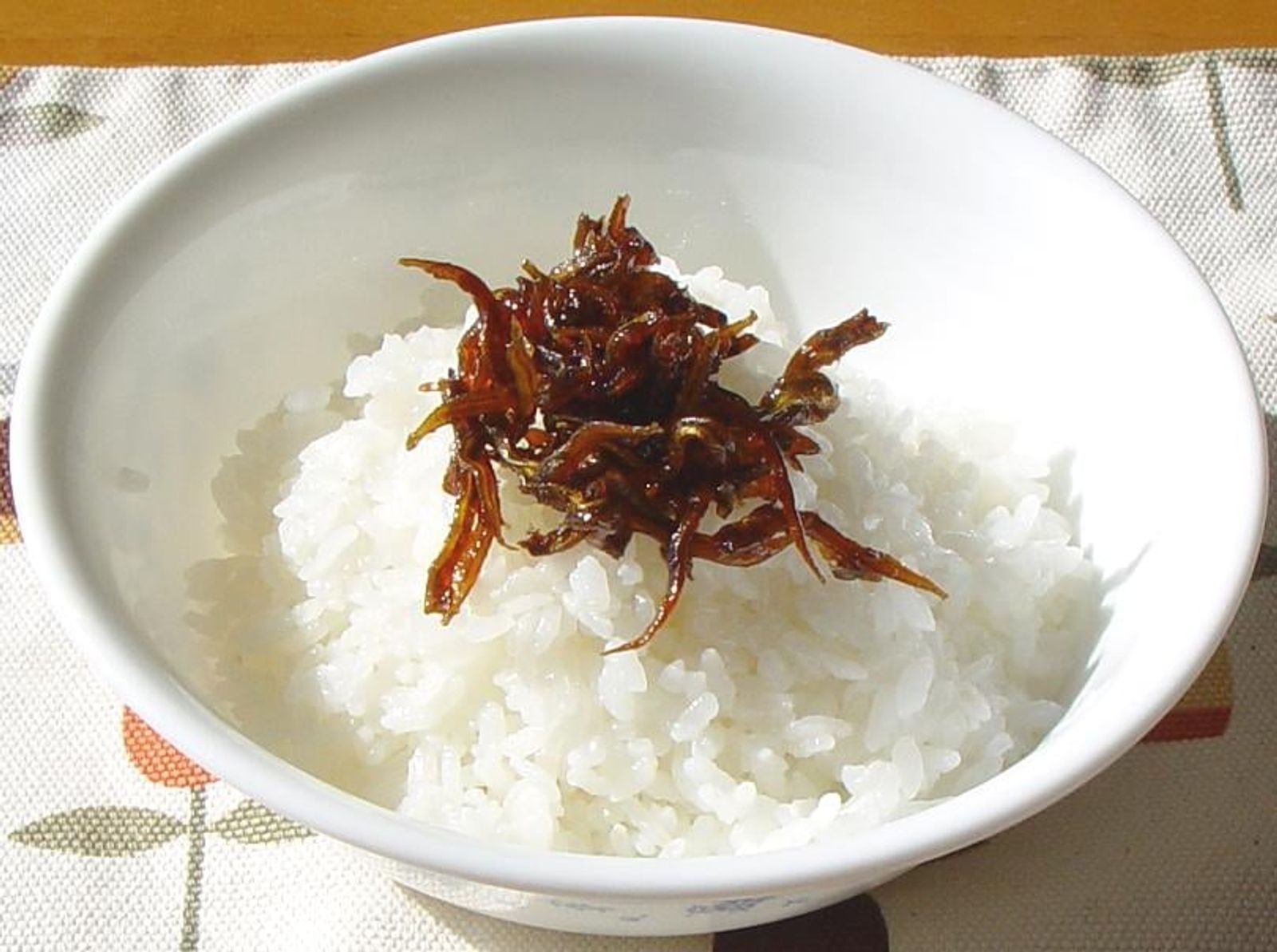
Ikanago no kugini on a bowl of white rice · Photo: Ro-~commonswiki / Public domain (Wikimedia Commons)
 JapanKobe
Ikanago no Kugini: The 'Rusty Nail' Sand Lance That Announces Spring in Kobe and Akashi
When spring came, homes across Kobe and Akashi filled with the sweet smell of baby sand lance simmering in soy sauce and sugar. Here is where the name comes from, where it began, how every family's version differs, and why it has become so scarce.
Ikanago and Shinko: A Little Fish of Early Spring
Ikanago is the Pacific sand lance, a slender silvery fish. In western Japan the young of the year are called shinko, while grown fish go by names such as furuse or kanagi. It is originally a northern fish, so in warm waters like the Seto Inland Sea it burrows into the sand and lies dormant through the summer. That made early spring, the short season when shinko only a few centimeters long are caught in Harima-nada and Osaka Bay, a highlight of the year in the eastern Inland Sea. The fishery traditionally opened between late February and March, and supermarkets and department stores across Hyogo set up special shinko counters to match. Shinko is what goes into ikanago no kugini.
Why 'Nail Simmer'? The Name and Two Birthplaces
Kugini (釘煮) means 'nail simmer'. Once cooked, the shinko turn glossy brown and curl up, looking like bent, rusty nails, which is how the dish got its name. It is often said to have originated in Kobe, where it was first made in fishing families' homes. Nobody knows exactly when it began. Sand lance fishing has gone on at Komagabayashi in Kobe's Nagata Ward for more than a thousand years, and kugini already appears in a 1935 book on regional food, Jimi Fudoki. Its author listed two places to order it from, the Komagabayashi fishing cooperative and the Tarumi fish market, now in Kobe's Tarumi Ward, and these two are regarded as its birthplaces. In October 2013 a stone marking the 'birthplace of ikanago no kugini' was erected in front of a shrine in Komagabayashi.
Every Family's Own Recipe, and the Smell of Spring
Kugini is made by simmering freshly landed shinko with soy sauce, sugar, mirin and ginger. In March, when the shinko arrived, families across Kobe and Akashi cooked big pots of it, and people say the sweet smell drifting through the neighborhood told them spring had come. Each household has its own secret, such as adding yuzu or chili, and neighborhood associations and women's groups even hold kugini contests. It was originally strongly flavored and salty, made for fishermen. Women of the Akashi fishing cooperative adapted the recipe for ordinary homes and spread it through cooking classes, and from the 1980s it became known nationwide. Many families also send their kugini to relatives and friends far away; post offices in Akashi are said to sell containers sized to fit Japan Post's Letter Pack envelopes.
Disappearing Shinko: Years of Poor Catches
Lately, though, this spring tradition is in trouble. According to Hyogo Prefecture, the prefecture's sand lance catch swung between about 15,000 and 30,000 tons until around 2002 and then hovered around 10,000 tons, but since 2017 it has fallen below 2,000 tons. The prefecture's fisheries research center believes falling nitrogen levels in the sea have reduced the plankton the fish eat, leaving them thinner and laying fewer eggs. In 2026, Osaka Bay stayed closed for a third straight year under a voluntary fishing halt. Harima-nada opened on March 17 but ended the season the very next day, and only 14 baskets were landed at Akashi's Hayashizaki fishing port on opening day. The first auction price was about 130,000 yen a basket; in 2025 a record 200,666 yen was paid.
Where and How Travelers Can Try It
These days many people buy kugini ready-made rather than cooking it at home. You can find it in jars and packs at department store food halls in Kobe and Akashi, around Uonotana, the market street south of Akashi Station, and at station and airport souvenir shops. With poor catches continuing, prices have risen sharply, and substitutes such as 'chirimen kugini' made with dried baby anchovies instead of shinko have appeared. Eating it is simple: put a little on hot white rice, tuck it into a rice ball, or enjoy it as a snack with drinks. It is so sweet and salty that a small amount gets you through a whole bowl of rice. If you visit Kobe or Akashi in spring, ask at the shop whether this year's kugini is out yet. In lean years, a label reading 'this year's shinko' feels all the more special.