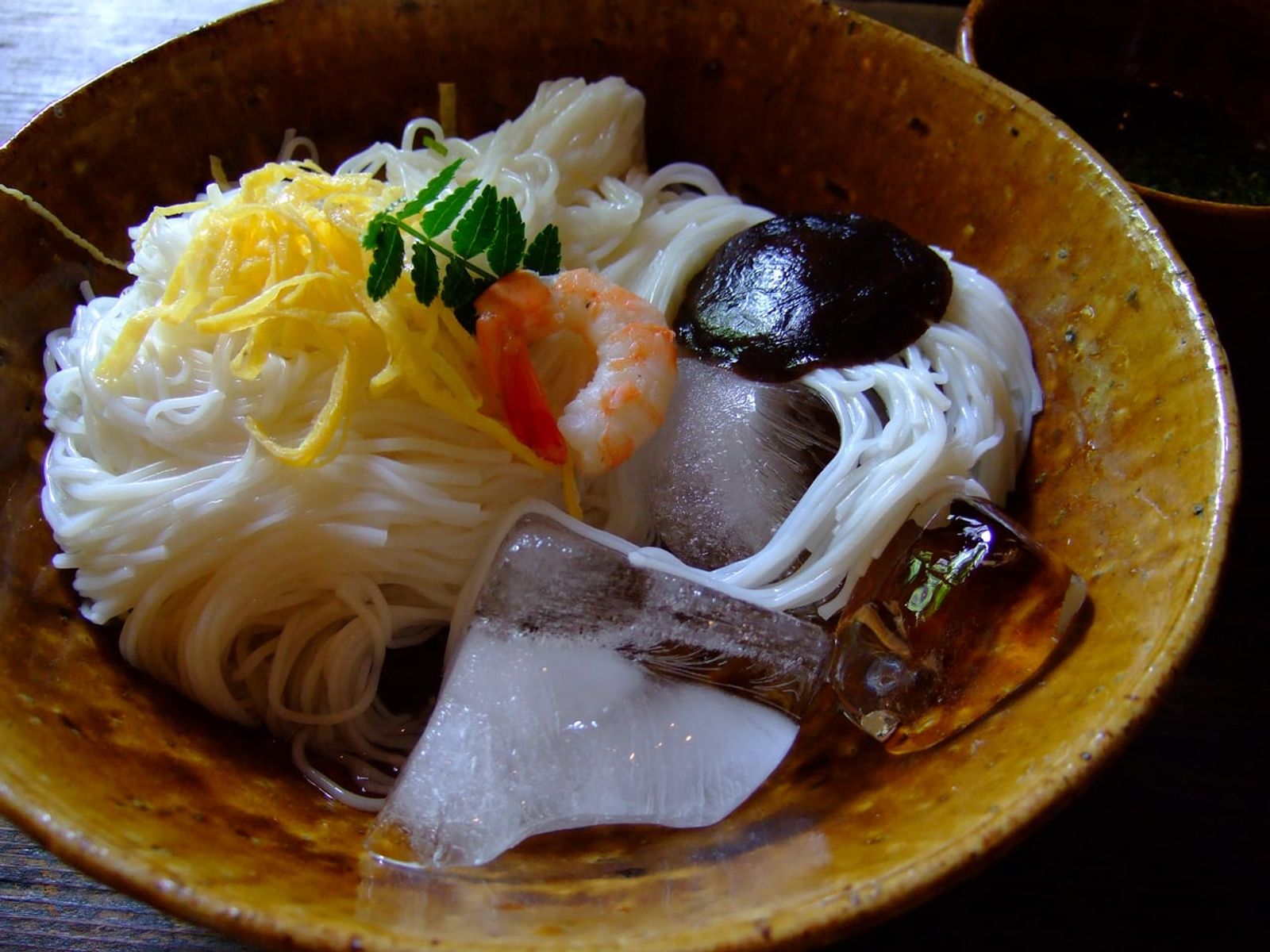
Chilled Miwa somen served with ice · Photo: ちぃこ (Chiiko) / CC BY 2.1 JP (Wikimedia Commons)
 JapanNara
Miwa Somen: Sakurai's Claim as the Birthplace of Somen, and a Price Set by the Gods
Miwa in Sakurai, Nara, is called the birthplace of Japanese somen. Here is the legend tied to Omiwa Shrine, the hand-stretching done only in winter, the wholesale price decided by divination at the shrine, and how to enjoy it on your trip.
At the Foot of Mount Miwa: The Birthplace Legend
In Miwa, in Sakurai city at the southeast edge of the Nara Basin, stands Omiwa Shrine (大神神社), one of Japan's oldest shrines, which worships the mountain itself as its sacred body. The area is called the birthplace of Japanese somen. According to the Ministry of Agriculture, tradition holds that more than 1,200 years ago the son of the shrine's chief priest grew wheat in Miwa and made it into noodles. Another story says Omiwa no Tanenushi (大神穀主), a descendant of the shrine's deity, made somen from wheat grown at the foot of Mount Miwa and its clear water, and the shrine is regarded as the guardian of somen making. These are legends, not established history. Wheat growing and milling are said to have reached Japan via envoys to Tang China in the Nara period.
Spreading Along the Pilgrim Road to Ise
In the Edo period Miwa thrived as a post town on the road taken by pilgrims heading to Ise Grand Shrine. Through travelers passing along it, Miwa's somen-making methods are said to have spread to Banshu in Hyogo, Shodoshima in Kagawa and Shimabara in Nagasaki. In other words, several of Japan's famous somen regions trace a link back to Miwa. A Miwa somen guild was founded in 1895 (Meiji 28) and quality control began in earnest; production is said to have peaked from the Taisho era to the early Showa era. In 2002 somen made elsewhere and sold as Miwa somen became a scandal, and in March 2016 Miwa somen was registered as a Geographical Indication (GI), giving the name legal protection.
Hand-Stretched, and Made Only in Winter
Miwa somen is tenobe, hand-stretched somen. Dough of wheat flour kneaded with salt water is coated in oil, then twisted and stretched thinner and thinner. Along the way it is rested several times in a maturing step called umashi, which relaxes the dough and lets just enough moisture escape; this is said to give the noodles a smooth slurp and keep them from going soft when boiled. It takes two days: stretching on day one, drying and cutting on day two. Production runs only from December to the end of March, when the air is cold and dry, so in a sense the winter air of the Nara Basin makes the noodles. The scene of somen hung out to dry in the sun is registered as a Nara Prefecture landscape asset. Somen aged more than a year is called hinemono, and more than two years ohine; aging is believed to improve the firm, springy bite.
A Wholesale Price Decided by Divination
Miwa somen has a custom you will hardly see anywhere else: the Bokujo-sai (卜定祭), held at Omiwa Shrine every February 5, where the gods are asked to set the wholesale price for the year's first somen trading. It works like this. Producers and trading firms first agree on a middle price, then set a high and a low price 100 yen above and below it. A priest brings a tube-shaped bundle of hemp close to three small paper balls marked with the prices, and whichever ball sticks to the hemp is taken as the divine will. On February 5, 2026, the benchmark grade homare in 18 kg cases was reported to have landed on the low price, 12,600 yen. In actual trading it is said to serve mostly as a reference.
Cold or Hot: How to Eat It and How to Get There
In summer the classic is hiyashi somen, noodles rinsed in ice water and dipped in tsuyu; in the colder months try nyumen (にゅうめん), somen served in hot broth. Miwa somen is thin yet slow to go soft, so it holds its texture well even in hot soup. Some places serve curry nyumen or use it in stir-fries. Miwa somen is also a popular summer gift in Japan, and you will see plenty of boxed gift sets. To get there, take the JR Sakurai Line (nicknamed the Man'yo Mahoroba Line) to Miwa Station, where the approach to Omiwa Shrine begins right away; noodle restaurants and gift shops cluster in front of the shrine and around the station. Pairing a shrine visit with a bowl of somen makes an easy half-day trip. Besides the February divination, the shrine holds a somen thanksgiving festival at the end of summer, and somen-sliding (nagashi somen) events have been held there too.