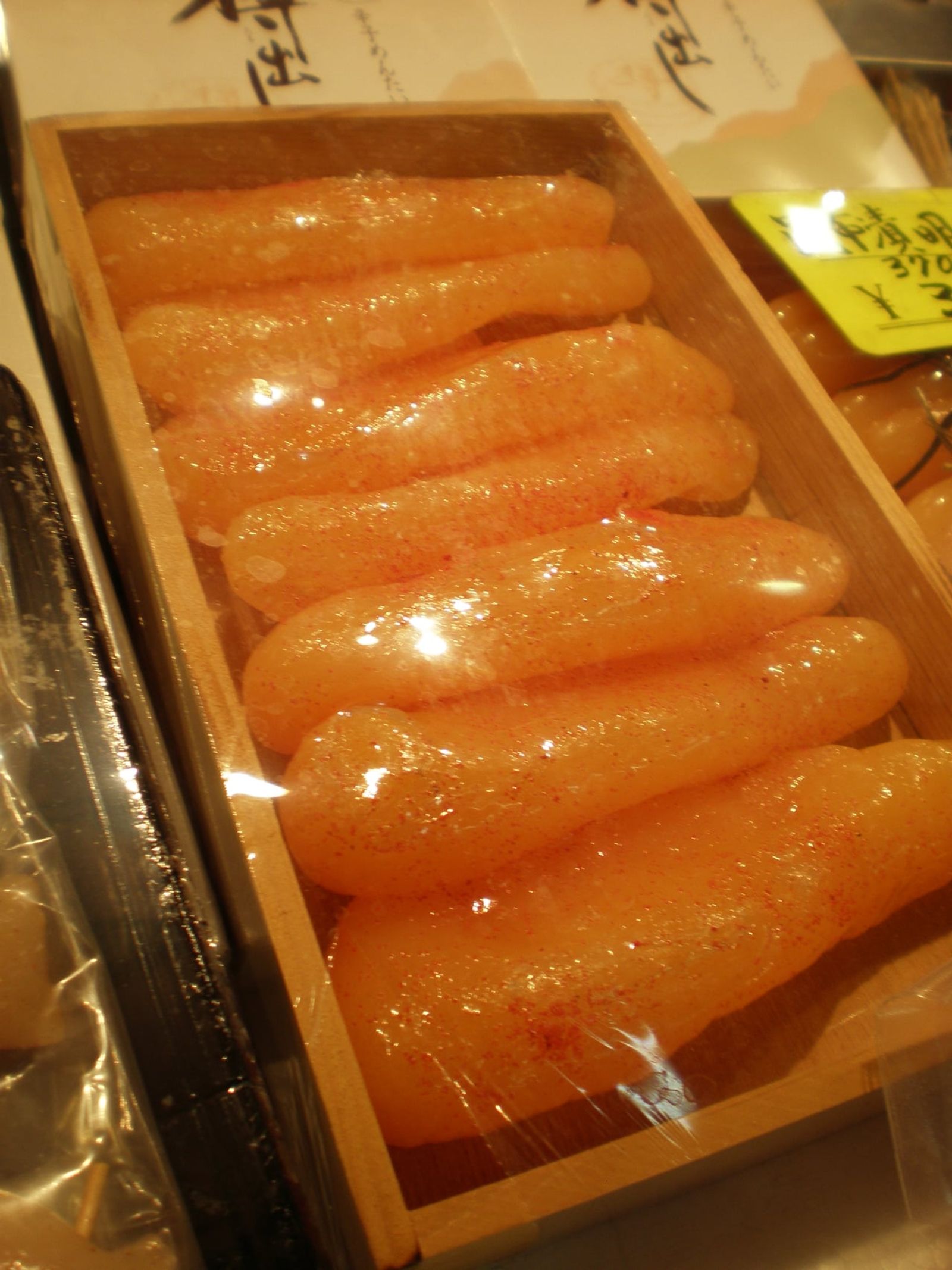
Karashi mentaiko at a fish market in Fukuoka · Photo: Chester Siu / Public domain (Wikimedia Commons)
 JapanFukuoka
Mentaiko: How Korean Pollock Roe Became Hakata's Signature Souvenir
Karashi mentaiko, Fukuoka's best-known souvenir, takes its very name from the Korean word for pollock. Here is how Korean myeongnan-jeot travelled via Busan and Shimonoseki and was reinvented for Japanese tastes in postwar Hakata, plus tips on choosing and eating it.
A Name Borrowed From Korean
The "mentai" in mentaiko (明太子) is the Japanese reading of the Korean word myeongtae (明太), meaning Alaska pollock, and "ko" means roe. So the name literally says "pollock roe." The word myeongtae is said to appear as early as a 1652 entry in the Seungjeongwon Ilgi, a royal record of Korea's Joseon dynasty. Koreans have long eaten myeongnan-jeot, pollock roe salted and coated with chili powder, as a side dish, and Japanese karashi mentaiko branched off from it. In Japan, roe that is simply salted is called tarako, while roe seasoned with chili is called karashi mentaiko, usually shortened to mentaiko. Korean visitors will find the flavor familiar, but the seasoning method is quite different.
From Busan to Shimonoseki, Across the Strait
Pollock roe arrived in Japan in earnest in the early 20th century. Around 1907 a Japanese merchant in Busan started a myeongnan-jeot business that exported to mainland Japan, Taiwan and China, and the product is said to have crossed on the regular ferry linking Busan and Shimonoseki. As a result, people in Shimonoseki, Kitakyushu and Fukuoka, just across the strait, were eating pollock roe early on. That trade ended with the Second World War. Among those who returned to Japan from the Korean Peninsula were people who missed the roe they had eaten in Busan, and that longing is widely told as the spark for a new kind of mentaiko in postwar Hakata. Shimonoseki also has a long history of roe processing, so there are competing claims about where it all began.
1949 Hakata: Mentaiko for Japanese Palates
Today's Hakata-style mentaiko is generally traced to a grocery store in Hakata in 1949. Korean myeongnan-jeot is coated in chili powder and can be very spicy, so the shop toned down the heat and instead marinated the roe in a seasoning liquid with kombu, sugar and soy sauce to bring out umami. It reportedly went on sale in January that year. What stands out is that the shop did not keep its method secret but shared it with anyone who wanted to learn. From the 1960s on, mentaiko makers sprang up across Fukuoka, each competing with its own marinade and spice level. That is why the souvenir shops at Hakata Station today are lined with so many different brands.
The Bullet Train That Made It Famous
The turning point that made mentaiko a nationally known Hakata specialty came in 1975, when the Sanyo Shinkansen was extended to Hakata Station. Business travelers from Osaka and Tokyo started buying mentaiko on their way home, and "Fukuoka souvenir equals mentaiko" became a fixed idea. Today more mentaiko is sold for processing than as gifts. According to industry figures, shipments for processed foods such as onigiri fillings overtook gift and souvenir shipments around 2007. Besides roe from Japanese waters, a lot of the raw material comes from Alaska and Russia. A flavor created in Hakata has become an everyday food across Japan, from convenience store rice balls to pasta sauce.
How to Choose and Eat It
You will notice that prices vary a lot even for the same brand. Roe in an intact sac is called mako, a torn sac is kireko, and loose roe is barako. They taste the same, but appearance drives the price. Mako is the pick for gifts, while kireko is great value for rice or pasta at home. Spice levels range from mild to very hot. The classic way to eat it is on a bowl of warm white rice. Lightly seared mentaiko is a popular drinking snack, and it also goes into ochazuke, onigiri, mayonnaise-based sauces and mentaiko spaghetti, all common in Japan. Department store food halls around Hakata Station and Tenjin often offer tastings of several brands. Mentaiko needs refrigeration, so time your purchase to your trip home.