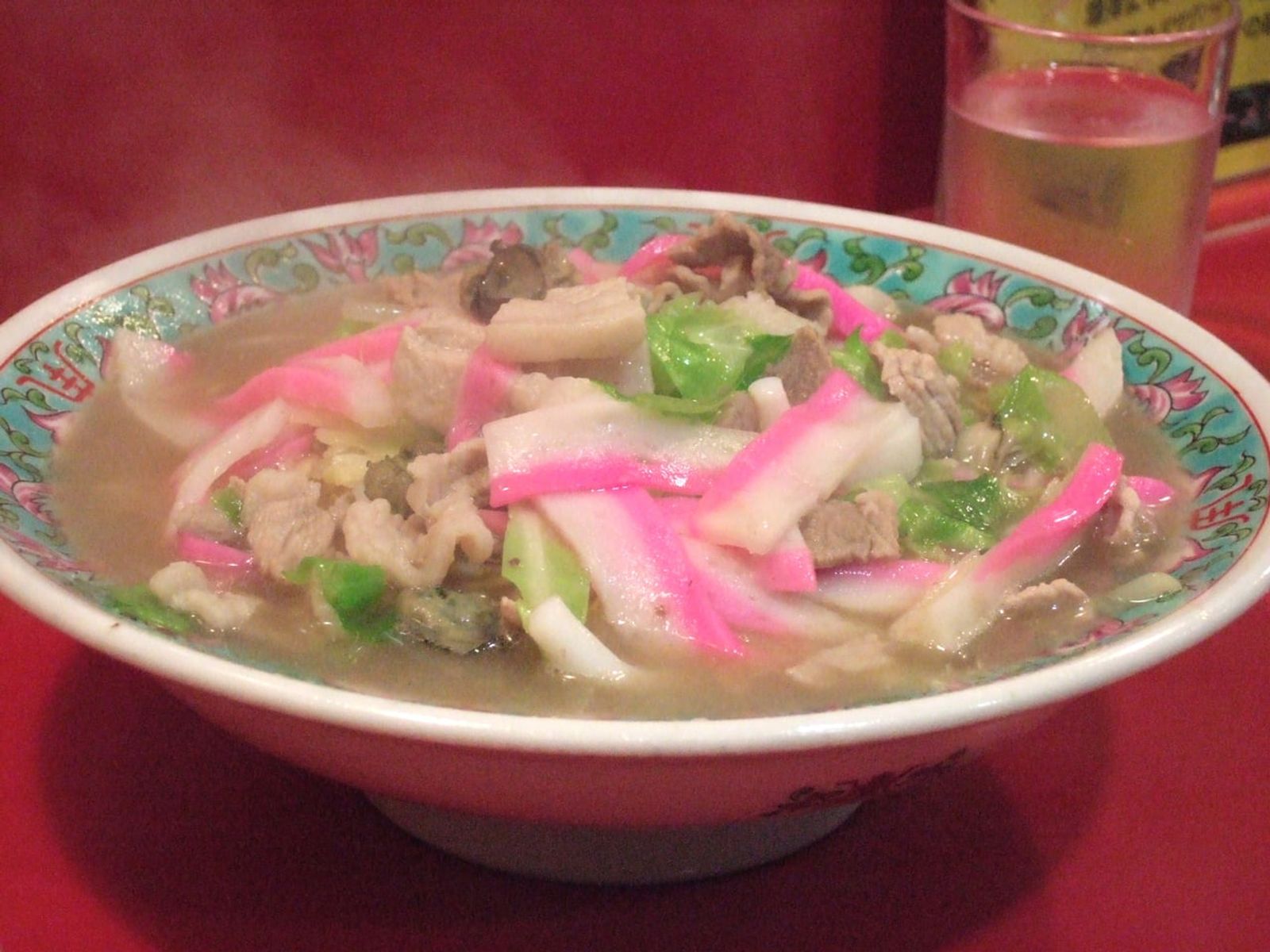
Nagasaki champon in Nagasaki · Photo: Midori / CC BY-SA 3.0 (Wikimedia Commons)
 JapanNagasaki
Nagasaki Champon and Sara Udon: Port-City Noodles Born to Feed Chinese Students
It shares a name with Korea's fiery red jjamppong, but Nagasaki champon is a completely different dish: a milky broth loaded with seafood and vegetables. Here is how a Chinese cook in Meiji-era Nagasaki created it, the competing theories behind the name, and how to order its soupless sibling, sara udon.
Not Korean Jjamppong: A Milky, Mild Noodle Soup
In Korea, jjamppong means a red, chili-spiked seafood soup. Nagasaki champon is not spicy at all; its broth is milky white. Pork, seafood such as squid and shrimp, vegetables like cabbage and bean sprouts, and kamaboko fish cake, more than ten ingredients in all, are stir-fried in lard, then simmered in a chicken or pork bone stock. The key difference is that the noodles are not boiled separately but go straight into the pot with the soup. They absorb the broth, and their starch thickens the soup slightly. The noodles themselves are special: under industry labeling rules, anything sold as Nagasaki champon must use thick noodles made in Nagasaki Prefecture with toaku (唐灰汁), a local alkaline water.
A Meiji-Era Bowl for Students From Qing China
Nagasaki stayed open to China and the Netherlands even during Japan's Edo-period isolation, and it had a large Chinese community from early on. The best-known origin story says that in the mid-Meiji era, a Chinese cook from Fujian who had opened a restaurant in the city created champon to give poor students from Qing China a cheap, filling and nourishing meal. It was based on a Fujianese noodle soup, and a similar dish is said to survive in Fuqing, Fujian, today. There is also a claim that someone else sold "shina udon" under the name champon in the early Meiji years. What is certain is that a 1907 Nagasaki Prefecture document describes the dish as popular among Chinese students and sold at more than ten places in the city.
Where Does the Name "Champon" Come From?
Sources disagree on the name. The most famous theory says that a Fujianese greeting, 吃飯 ("have you eaten?"), sounded like "champon" to Japanese ears. Other theories point to different Chinese words or link it to "campur" (to mix), as in the Indonesian dish nasi campur, though several of these are considered far-fetched. Japanese dictionaries sometimes trace it to Edo-period onomatopoeia, but that also lacks firm evidence. In Japanese, "champon" still means mixing things together. The Korean name jjamppong is generally said to have come via Japan, but in Korea the dish evolved on its own into a spicy, chili-red soup. Same name, different dish.
Its Soupless Sibling: Sara Udon
Sara udon means "udon on a plate," but it does not actually use udon noodles. A widely told story says the same restaurant created it by cutting back the soup so champon would not spill when delivered, though some trace it back to the late Edo period. There are two types. One uses thin noodles deep-fried until crisp and topped with a thick, glossy sauce of seafood and vegetables. The other stir-fries the same thick noodles used in champon with the toppings. Most travelers picture the crispy thin version, but in Nagasaki what you get can depend on the shop if you do not specify, so ask whether it is hosomen (thin) or futomen (thick).
Eating It the Nagasaki Way, and Where
When your sara udon arrives, try a splash of the Worcestershire sauce on the table. It is a common Nagasaki habit: the tang cuts through the slightly sweet sauce. A local company even makes a sauce specifically for sara udon, and some shops set out vinegar instead. Part of the fun is watching the crisp noodles soften as the sauce soaks in. Locals often order a large platter to share. For champon and sara udon, specialist shops and Chinese restaurants cluster in and around Shinchi Chinatown, and you can easily find both near Nagasaki Station and all over the city. Its influence reaches beyond Nagasaki: tonkotsu ramen in Kurume, Fukuoka Prefecture, is said to have been inspired partly by Nagasaki champon.