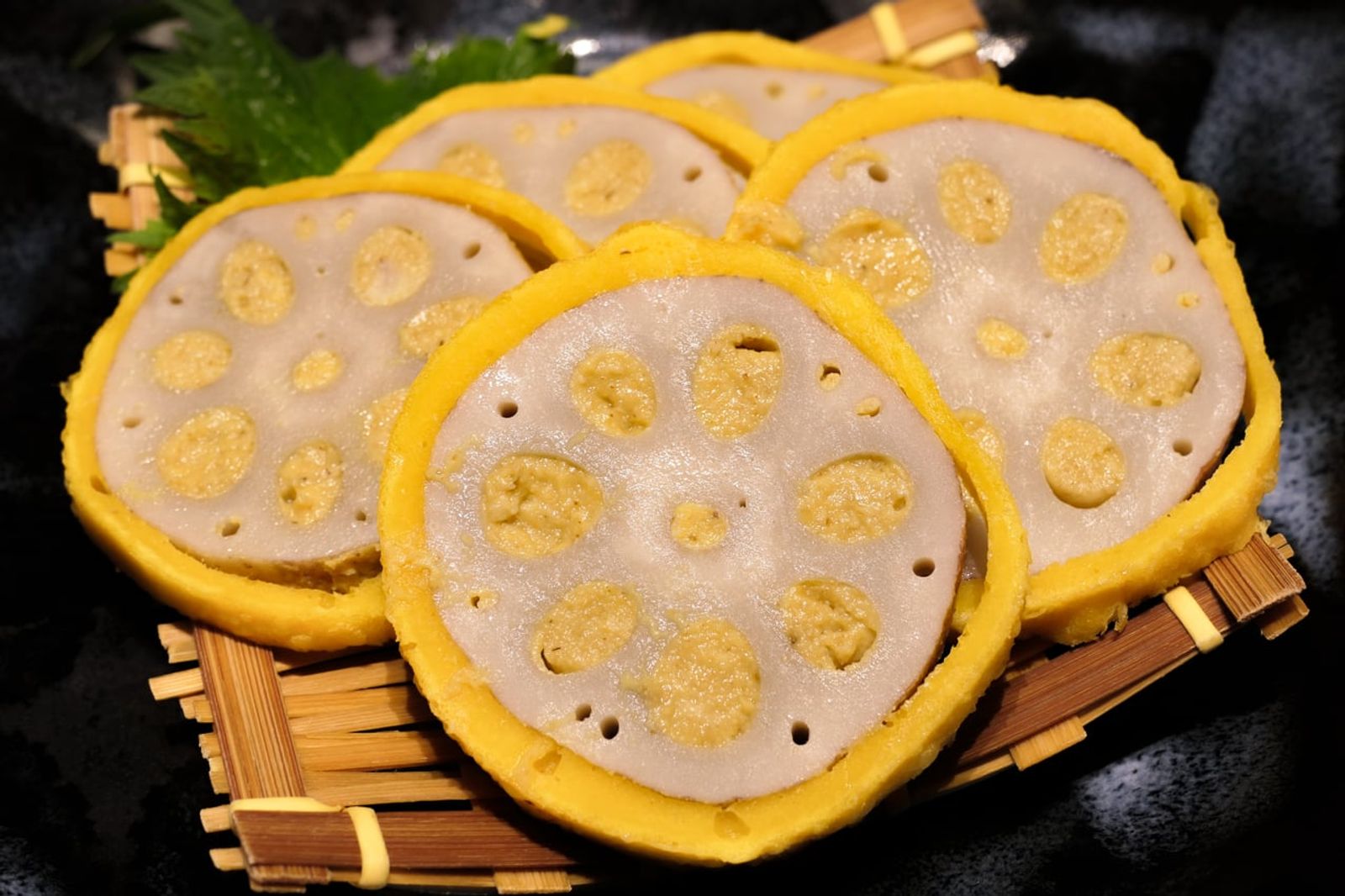
Sliced karashi renkon · Photo: MaedaAkihiko / CC0 (Wikimedia Commons)
 JapanKumamoto
Karashi Renkon: The Yellow Mustard Lotus Root Said to Have Been Made for a Sickly Lord
Karashi renkon is lotus root with every hole packed with mustard miso, coated in yellow batter and fried. Here is the Hosokawa legend behind it, the family crest its cross-section resembles, what changed after a 1984 incident, and how to enjoy it.
What It Is: A Yellow Slice With a Kick
Karashi renkon (辛子蓮根) is a Kumamoto dish of boiled lotus root whose holes are packed tightly with mustard miso, miso mixed with mustard powder. It is then coated in a batter of flour and turmeric and fried in rapeseed oil. The turmeric makes the outside bright yellow, and each slice shows yellow mustard miso set like a flower in the white root. According to Japanese Wikipedia, home cooks pile the miso on a tray and press the cut end of the root into it, while producers work with a mound about 50 cm high. The stuffed root rests for at least five hours before frying. It is usually cut 5 to 10 mm thick and eaten as is: first the crunch of lotus root, then a rush of mustard heat right up the nose.
The 1632 Legend: Lord Hosokawa Tadatoshi and the Monk Gentaku
Karashi renkon comes with an origin story from the early Edo period. Hosokawa Tadatoshi, the first lord of the Kumamoto domain, was in poor health. In 1632 (Kan'ei 9), the Zen monk Gentaku of Rakanji temple in Yabakei, Buzen Province, is said to have visited him and recommended lotus root. The story adds that the lotus had been planted in the castle's outer moat as emergency food by Kato Kiyomasa, the builder of Kumamoto Castle. Tadatoshi supposedly refused at first, thinking a root grown in mud was unclean. So a cook of the domain filled the holes with mustard miso, coated the root in batter and fried it. The lord liked it and regained his strength, the legend says. It is a traditional tale, not verified history, but people in Kumamoto still love to tell it.
A Slice Like the Family Crest, Kept Secret Until Meiji
According to the legend, the cook who invented the dish was rewarded with a short sword (wakizashi), ten gold coins and the right to a surname and to wear a sword. Because a round slice of lotus root resembles the Hosokawa family crest, the kuyō-mon, a large circle ringed by eight smaller ones, the recipe was supposedly kept secret within the domain until around the Meiji Restoration. Look at a slice and the pattern of holes really does recall the crest, which makes it fun to check for yourself. There is also a view that the yellow batter coating only became standard after the Meiji era, so it is hard to say the dish is exactly what it was 400 years ago.
The 1984 Incident and What Changed
Karashi renkon's history also has a painful chapter. In June 1984, vacuum-packed karashi renkon from one manufacturer caused a botulism outbreak: 36 people fell ill and 11 died. Investigators found that the mustard powder used as an ingredient was contaminated, and that the bacteria multiplied in the oxygen-free packs during long storage. Products were pulled from shelves across Kumamoto and beyond, other makers suffered badly, and about half of the nearly 50 producers closed. That December, the Kumamoto Prefecture Karashi Renkon Cooperative was formed and adopted a voluntary rule against vacuum-packed products. This is part of why most karashi renkon sold in Kumamoto today is kept refrigerated and has a short shelf life.
How to Eat It and Buy It
Karashi renkon is an everyday side dish and drinking snack in Kumamoto homes, and it appears in New Year osechi boxes because lotus root, with its holes, symbolises seeing far ahead. It is seasoned already, though some households add a touch of soy sauce or mayonnaise. Heat levels vary by maker, so on your first try cut it thin and taste one slice. Modern spin-offs include croquettes, sandwiches, burgers and lotus root chips. You can buy it easily at Kumamoto Station, Kumamoto Airport, department store food halls and souvenir shops, and izakaya serve a few slices as a snack. Many products need refrigeration and keep only a short time, so if it is a souvenir, buy it on your last day and check the storage instructions. In neighbouring Fukuoka you may also see versions filled with mentaiko instead of mustard.